
Foreword
When Philip Mendes published Jews and the Left: The Rise and Fall of a Political Alliance in 2014, he documented a profound historical rupture — the severing of what had been, for much of the 20th century, a natural and productive relationship between Jewish communities and progressive political movements. That rupture has since widened into an abyss.
Progressive Intolerance charts the disturbing endpoint of that trajectory. What Mendes describes here is no longer merely a falling out between former allies, but rather the emergence of antisemitism as a defining characteristic of significant sectors of Australia’s self-described ‘progressive’ institutions.
The evidence is comprehensive and damning. From universities to trade unions, from civil society organisations to arts institutions, Mendes documents a systematic pattern of hostility toward Jews going far beyond legitimate criticism of Israeli government policy.
We see the active harassment of Jewish students and academics, the celebration of terrorist violence, the deployment of classical antisemitic tropes about Jewish power, and the weaponisation of theoretical frameworks — from that of settler-colonial theory to critical race theory — to justify treating Jews as uniquely undeserving of protection from racism.
Most valuable is Mendes’s distinction between three responses to this crisis: anti-racist solidarity that treats antisemitism as seriously as any other form of racial hatred; pro-racist activism that actively promotes or excuses antisemitism; and the bystander approach that enables hatred through studied neutrality. His documentation of the bystander phenomenon is especially troubling, revealing how groups that pride themselves on opposing racism have remained silent when Jews are targeted.
The convergence Mendes identifies between political anti-Zionism and antisemitic prejudice represents one of the most significant developments in contemporary race hatred. The Boycott, Divestment and Sanctions movement, with its absolutist demand for Israel’s elimination and its construction of all Jews who support Israel’s existence as ‘the enemy’, has provided ideological cover for what would otherwise be recognised immediately as racial hatred. Through case studies, Mendes demonstrates how this has created structures of permission within progressive spaces for exclusion, vilification and intimidation that would be unthinkable if directed at any other minority group.
The December 2025 terrorist attack at Bondi tragically confirmed this report’s central thesis: the normalisation of antisemitic rhetoric creates the conditions for antisemitic violence. Those murdered that day were killed in an environment where hatred of Jews had been permitted, and in some quarters actively encouraged, by institutions that should have known better.
Mendes proposes responses ranging from immigration controls excluding those with records of hate speech, to targeted education illuminating antisemitism’s diverse historical sources, to structural university reforms. But perhaps his most important recommendation is the simplest: effective anti-racism must privilege the lived experience of those targeted by racism. The systematic failure of progressive institutions to engage with Jewish voices about antisemitism represents not merely tactical error but fundamental betrayal of anti-racist principles.
The question this report poses is whether Australia’s progressive institutions are capable of the honest reckoning required to restore their moral credibility. That will require acknowledging that antisemitism on the left has become, in many quarters, the norm. It will require recognising that opposing racism means opposing all racism, even when it emerges from one’s own political community. And it will require understanding that defending Jewish Australians’ right to participate as equals is not a partisan position but a basic requirement of liberal democratic citizenship.
Philip Mendes has provided an essential service by documenting this crisis with scholarly rigour and moral clarity. Now the rest of us must decide whether we have the courage to act on his findings.
Peter Kurti
Director – Culture, Prosperity & Civil Society Program
Introduction
Since the Hamas massacre of October 7 little more than two years ago, Australia has experienced an unprecedented outbreak of politically-motivated antisemitism. The aim of this report is to uncover the principal manifestations and sources of this campaign of hate. I define antisemitism as pro-racist actions that seek to discriminate against and exclude Jews from the right to participate as equals in Australian society and discourse, and instead relegate them to second-class citizens.
Although contemporary antisemitism in Australia has specific chronological and locational components, it also builds on long histories of anti-Jewish racism across the globe.[1] And equally, the harm experienced by Jews today is directly informed by that history of intergenerational trauma. When Jews witness demonstrations and banners in Melbourne or Sydney espousing antisemitic tropes and hatred, they cannot help but remember that similar prejudices ignited catastrophic anti-Jewish violence throughout the early-mid 20th century both in Europe (e.g., Tsarist Russia, Ukraine and Nazi Germany), and Middle Eastern countries such as Iraq and Libya.
Although the antisemitism crisis is definitely linked to the October 2023 Hamas massacre and the succeeding Israeli military response in Gaza, this is not a study of current events in the Middle East, or the wider pros and cons of competing Israeli/Jewish versus Palestinian/Arab ethno-national narratives. However, as will become evident, political anti-Zionism and racist antisemitism have increasingly converged.[2] Although it is possible in principle to be an anti-Zionist and not propagate or even oppose antisemitism, many prominent anti-Zionist groups and individuals in practice directly demonise Jews (often disingenuously labelled ‘Zionists’) as a legitimate strategy within their tribal struggle against Zionism and Israel.
Historically, Australia has often been described as a ‘goldene medina (land)’ for Jews. Most Australian institutions have accepted Jews as equals, and indeed numerous Jews have held prominent roles including two Governors-General, Sir Isaac Isaacs and Sir Zelman Cowen.[3] Despite some isolated incidents of violence, there has never previously been a major campaign of politically-inspired antisemitism.[4] The only preceding antisemitism crisis occurred briefly in 1960 when an international campaign of antisemitic swastika daubings and vandalism covertly organised by the KGB found its way to Australia.[5] Significantly, that campaign was actively opposed by a united front against antisemitism that included political groups and parties across the spectrum including the Liberal-National Party coalition, the Labor Party and the Communist Party, and numerous civil society bodies including trade unions, churches, business and women’s groups, returned soldiers, and the print and broadcast media.[6]
If that bipartisan zero tolerance approach to antisemitism had been applied in the current crisis, then it is likely that antisemitic incidents would have been limited to the margins, and there would have been far less harm to the Jewish community. But in contrast to 1960, contemporary Australian society has been divided between three perspectives: anti-racist groups that display public solidarity to the Jewish community; pro-racist groups that actively promote antisemitism; and bystanders whose silence arguably enables the haters.[7] There appears to be a major generational divide between older Australians who are less likely to hold antisemitic views, and younger Australians aged 18-24 years who are more likely to hold negative views concerning Zionism, Israel and Jews generally.[8]
Pro-racist attacks on Jews incorporate manifestations of both institutional and interpersonal racism including internalised racism.[9] Perpetrators typically present arguments based on:
- blaming-the-victim assumptions that conflate political anti-Zionism and anti-Jewish racial hatred.
- confounding a legitimate right to individual academic freedom in areas of demonstrated knowledge (but usually including nil research output or expertise pertaining to an understanding of antisemitism) with a non-existent collective right to engage in hate speech
- attacking the International Holocaust Remembrance Association definition of Antisemitism (and the different, but in part overlapping, Universities Australia definition adopted in February 2025) in a tactical attempt to prevent the creation of an effective framework and strategies for responding to the antisemitism crisis
- adopting such spurious concepts as ‘moral panic’ and the alleged ‘weaponising’ of antisemitism in an attempt to reverse the status of perpetrators and victims of racism and silence effective opposition to antisemitism
- opportunistically leveraging the support of tokenistic Jewish groups as alibis, and fail to engage with the genuine lived experience of most Jews.[10]
- actively smearing those Australians from across the spectrum who publicly oppose antisemitism as having ulterior ideological motives, rather than being influenced by a genuine opposition to racism.[11]
More common in progressive organisations such as trade unions, social movements, advocacy groups, human rights bodies and media outlets such as the ABC has been adoption of the bystander approach whereby groups sit passively on the fence half way between the perpetrators and victims of antisemitism. Bystanders do not support ‘progressive’ anti-Jewish racism, but tend to overlook its impact compared to that emanating from far-right sources. This is because they misread the growing antisemitism on the Left as a minor aberration from what they consider to be a generally righteous progressive rejection of racial prejudice, and fail to recognise the increasingly serious threat it poses to Jewish physical safety.[12] However, their neutralist silence has implicitly caused harm by ceding permission to pro-racist groups to espouse anti-Jewish prejudice without any fear of public disapproval.[13] On an individual level, the failure of many progressives to publicly call out antisemitism has left their Jewish friends feeling abandoned on both a personal and systemic level.[14]
In contrast, anti-racist advocates actively oppose all forms of antisemitism, and prioritise consultations with Jewish individuals/groups and communities harmed by racism.[15] Most mainstream Australian conservatives fall into this category. Over the past two years, anti-racist views have been consistently presented without spineless excuses or qualifications by News Corp print and media publications such as The Australian newspaper, Herald Sun and Sky News, by the leading free market think tanks, the Institute of Public Affairs and The Centre for Independent Studies, and by the smaller right-wing journals such as Quadrant and The Spectator.[16] Many other Australians across the spectrum have also acted as firm allies of the Jewish community. For example, prominent Indigenous Australians Professor Marcia Langton and former Labor Party Senator Nova Peris, leading academics such as Western Sydney University chancellor Jennifer Westacott and others who have joined and supported the 5A group, industry leaders, social democrats within and beyond the Labor Party, such as former Victorian Premier Daniel Andrews, representatives of other minority communities such as Hindus and Iranians, and participants in the 2025 Australian Mayors Summit against Antisemitism have all demonstrated their unequivocal opposition to anti-Jewish racism.
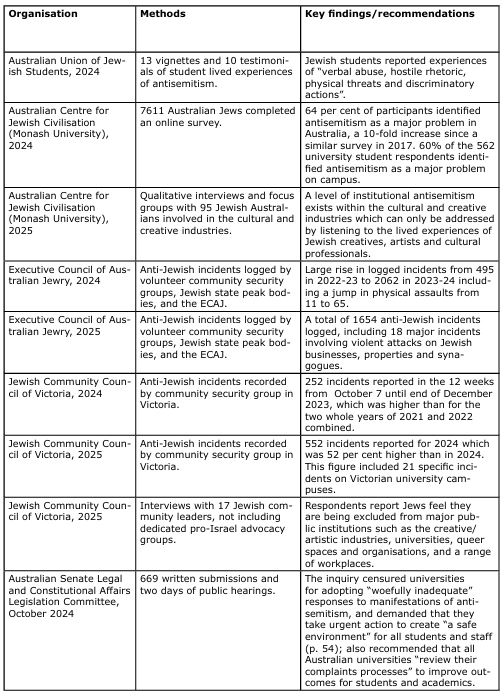
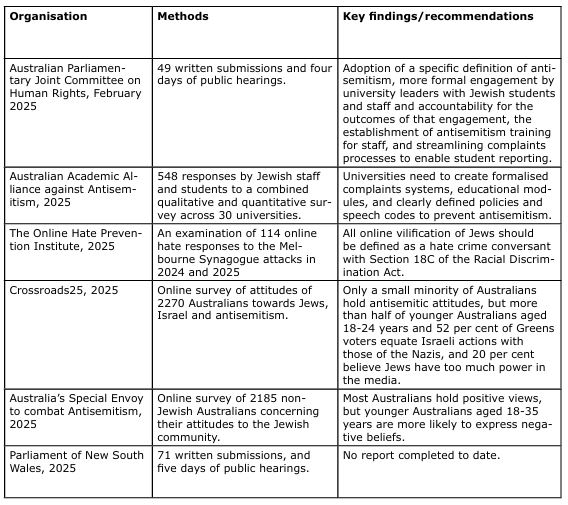
To date, a large volume of research reports by Jewish community organisations and other bodies including two completed Commonwealth parliamentary inquiries have documented the extent of the contemporary antisemitism crisis in Australia.[17] These research studies present a broad consensus regarding the nature of antisemitism, the leading sources of antisemitism, and particularly the traumatic impact of antisemitism on the domestic Jewish community. They overwhelmingly present the case for institutions to actively engage with the lived experience of Jews in order to understand the needs of victims of antisemitism, and advance the identification of best practice responses.
These studies highlight that progressive sources and manifestations of antisemitism are particularly concerning given the significant impact of such views within institutions such as universities, schools, the arts, trade unions, human rights and civil liberties bodies and the media that wield major influence on current and future public attitudes. For example, 84% of the 548 Jewish student and staff respondents to the 5A online survey named the ‘political Left’ as the principal source of antisemitism on campus, compared to only 37% who tagged right-wing sources of anti-Jewish racism.[18] Similarly, the 2024 Victorian Antisemitism report identified “an unprecedented escalation of far-left hatred for Jews”, attributing 53.4% of recorded anti-Jewish incidents to far Left sources, as opposed to 19.7% from far-right sources.[19] The editors of the anti-racist collection, Ruptured, also noted the proliferation of anti-Jewish racism in “so-called progressive spaces”.[20]
To be sure, there are significant far-right (e.g., National Socialist Network), Islamic fundamentalist (e.g., Hizb ut-Tahrir and the Muslim Brotherhood) and other extreme sources of antisemitism within Australian society which demand naming and extensive investigation.[21] And there is evidence of paradoxical collaboration between progressives and Islamic fundamentalist groups (sometimes termed the Red-Green Alliance) within pro-Palestinian advocacy campaigns including the encampment at the University of Sydney.[22] Nevertheless, the non-progressive sources of antisemitism, particularly neo-Nazi groups, arguably have far less impact on the views of wide sectors of the population. Consequently, this report will principally interrogate the leading contemporary sources of progressive antisemitism.
There are arguably six principal manifestations of contemporary antisemitism in Australia as follows:
- The December 14, 2025, terrorist hate crime in Bondi that killed 15 people and left dozens injured, and an entire community traumatised;
- Other violent attacks on Jewish community institutions and Jewish businesses including the firebombing of the Adass Israel synagogue, attempted attacks on other synagogues in Melbourne and Sydney, aggressive vandalism targeting the parliamentary offices of Jewish MPs and Jewish-owned properties, cars and restaurants, and large numbers of threats against and physical assaults on ordinary Jewish Australians;[23]
- Aggressive and threatening invasions of Jewish-populated suburbs in the cities of Melbourne (e.g., Caulfield) and Sydney (e.g., Coogee and Bondi) by pro-racist mobs incited by activist groups such as Free Palestine Melbourne;[24]
- The doxing (release of highly personal details online) of hundreds of Australian Jews who were participating in a private online group to combat antisemitism resulting in them being subjected to hate mail and death threats; boycott campaigns against Jewish-owned companies such as Schwartz Media, philanthropists such as the Gandel family and prominent artists and performers such as singer Deborah Conway; Jews being forced to close businesses and leave workplaces and even residences due to ongoing threats and harassment; and attempts to exclude Jewish health practitioners from various public festivals;[25]
- Jewish university students and academics being subjected to various forms of defamation, physical threats and attacks and hate speech by university-based encampments and associated forums, student union meetings and newspapers, flyers and graffiti intended to exclude them from academic and public debates. For example, public statements urging that Zionists (i.e., employed as a code word for Jews) be excluded from campus, Jewish students being coerced to leave shared houses, and large student groups turning their backs on (i.e., discriminating against) their Jewish peers.[26] Two-thirds of Jewish university academics and students continued to report in October 2025 that they felt unsafe on campus.[27]
As a caveat, international evidence suggests a common division between predominantly humanities and social science disciplines and departments which regularly host leading purveyors of antisemitism, and in contrast, STEM fields such as science, technology, engineering and mathematics and related fields such as computer science and business, which are rarely captured by anti-Jewish racists.[28] It is possible this same typology can be applied to Australian universities, but empirical research evidence is not yet available.
- A general atmosphere of McCarthyist intolerance towards Jews in key progressive communities — the arts, some trade unions, online journals and blogs such as Overland and Michael West Media that have become uncritical sites for anti-Jewish diatribe, some sections of the mainstream media, the Australian Greens political party, and sub-cohorts of some social science, education and health care professions — which is akin to that experienced by Communists and other leftists in the USA and Australia during the Cold War. The question “Are you or have you ever been a Communist?”, which was ironically often used by the far-right to disproportionately attack Jewish leftists in the USA and other countries, has now been reframed by pro-racist progressives to impose a political test on whether or not a Jewish person is to be defined and excluded as a ‘Zionist’ from public bodies and institutions.[29]
The BDS movement and the rise of antisemitism
Formed globally in 2002, the pro-racist Boycott, Divestment and Sanctions (BDS) movement essentialises not only all Israeli Jews, but also all Jews anywhere who identify with the State of Israel — regardless of their diverse class and family backgrounds and political and ideological viewpoints — as evil oppressors to be targeted and attacked as the political enemy.[30] This racist ‘anti-Zionism’ has increasingly converged with older far-right conspiratorial stereotypes of Jews as secret and powerful influences on finance, politics and the media. For example, leading Australian BDS advocate, University of Sydney academic Associate Professor Jake Lynch, argued that Jewish financial pressure persuaded the Australian Labor Party to remove Kevin Rudd as prime minister in favour of the allegedly more pro-Israel candidate Julia Gillard.[31]
Another leading Australian BDS advocate, the University of Sydney linguistics academic Dr Nick Riemer, completely submerged political anti-Zionist and racist antisemitic viewpoints within two related papers. In one article co-authored with Jumana Bayeh, he/they made 20 separate references to the allegedly nefarious role played by what was called a “powerful Zionist lobby” (i.e., whom they essentialised as equivalent to a uniformly conservative Australian Jewish community) active in Australian universities and higher education and wider political parties and movements in opposing the extremist BDS movement. They dismissed concerns about antisemitism in universities as “baseless”, absurdly insisting that no connection existed between expressions of anti-Zionism and antisemitism. They also presented the evidence-free claim that Zionist lobbyists and donors (i.e., employing the classic stereotype of powerful wealthy Jews) “exert significant influence on Vice-Chancellors and university governing bodies”.[32]
In a further article, Riemer extended his application of traditional far-right stereotypes of Jewish power and influence by alleging that powerful ‘Zionists’ control academic institutions in western countries, and actively silence expressions of support for Palestinians on behalf of Zionist (read Jewish) ‘donors’. For Riemer, antisemitism is non-existent. Those Jews who feel unsafe because they are being vilified, harassed, defamed and attacked by pro-racist supporters of Palestinian nationalism are constructed by Riemer as complete liars. According to Riemer, their lived experience voices do not deserve to be heard.[33] Elsewhere, Riemer insists absurdly that opposition to antisemitism is an integral component of anti-Palestinian racism.[34] He has also demanded that ‘Zionism’ (i.e., Jewish academics) be excluded from membership of the National Tertiary Education Union.[35]
Both Riemer and his University of Sydney colleague, Professor John Keane, are currently the subject of a racial vilification claim by Jewish academics.[36] Keane allegedly doxed Jewish academics by publicly sharing without their consent views expressed (plus their personal identifying information) within an internal university email list on a public social media site which led to them receiving threatening and hateful messages.[37]
Another vocal BDS advocate, Palestine Action Group Sydney convenor and University of Sydney casual academic Fahad Ali, co-organised the October 9 2023 Sydney Opera House rally that celebrated the October 7 Hamas massacre.[38] Ali insisted that he had attempted “to shut down antisemitic chants from a group of idiots” participating in the rally.[39] But he later stated that he wanted to see “Zionists executed like we executed Nazis”.[40]
Macquarie University academic and pro-BDS advocate, Dr Randa Abdel-Fattah stated that “Zionists have no right to cultural safety”.[41] This statement implied that antisemitism was an acceptable form of racism, and Jews have no right to be protected from antisemitism because they are defending Israel’s actions.
The co-founder of the BDS movement in Australia, Professor Ghassan Hage, who had presented a philosophical defence of the motivations of Palestinian suicide bombers in 2003,[42] was removed from his academic role at the respected German-based Goethe Institute in late 2023 following comments he made equating Israeli military actions with Nazi violence against Jews.[43]
Since October 7, 2023, the BDS movement’s unqualified endorsement of the hardline Palestinian nationalist agenda seems to have become the new norm, not only in segments of the fringe Marxist left where it was always prevalent, but also in far wider (albeit still minority) sections of the Australian community. It has been accompanied by a widespread intolerance for any alternate, non-binary view, resulting in an active hostility directed at many Australians — mostly but not exclusively Jews — who reject its privileging of the national and human rights of one national group over another. In my opinion, many progressives have adopted what can only be called a ‘Progressive except for Jews: PEFJ’ position approximating what the 19th century German Socialist leader August Bebel famously labelled the ‘Socialism of Fools’.[44]
It seems that a skewed and deliberately malevolent misinterpretation of three theoretical frameworks have informed this transition to a PEFJ position.[45] One is settler-colonial theory, which (informed by the simplistic construction of the Australian historian Patrick Wolfe) wrongly equates Israel with other states that were formed by colonial powers sending residents from their home countries to displace the Indigenous population.[46] That theory is then used to falsely imply that Israeli Jews are not indigenous to the region, and hence not only that the state is not legitimate, but that its creation per se involves an act of genocide against the Palestinian Arab population irrespective of what Israel has done or not done since 1948.[47]
However, that political non-scholarly application of the theory is ahistorical.[48] The vast majority of Jews who relocated in Palestine during the British mandate period from 1917-1948 were not colonial settlers from Britain who could easily return to their home country at any time, but rather desperate refugees fleeing from antisemitic fascist regimes across Europe. Additionally, the vast majority of Jews who moved to the new State of Israel from 1948-67 were not colonial settlers, but rather refugees from violent institutional and popular antisemitism in the neighbouring Arab states and North Africa. Both groups of displaced arrivals viewed themselves as returning to an ancient homeland with which Jews had maintained long-term cultural and religious connections.[49] Notably, the long-standing Palestinian Authority adviser, Hussein Agha, has highlighted that the Israeli Jews are not the equivalent of the former French colonists in Algeria. Rather, “Jews have a deep-seated, historical attachment to the land and no mother country to which they can return”.[50]
The second framework is critical race theory (CRT) which is increasingly employed to contradict traditional universalistic progressive beliefs in favour of social justice and human rights for all peoples.[51] Instead, CRT is interpreted to hold that only black or coloured people can be victims of racism, but white people cannot because they hold structural power. Hence, this theory implies that coloured Palestinians are the victims of widespread racism by white Israeli Jews, and consequently so-called ‘privileged’ Jews cannot be oppressed, only oppressors.[52] That contentious application of the theory leads proponents to reverse the victims and perpetrators of racism so that Australian Jews experiencing systemic discrimination are denied the right to present their lived experiences of racism.[53]
This theory also does not fit the historical facts given that at least half the Israeli Jewish population are Mizrahim, who arrived mostly as refugees from Arab and North African countries. Additionally, Jews are the exemplar of an historically oppressed people, often rightly termed the canaries in the coal mine. Violent and genocidal antisemitism over the past 150 years in both Europe and the Middle East has been perpetrated against both white/Ashkenazi Jews and black/Mizrahi Jews. For example, there are obvious similarities between the well-known Kristallnacht pogrom in Germany 1938 and the lesser known Farhud in Baghdad 1941.[54]
The third and perhaps most important theoretical influence is intersectionality — recognition of the impact of multiple forms of disadvantage to inform social justice responses. A malevolent application of this theory (significantly informed by the writings of radical feminist philosopher and BDS advocate Professor Judith Butler)[55] has led some groups who have experienced discrimination on the basis of gender or sexuality to suspend any critical evidence-informed judgements of events in the Middle East, and express their unconditional solidarity with Palestinians on the simplistic grounds that both are oppressed.[56] Yet, that judgement ignores the fact that Hamas and most Arab regimes in the Middle East are explicitly patriarchal and homophobic in practice, while in contrast Israel ensures equal rights for all citizens irrespective of sexuality or gender.[57] Such ill-informed intersectional framings and alliances are dangerous for both Palestinians and Jews. They could expose LGBT+ Palestinians to serious threats of assault and death within the Palestinian territories of the West Bank and Gaza Strip,[58] and they have directly encouraged some LGBT+ activists and groups in Australia to incite antisemitic hatred against queer Jews.[59]
Most proponents of intersectionality do not, however, endorse bad behaviour by disadvantaged groups which overtly harms or traumatises other people. That approach is usually termed a reactionary rather than progressive response to disadvantage. For example, credible social justice advocates would never argue that: family violence is acceptable because some perpetrators were themselves victims of violence or oppression; racist attacks are justifiable because some perpetrators experienced childhood trauma; or that institutional child sexual abuse is understandable because some perpetrators were themselves molested as children.[60]
Similarly, the October 7 Hamas death squad massacre and equally the long history of suicide bombings and other indiscriminate attacks on civilian populations by Hamas cannot be justified by referring to the general oppression of Palestinians by Israel. Yet many Palestine solidarity supporters on the left do just that. For example, Professor Judith Butler has absurdly described Hamas and Hezbollah as “progressive social movements” that “are part of a global Left”.[61] More recently, she argued that the October 7 Hamas massacre was “an act of resistance” and not “terrorist”, and denied it should be described as “anti-Semitic”.[62]
Locally, leading BDS advocate Dr Nick Riemer from the University of Sydney , tweeted: “No progressive should feel the need to publicly condemn any choices by the Palestinian resistance. Doing so just adds to the perception that their cause is unjust. Condemnation is the speech-act you perform when breaking contact off with someone, not when standing in solidarity”.[63]
It is arguable that such distorted framings confuse nationalism and universalism, imply a racist stereotyping of all Israelis as evil, and obtusely conflate the impact of structural oppression with the methods chosen to attack it.[64] Overall the misapplication of these three theories has created a binary dogma that simplistically divides the world via a morality play-type logic into two camps: those infantilised as the pure oppressed, and those termed evil oppressors. The first camp includes any group that opposes western interests and culture. Some members of this supposedly anti-imperialist camp are far-right religious and racist fundamentalists such as Hamas and Hezbollah and the theocratic regime in Iran that incite hate against women, LGBT+ people, and religious and ethnic minorities. Conversely, liberals, democrats, feminists, trade unionists and human rights activists who oppose these fundamentalists are placed in the oppressor camp.[65] Not surprisingly, this world view precludes any empathy for Jewish lived experience concerns regarding racist hatred.
The BDS movement’s extreme demand for the elimination of the existing Jewish nation state of Israel and its accompanying integration of political anti-Zionist and racist antisemitic agendas has now secured hegemonic status within wider Australian pro-Palestinian groups and movements such as the Australian Palestine Advocacy Network (APAN), the Palestine Justice Movement and the Palestine Action Group.[66] In contrast, moderate Palestinian views that seek to reconcile Palestinian and Israeli national rights and achieve partial justice for both nations via implementation of a two-state solution have not only been marginalised, but actively disrespected by such fundamentalist groups.[67]
APAN has consistently demanded the elimination of the State of Israel, and its replacement by an ethnocentric Arab state of Greater Palestine in which Jews would only be allowed to remain as a tolerated religious, not national, minority group.[68] APAN president Nasser Mashni, who is a major donor to the Australian Greens, has also used language comparable to that of the antisemitic conspiracy theory known as the Protocols of the Elders of Zion to imply that Zionists (i.e., Jews) wield enormous influence within western imperialist power structures. According to Mashni, “the power structures that exist in the world all focus upon Zionism”.[69] He has also patronisingly dismissed the fears of Jewish students concerning racist harassment on university campuses as a hoax.[70]
Case studies of pro-racist groups and activities
Australian Greens
Since October 2023, the Greens have transitioned into an institutionally antisemitic political party to paraphrase a term used to describe the British Labour Party’s pro-racist stance under former leader Jeremy Corbyn. That term refers to organisational “processes, attitudes and behaviour” which advance forms of “prejudice, ignorance, thoughtlessness and racist stereotyping which disadvantage minority ethnic people”. Institutional antisemitism persists when leadership groups deny its existence, and fail to take action to address its causes.[71]
An enabling of antisemitism has arguably become a normal component of Greens policies and practices.[72] For example, the Greens have consistently failed to engage with the lived experiences of Jews harmed by antisemitism, opposed the government’s appointment of an antisemitism envoy,[73] rejected all proposals for an inquiry into antisemitism in universities, opposed the definition of antisemitism adopted by Universities Australia to restrict anti-Jewish hate speech,[74] and have not advanced even one single idea for combatting the wave of antisemitism.
During the two parliamentary inquiries into antisemitism, they presented a uniform blaming-the-victim perspective that denied any real threat of antisemitism, and privileged the views of tokenistic Jewish groups such as the Jewish Council of Australia (discussed below). In the Senate inquiry, they insisted that concerns about antisemitism were falsely invented by the Liberal-National Party Coalition to undermine campaigns in favour of Palestinian national rights. According to Senator Mehreen Faruqi, who despite being a member of the Legal and Constitutional Affairs Legislation Committee, failed to attend the public hearings, “The intention of this Bill is not to tackle racism, but to weaponise the discourse surrounding racism, and antisemitism in particular, to target legitimate criticism of the State of Israel and its genocide of the Palestinian people”.[75] Within the second inquiry, Senator David Shoebridge stated the Greens opposed antisemitism, but failed to engage with Jewish lived experiences of antisemitism, and opposed any specific measures to combat anti-Jewish racism.[76]
Additionally, Senator Faruqi responded to the University of Melbourne’s disciplining of four students who had participated in a racist invasion of Jewish academic Steven Prawer’s office (see case study below) by standing with the perpetrators, not the victim. The Senator seemed unable to distinguish between reasonable expressions of political dissent, and intimidatory racial targeting.[77]
The new Greens leader, Senator Larissa Waters, similarly used blaming-the-victim language in responding to the terror attack that killed two British Jews in Manchester. Waters vented her chief anger not at the perpetrators of the attack, but rather at the Australian government for allegedly provoking the attack by being insufficiently critical of the Israeli government’s actions in Gaza.[78]
However, the most overtly pro-racist views were arguably expressed by Jenny Leong, a Greens member of the New South Wales State Parliament, at a December 2023 event hosted by the Palestine Justice Movement in Sydney. That forum, which praised the role of the BDS movement, featured five speakers including leading Australian BDS advocate Nick Riemer. Leong presented arguably one of the most antisemitic statements by a mainstream Australian politician in more than five decades. Using racist rhetoric reminiscent of early-mid 20th century far-right antisemitic conspiracy theories, she alleged that Jews extended their ”tentacles” to secretly infiltrate political movements solely in order to promote their own narrow interests and power.[79]
Leong later apologised for using “language that had unintended antisemitic implications” and donated $2000 to the Sydney Jewish Museum.[80] However, she compounded her wrongdoing by donating $2000 to the tokenistic Jewish Council of Australia which, ironically, had condemned her rhetoric as an example of “antisemitism on the Left”.[81] Most significantly, no other Greens MPs criticised her bigotry, and she was not asked by the Greens to resign from the party or parliament, or even subjected to any disciplinary actions whatsoever.[82] Nor did the Greens use her hate speech as a catalyst for introducing a wider internal political education campaign to inoculate other party members against antisemitism.
Overland journal
The Overland literary journal was formed by ex-Communist Stephen Murray-Smith and his Jewish wife Nita Bluthal in 1954 to promote progressive and democratic debate, but was captured more than a decade ago by fanatical supporters of the BDS movement. The journal has published multiple inflammatory petitions and articles since October 2023 that deny or belittle Jewish lived experiences of antisemitism, privilege the internalised racism of tokenistic Jews, and directly align with the perpetrators rather than the victims of anti-Jewish racism. Overland denies even the possibility that a person can be both a robust critic of Israeli policies in Gaza, and an anti-racist opponent of antisemitism in Australia.
For example, a group letter signed by a total of 1073 academics and professional staff defended the pro-Palestinian university encampments against media allegations of anti-Jewish racism despite widespread evidence of their fermenting of antisemitic incidents.[83] The letter disingenuously used the presence of some tokenistic Jews in the encampments to insist that their agenda was only anti-Zionist, and not antisemitic.[84] Another blaming-the-victim group letter signed by hundreds of Victorian teachers, school staff and education affiliates dismissed legitimate concerns about antisemitism as merely “false accusations and disciplinary threats”…intended to “shut down human rights conversations in education”.[85]
A further example of bigotry was an ‘Open Letter against the adoption of the Australian Special Envoy to combat Antisemitism’s plan’ that appeared under the ironically titled group name of ‘Academics against racism’. Signed by hundreds of academics including many professors and associate professors, the letter accused the envoy of mounting an “unprecedented attack on academic freedom and the autonomy of universities”. Yet ignoring the unique history and diverse sources of antisemitism across the globe, the letter failed to propose even one single strategy to combat manifestations of anti-Jewish racism on campus. Instead, the letter opposed any official definition of antisemitism on the absurd grounds that political anti-Zionism never converges with anti-Jewish racism, falsely implied that other ethnic, cultural and religious minorities, as well as Jews, were also the subject of an organised racist campaign within universities, and obtusely conflated principled opposition to anti-Jewish hate speech with the right of academics to academic freedom in areas where they have specialised knowledge and skills.[86]
Even worse was the group letter signed by over 120 University of Melbourne staff and students (including three influential senior academics) defending the pro-racist mob that invaded Professor Prawer’s office (see details below), and insisting that such “protest actions” be protected as “legitimate student activism”. That letter rejected any opposition to antisemitism as necessarily undermining the political struggle against Zionism.[87]
Social Workers for Palestine Australia (SWFPA)
A small pro-racist group called Social Workers for Palestine Australia (led by an activist in the fringe Left Socialist Alliance) has actioned discrimination against both Israeli Jews and Jewish Australians. Initially, the SWFPA and three aligned organisations — the Australian Palestine Mental Health Network, Families for Palestine, and Mental Health Workers for Palestine — employed an abusive online campaign to compel the Australian and New Zealand Mental Health Association to rescind an invitation to Israeli trauma specialist Dr Moshe Farchi to be a keynote speaker at its March 2024 Frontline Mental Health conference on ‘Psychological First Aid’.[88]
Later, it directly attacked an Australian Jew, arguing in a malicious online petition that the author, a senior social work academic, was a “Zionist and racist nationalist”, and hence not a suitable person to work as either a social worker or academic. That petition was accompanied by a picture of the targeted academic depicting a threatening red line drawn through his face.[89] Two other members of SWPA published an ethnocentric article which attempted to reverse the victims and perpetrators of racism. Citing the pro-racist JCOA as a Jewish alibi, the authors misrepresented the Universities Australia definition of antisemitism as a cynical attempt to limit free speech, rather than as a genuine strategy to prevent hate speech against Jews.[90]
The Jewish Council of Australia (JCOA)
A number of small fringe groups of tokenistic anti-Zionist Jews including most notably the Jewish Council of Australia have collaborated with the pro-racist campaign. They seem to be modelled on similar groups in the USA (e.g., Jewish Voice for Peace) and the UK (e.g., Jewish Voice for Labour). The JCOA claims to be a successor organisation to the pro-Soviet Jewish Council to Combat Fascism and Antisemitism (JCCFAS) that was prominent in the Jewish community from about 1942-1953,[91] and indeed their actions arguably mirror the lamentable support that the JCCFAS and other Jewish progressives gave to Stalinist antisemitism, including the deadly Slansky Trial and Doctors Plot in the early 1950s.[92]
Their expression of ‘as a Jew’ dissident views enables them to claim significant ‘power’ and ‘influence’ as welcomed substitutes (i.e., so-called ‘good Jews’) for mainstream Jewish lived experience views within some progressive groups,[93]despite the fact that their ideological platform is representative of only a tiny minority of Australian Jews.
The tokenistic Jews of the JCOA insist without any evidence that antisemitism in Australia is almost solely generated by ultra-right Nazis and never associated with pro-Palestinian protests.[94] The JCOA refuses to engage with and actively denies Jewish lived experience voices of antisemitism, fails to distinguish individual incidents of antisemitism from examples of systemic and institutional antisemitism, argues that Palestinian national rights can only be advanced via an ethnocentric targeting of all pro-Israel Jews as evil oppressors, and has consistently opposed any actions by governments, universities or other civil society institutions and bodies to combat antisemitism.[95] Indeed, the JCOA’s attack on conservative (former Liberal National Coalition leader) Peter Dutton’s anti-racist solidarity with the Jewish community via the inflammatory ‘Dutton’s Jew’ presentation demonstrates beyond doubt that the organisation has nil understanding of the complex historical and political causes of antisemitism, and is ideologically incapable of defending equal rights for Jews in Australia.[96]
The racist scapegoating of Professor Steven Prawer
Professor Steven Prawer is a University of Melbourne academic who specialises in studies of bird flights, and participates in a doctoral exchange program — that includes multiple other University of Melbourne scholars — with the Hebrew University of Jerusalem. He is also a spokesperson for the anti-racist Australian Academic Alliance against Antisemitism (5A) group, and co-presented (alongside a colleague) their concerns at the Australian Senate inquiry into antisemitism.
Over a number of months, Prawer, who wears a kippah and hence is identifiably Jewish, was racially targeted and harassed by a group called Students Against War (aided by some university staff). That pro-racist group distributed posters across the campus accusing him of aiding war crimes and genocide, posted his personal phone number online, held an inflammatory protest rally outside his office building, scrawled death threats against him on the university entrance gate, and on October 9, 2024, invaded his office (most of them wearing masks) to intimidate and threaten him.[97]
The University of Melbourne Academic Board condemned the harassment, and stated “that acts of intimidation, violence, vilification, or antisemitism have no place in the university”. A group of university leaders including the vice chancellor also held a Mezuzah ceremony at Prawer’s office to signify their uniform condemnation of the antisemitic attack.[98] Four of the students involved in the invasion of Prawer’s office were later expelled or suspended by the university for serious misconduct.[99]
Loaded responses to the Special Envoy’s plan
In July 2025, the Special Envoy to combat Antisemitism, Jillian Segal, presented her plan to combat antisemitism. The plan identified a ‘national crisis’ involving threats to Jewish safety within major Australian institutions such as schools, universities, public broadcasters, cultural and arts organisations and the public sector. Segal proposed multiple strategies to confront these manifestations of racial hatred including legal, educational, cultural, media and national security and immigration initiatives. Some were contentious such as the recommendation that universities be required to present a report card detailing the efficacy of their actions to combat antisemitism, or potentially lose access to government funding.[100]
The Envoy’s plan provoked the particular ire of pro-racist groups. However, most critics of the plan did not examine the evidence she presented, or present alternative solutions to the problems she identified. Rather, they misused Critical Race Theory in an attempt to pretend that there was no antisemitism crisis. For example, publisher Louise Adler attempted to reverse the roles of victim and perpetrator. Using blaming-the-victim language, she insisted that a powerful Jewish lobby had bullied the government and the media into mischaracterising what she termed “legitimate criticism” of Zionism as “racist attacks”. She opposed any serious action to prevent antisemitism, arguing that Segal’s proposals would only “privilege” an ethnic community consisting of “well-educated, secure and mostly affluent individuals”.[101]
Similarly, the JCOA and eight other tiny groups of tokenistic Jews authored an open letter rejecting the Envoy’s plan on the spurious grounds that it would “privilege one form of discrimination over others”. The letter also framed far-right groups as the only source of threats to Jews, and rejected any “specific definition of antisemitism” as “unnecessary”. That letter was uncritically endorsed by a wider group of supporting progressive organisations including Amnesty International Australia, and a number of peace, human rights and civil liberties bodies.[102]
Another academic, Louise Chappell, downplayed the seriousness of the antisemitism “problem”, and accused Segal of “seeking special treatment for the Australian Jewish community”.[103] A further academic Henry Reynolds argued that violent acts of antisemitism such as the attempted arson of a synagogue did not deserve significant public attention or censure. He alleged they only attracted public attention because of the disproportionate “power and influence” of the numerically small Jewish community being wielded at the expense of the needs of the other 99.5 per cent of the Australian population.[104]
Former journalist from The Age (now freelance) Julie Szego exposed the absurdity of well-connected progressive academics and commentators slamming the Jewish community for fighting back against racism. She highlighted that because an effective response to antisemitism would “demand soul-searching from the intellectual left, the left will resist the demand with its vast institutional power. Because it won’t, or can’t, admit to its own racism”.[105] Notably, not one of these critics of the Envoy’s plan actively engaged with the lived experience voices of Jewish victims of racism.
A case study of the bystander approach
The National Tertiary Education Union (NTEU)
The National Tertiary Education Union (NTEU), a trade union with 28,000 members, arguably stands as the prime example of bystander views. The NTEU is divided between a small moderate group of mostly national officials who support a moderate two-state solution to the Israeli-Palestinian conflict, and a larger group of university branch representatives (many aligned with the fringe Left Socialist Alliance) who favour the elimination of Israel and its replacement by an exclusivist Arab state of Greater Palestine. That dogmatic majority pressured the NTEU at its 2022, 2024 and 2025 national conferences to adopt extremist motions in favour of the pro-racist Boycott, Divestment and Sanctions (BDS) movement’s demand for an academic boycott of Israeli universities and researchers.[106]
Although the NTEU consistently states its opposition to antisemitism, the union’s entrenched divisions over Middle East politics seem to have disabled it from taking any public action against antisemitism. It has not actively engaged with any of the lived experience narratives of its Jewish members, has opposed both the IHRA and Universities Australia definitions of antisemitism on evidence-free grounds,[107] and has not adopted any measures to oppose antisemitism within its membership or within universities more generally. Indeed, dozens of Jewish members resigned from the union in November 2023 after it failed to unequivocally condemn the October 7 Hamas massacre.[108]
At the second parliamentary inquiry into antisemitism, the national NTEU robustly condemned the invasion of Steven Prawer’s office as an example of “intimidation and bullying by masked protesters” that threatens the safety of academics and should not be permitted on university campuses.[109] But conversely, the NTEU University of Melbourne branch has actively aligned with the pro-racist students. For example, branch representatives spoke at the September 2024 Students Against War rally that targeted Professor Prawer.[110] Later, the branch condemned the university’s decision to expel and suspend students involved in the racist attack on Prawer’s office, arguing that “staff safety and antiracism” were not sufficient grounds for these disciplinary actions.[111]
Towards a best practice anti-racist response: zero tolerance
Much of this report was drafted before the Bondi terrorist attack of December 14. If there was ever any ethical or legal doubt that the ongoing antisemitic incitement from pro-racist sources would produce not only discrimination and exclusion and violent attacks on Jewish businesses and synagogues, but also inevitably multiple killings of Jews, that moment has passed.
Antisemitism in Australia arguably has become a proxy for anti-Zionism. Many of the groups and individuals that hate Israel and Zionism, but have no capacity to directly harm the Israeli population, vent their anger instead by targeting Australian Jews for racist abuse and violence. It may be likely as argued by an informed scholar that the pro-racist groups only represent a small minority of the population, and can reasonably be termed ‘pockets of hate’. [112] It also seems true that there are many anti-racist allies of the Jewish community, and their numbers and influence across the political and cultural spectrum and willingness to push back against antisemitism should not be underestimated.
But conversely, as detailed in my case studies, there are dedicated groups of antisemites throughout civil society organisations. Since the Bondi attack, numerous voices from these cohorts have refused to express any remorse or contrition for advancing the pro-racist ideological climate that enabled terrorists and terrorism to flourish.[113] They are unyielding deniers of the existence and impact of antisemitism. The challenge is not only on our governments to take immediate effective action to shut down the most overt and violent manifestations of antisemitism through their legal, justice and other structural powers. The longer-term onus is also on civil society groups — unions, universities, schools, human rights bodies, professional associations, etc. —to educate and inoculate their members against antisemitism, to make Jews feel welcome and included, and to pro-actively exclude any unrepentant antisemites from their ranks. We need to actively reverse the growing normalisation of antisemitic prejudice within Australia.
So what are the key steps that should enable anti-racist policy makers to fight back?
Step 1: exclude antisemites from our immigration admission processes
The new laws announced by the federal government indicate it will pro-actively cancel or reject visas of applicants who have propagated hate speech.[114] This was also a recommendation of the Special Envoy’s Report.[115] There should definitely be no consideration, let alone admission, by the Department of Home Affairs of persons who have any record of anti-Jewish views on social media, or association with groups perpetrating anti-Jewish violence. Contrary to what some human rights bodies absurdly claim,[116] that is a positive affirmative action approach in favour of those who share our multicultural and non-discriminatory values, not discrimination against people from specific cultural or religious backgrounds. The alternate approach is alarmingly disrespectful to the lived experiences of the many Australians originally from the Middle East and/or Muslim-majority countries, that in most cases are not antisemites, and more often than not, came to Australia to escape persecution by violent, exclusivist Arab nationalist and/or Islamic regimes.[117]
Step 2: prevent hate speech
The federal government has also indicated it will act to ban manifestations of hate speech that incite anti-Jewish violence. The first necessary measure is to use existing legal powers or introduce new laws to silence well-known Islamist preachers who misuse religious language and doctrines to demonise Jews. The second measure is to ban the use of the term ‘globalise the intifada’ by wider groups of pro-Palestinian demonstrators which implicitly endorses a global ‘Jew hunt’. The Second Palestinian Intifada, which commenced in September 2000, involved the indiscriminate murder of Jewish civilians within Israel’s population centres by Hamas and other Palestinian terror groups.[118] Australian groups that use this term are celebrating the extension of this indiscriminate murder to Jewish communities globally as evidenced by the recent terror attacks in Manchester and Bondi.
Step 3: interventions within educational institutions to stop young Australians absorbing racist ideas
The federal government has announced an Antisemitism Education Taskforce headed by David Gonski to tackle racism within the education system.[119] Arguably a combination of universal and targeted education and other strategies are needed to prevent antisemitism becoming embedded longer-term within key sections of Australian society, to encourage Australians across the spectrum to demonstrate via actions as well as words their zero tolerance for antisemitism, and to marginalise current inciters of anti-Jewish prejudice within influential institutions such as universities.
Given the evidence cited above that Australian youth are more likely to be antisemitic, mandatory education is badly needed both within all secondary schools (public and private including faith-based) and universities to directly counter antisemitic arguments that are prevalent and/or uncontested, and hence limit further recruits for the antisemitic cause. Those forms of education should identify, explain and critique the varied historical and contemporary origins and sources of antisemitism.[120] Many teachers, academics and students seem to believe, erroneously, that antisemitism is the product only of Nazis and the far-right, and indeed this belief allows so-called ‘progressive’ antisemites to pretend that they can’t be racists because the left is allegedly anti-racist.
Such superficial judgements ignore what has been rightly termed “the unique, continuous and catastrophic history of antisemitism and the links between the history and current experiences”.[121] To use an obvious comparison, no serious examination of racism against black people in Australia or elsewhere would fail to engage with the specific history and detail of anti-black racism.[122] Similarly, any effective educational awareness training response to anti-Jewish racism needs to illuminate that the worst manifestations of 20th century antisemitism emanated from three vastly different sources:
- The far-right including the Nazi Holocaust murder of six million Jews, and also the preceding slaughter of hundreds of thousands of Jews by anti-communist nationalists in Ukraine from 1918-20;[123]
- Arab nationalists and ultra-religious Muslims, particularly the ethnic cleansing of around 800,000 Jews from Arab countries such as Iraq and Egypt and North African states such as Algeria and Tunisia between 1948 and 1967. Most of that population settled in Israel, and now constitute the majority of Jews in that country;[124]
- Communism and the Soviet Union including the specific Stalinist persecution of Jews from 1948-53 (often superficially disguised by the use of the term ‘Zionist’ instead of Jew) as evidenced by the infamous Slansky trial and Doctors Plot, and the later post-1956 global antisemitic propaganda campaign.[125]
Beyond universal anti-racist education and training, there also needs to be specific targeted strategies via existing frameworks, such as codes of conduct and complaint procedures, to combat the prejudiced views of the antisemites,[126] and associated action aimed at restoring a balance of views on Israel, Zionism and Jews within university curricula. But this task to end the indoctrination of many young people into pro-racist ways of thinking is unlikely to be straightforward. Political scientist Cary Nelson highlights that in the USA many university departments, and in some cases whole academic disciplines, have pledged commitment to an anti-Zionist statement.[127] This illiberal vow informs practices to ensure ideological uniformity (what has been controversially termed ‘faculty in-breeding’)[128] by actively discriminating against alleged Zionists who apply for employment. Nelson recommends that departments which fail to conform to minimal governance standards regarding the hiring of scholars on grounds of evidence-based merit rather than political beliefs should have their independence restricted.[129] In short, those departments that are stacked with anti-Jewish racists should arguably be compelled to achieve balance and diversity of ideas by hiring an equal number of anti-racists.
Alternatively, universities may prefer to at least attempt to persuade antisemitic academics to voluntarily agree to end offerings of one-sided curriculum, and instead incorporate evidence-based diverse ideas including anti-racist perspectives in their course materials and reading lists.[130] In practice, this would mean that on any syllabus pertaining to the Israeli-Palestinian conflict, recommended texts by leading Palestinian historians such as Edward Said and Rashid Khalidi would always need to be balanced via books by recognised Israeli historians such as Benny Morris and Hillel Cohen, and similarly texts by settler colonial theory apostles such as Patrick Wolfe would need to be balanced by critics such as Adam Kirsch.
But in my opinion, this pluralistic approach is unlikely to succeed in isolation given the entrenched cult-like pro-racist views within sections of academia, as evidenced throughout this report and other studies[131] It increasingly seems that application of more of the sticks (i.e., cessation of funding of particular departments or centres that refuse to end their propagation of pro-racist ideas) rather than carrots from the Special Envoy’s proposed university reforms[132] may be required to effect change.
In conclusion, Australian policy makers attempting to combat manifestations of antisemitic intolerance will need to take a long-term approach given the ingrained nature of these racist and illiberal views within sections of academia and the wider community. Any effective anti-racist strategy to defend the Jewish community and push the antisemitic virus back from the mainstream to the gutter fringes will need to be informed by three key principles:
- Only perpetrators, never victims, are responsible for antisemitism;
- The lead groups that incite hatred and perpetrate violence against Jews — whether Islamist, progressive or far-right — must be named, shamed and targeted by a range of legal, cultural and educational measures including the recently announced Royal Commission;
- Anti-racist solidarity with the Jewish community has to include an absolute privileging of Jewish lived experience voices of antisemitism.[133]
Appendix 1: definitions of key terms
Anti-racist: a principled opposition to all forms of antisemitism, regardless of source or intent, that cause harm to the victim. Adherents engage with and listen to Jewish lived experience voices, and actively support evidence-based actions by governments and civil society bodies and institutions to combat and prevent manifestations of antisemitism.
Pro-racist: adherents deny, belittle or minimise manifestations of antisemitism, fail to engage with Jewish lived experience voices, blame the victim, and oppose evidence-based actions to combat and prevent antisemitism.
Bystander: adherents may claim to oppose antisemitism in principle, but in practice do not adopt a public stand against antisemitism, do not engage with Jewish lived experience voices, and do not actively endorse evidence-based actions to combat and prevent antisemitism.
Tokenistic Jews: Jews who internalize manifestations of antisemitism in order to conform to dominant social codes within their ideological communities, actively align with and provide a Jewish alibi for pro-racist groups, and deny or belittle Jewish lived experiences of racism.[134]
Appendix 2: leading studies of antisemitism in Australia
Personal acknowledgement
I am grateful to the many Australians from across the political spectrum who have provided anti-racist solidarity to the Jewish community during these challenging times. I am particularly grateful to the Australian Academic Alliance against Antisemitism (5A group) which has delivered badly needed personal and systemic support to those Jewish academics and students targeted by bigots within the academy.
Publisher’s note
This paper has been published as part of The Centre for Independent Studies, The New Intolerance: Antisemitism and religious hatred in a fracturing civic compact program.
References
[1] Alan Johnson, Institutionally Antisemitic: Contemporary Left Antisemitism
and the Crisis in the British Labour Party (Fathom: London, 2019), pp.15-25.
[2] Cary Nelson, Mindless: What happened to universities?, The Jewish Quarterly, 259, 2025, p.6.
[3] Sam Lipski, “Facing up to the future”, Australian Jewish News, 25 December 2009.
[4] Gavin Silbert, “The surprising extent of Australian Jewishness”, Quadrant, April 2024, pp.57-59.
[5] Mark Mazower, On Antisemitism: A word in history (London: Allen Lane, 2025), pp.159-161.
[6] Philip Mendes, “Australia’s last antisemitism crisis was different”, The Jewish Independent, 7 April 2025.
[7] See Table One for full definitions of these three terms.
[8] Michael Visontay, “Antisemitic attitudes are no more widespread in Gaza War: Crossroads25 survey”, The Jewish Independent, 28 October 2025; Michael Visontay, “Younger Australians most negative about Israel and Jews: Crossroads25 survey”, The Jewish Independent, 6 November 2025; Michael Visontay, “The biggest problem with Australian views of Zionism and Israel”, The Jewish Independent, 13 November 2025. See also Australia’s Special Envoy to combat Antisemitism/ASECA, Special Envoy’s plan to combat Antisemitism: A policy-oriented framework for government and the Australian community (ASECA: Canberra, 2025), pp.4 & 16.
[9] Padmapriya Muralidharan, Yasmine Hosseini and Zuleika Arashiro, An anti-racism framework: Experiences and perspectives of multicultural Australia (Federation of Ethnic Communities Council of Australia: Canberra, 2024), p.2; Yael Silverstein and Caryn Block, “Making the invisible visible: A taxonomy of contemporary Antisemitic experiences on college campuses”, Journal of Jewish Education, 91, 2, 2025, p.152.
[10] Philip Mendes, “Reversing the victims and perpetrators of racism: the use of blaming the victim strategies to minimize and deny the antisemitism crisis in Australian universities”, Fathom Magazine, April 2025. For a particularly crude examplar of this ‘blaming the victim’ of Antisemitism approach, see Noam Peleg, “Australia is dismantling academic freedom in defense of Zionism”, Mondoweiss, 19 October 2024.
[11] Marcia Langton, “No excuse for allowing Jewish hate to fester”, The Australian, 27 January 2025.
[12] Eric Heinze, Coming clean: The rise of critical theory and the future of the Left (MIT Press: Cambridge, MA, 2025), pp.138-150; Brendan O’Neill, After the pogrom: 7 October, Israel and the crisis of civilization (Spiked Ltd: London, 2024), pp. 169-171.
[13] Philip Mendes, “Prejudice in the academy: An analysis of the parliamentary inquiry into antisemitism at Australian universities”, Fathom Magazine, December 2024; Peter Kurti, “When hatred finds a home in our institutions”, Spectator, 12 June 2025; Brendan O’Neill, “Silence allowed hatred to take root in toxic soil”, The Australian, 4 October 2025.
[14] Ramona Koval, “A stone under history’s wheel”, in, Lee Kofman and Tamar Paluch, Ruptured: Jewish women in Australia reflect on life post-October 7 (Lamm Jewish Library of Australia: Melbourne, 2025), p.21; Chloe Green, “Being a Jewish student in a world that keeps burning”, The Jewish Independent, 2 July 2025.
[15] Muralidharan et al, An anti-racism framework, as above, p.3.
[16] Philip Mendes, “The JCOA’s Dutton’s Jew”, Times of Israel, 25 April 2025.
[17] See Table Two for summary of these studies.
[18]Australian Academic Alliance against Antisemitism, Antisemitism in Australian Universities post 7 October (AAAAA: Melbourne, 2025), pp.v and 34.
[19] Jewish Community Council of Victoria/JCCV, 2024 Victorian Antisemitism report (JCCV: Melbourne, 2025), p.6.
[20] Lee Kofman and Tamar Paluch, “Introduction”, in, Lee Kofman and Tamar Paluch, Ruptured: Jewish women in Australia reflect on life post-October 7 (Lamm Jewish Library of Australia: Melbourne, 2025), p.14.
[21] Australia’s Special Envoy to combat Antisemitism/ASECA, Special Envoy’s plan to combat Antisemitism: A policy-oriented framework for government and the Australian community, as above, p.16; Executive Council of Australian Jewry/ECAJ, Anti-Jewish incidents (ECAJ: Sydney, 2024), p.2; ; Jewish Community Council of Victoria/JCCV, 2023 Victorian Antisemitism report (JCCV: Melbourne, 2024), p.15.
[22] Nick McKenzie, Marta Pascual Juanola and Anne Worthington, “Hate group members in pro-Palestine protest camp”, The Age, 16 June 2024; Executive Council of Australian Jewry/ECAJ, Anti-Jewish incidents (ECAJ: Sydney, 2024), p.2.
[23] Rachel Baxendale, “I can’t believe this is Australia I grew up in”, The Australian, 21 May 2024; Rachel Baxendale, “Anti-Semitism rally met with violence”, The Australian, 4 June 2024; Carly Douglas, Regan Hodge and Emma Sudano, “Fury after synagogue firebombed”, Herald Sun, 7 December 2024; Jillian Segal, “This conduct must end for all our sakes”, The Australian, 15 January 2025. See the multiple reports listed in Table Two for full details of anti-Jewish incidents across this period.
[24] Carly Douglas and Matthew Younan, “Violence flares at synagogue”, Herald Sun, 11 November 2023; Cameron Stewart, “Caulfield becomes a violent Middle East battleground”, The Australian, 13 November 2023; Michael Visontay, “Caulfield and Coogee: a chilling new phase in physical hostility towards Jews”, The Jewish Independent, 14 November 2023; Rebecca Davis and Carly Adno, “From Caulfield to Coogee: Hate comes to our doorstep”, Australian Jewish News, 17 November 2023; Jewish Community Council of Victoria/JCCV, 2023 Victorian Antisemitism report (JCCV: Melbourne, 2024), pp.10-11.
[25] Carly Douglas, “Jewish families flee”, Herald Sun, 9 February 2024; John Ferguson, “Attacks on Jewish businesses” it’s not who we should aspire to be”, The Australian, 10 February 2024; Alex Demetriadi and Antonella Gambotto Burke, “Target on their backs for being Jewish: Australia in 2024 – how can this be?”, The Australian, 23 February 2024; Ron Kampeas, “Australian Jews grapple with mass doxxing, question future in their country”, Jerusalem Post, 10 July 2024; Stuart Cohen, “Why haven’t the police investigated the doxxing of Jewish creatives?”, Australian Financial Review, 28 August 2024; Chip Le Grand, “Jewish-owned business marked with Hamas symbol”, The Age, 15 September 2024;
Erica Cervini, “The normalisation of antisemitism”, Eureka Street, 3 October 2024; Marcia Langton, “No excuse for allowing Jewish hate to fester”, The Australian, 27 January 2025; Mohammad Alfares, “Hate brigade blamed for Jewish healer festival axing”, The Australian, 4 June 2025; Deborah Conway, “Pacing the stage” in, Lee Kofman and Tamar Paluch, Ruptured: Jewish women in Australia reflect on life post-October 7 (Lamm Jewish Library of Australia: Melbourne, 2025), pp.84-89. See the multiple reports listed in Table Two for further details of these anti-Jewish incidents.
[26] Alex Demetriadi, “Uni too dangerous for a show of faith”, The Australian, 16 March 2024; Rebecca Borg and Susie O’Brien, “University campus protests turn violent”, Herald Sun, 8 May 2024; Paul Sakkal and Alex Crowe, “Uni orders removal of Zionist not welcome sign”, The Age, 9 May 2024; Thomas Henry, “Uni students turn backs on Jewish peers”, The Australian, 16 May 2025; Caitlin Cassidy, “Amid reports Jewish students in Sydney ‘afraid to go to class’ Minister urged to condemn university encampments”, Guardian Australia, 7 May 2024; Mia Kline, “I was kicked out of my sharehouse for being a Zionist”, The Jewish Independent, 8 September 2025; Philip Mendes, Reversing the victims, as above; Australian Academic Alliance against Antisemitism/AAAAA, Antisemitism in Australian Universities post 7 October (AAAAA: Melbourne, 2025). See the multiple reports listed in Table Two for additional details including case studies of anti-Jewish incidents across university campuses.
[27] Michael Visontay, “Antisemitic attitudes are no more widespread in Gaza War: Crossroads25 survey”, as above.
[28] Cary Nelson, Hate speech and academic freedom (Academic Studies Press: MA, 2024), p.118; Cary Nelson, Mindless: What happened to universities?, as above, pp.94-95.
[29] Philip Mendes, “Zionists have no right to cultural safety: The Australian BDS movement’s transition from racist anti-Zionism to xenophobic Antisemitism”, Fathom Magazine, June 2024.
[30] Cary Nelson, Hate speech and academic freedom, as above, pp. 108-123; Cary Nelson, Mindless: What happened to universities?, as above, pp.55-60.
[31] Philip Mendes and Nick Dyrenfurth, Boycotting Israel is wrong: the progressive path to peace between Palestinians and Israelis (New South Publishing: Sydney, 2015), pp.95-96.
[32] Jumana Bayeh and Nick Riemer, “Palestine solidarity and Zionist backlash in Australian universities”, Middle East Critique, 33, 3, 2024, pp. 441, 443.
[33] Nick Reimer, “Resisting the Israelisation of Western universities”, Overland, 6 May 2024. See also Nick Reimer, “Sydney University and the antisemitic cake stall”, Michael West Media, 30 October 2024; Jumana Bayeh and Nick Riemer, “Australian universities in the Gaza genocide: Managerial capitulation, staff and student resistance”, in, Walaa Alqaisiya and Nicola Perugini (eds.), Palestine and the western academe: Fighting the exception, defending epistemic justice (Routledge: London, 2026), pp.154-158.
[34] Nick Reimer, “Genocide showrooms: Universities after Gaza”, Overland, 22 April 2025.
[35] Jordyn Beazley, “University of Sydney argues academic’s article not racist against Jewish people as Zionism is a political concept”, Guardian Australia, 13 October 2025.
[36] Jordyn Beazley, “University of Sydney argues academic’s article not racist against Jewish people as Zionism is a political concept”, as above.
[37] Rhiannon Down, “Professor accused of doxxing”, The Australian, 30 April 2024; Noah Yim, “Union faces class action suit over anti-Semitism”, The Australian, 2 November 2024.
[38] Timothy Coates, “Fahad Ali, a nasty piece of work”, Quadrant Online, 16 June 2025.
[39] Anon, “Police investigating Sydney pro-Palestinian protest”, SBS News, 10 October 2023.
[40] Joanna Panagopoulos, “Uni to review academic’s execute Zionists post”, The Australian, 14 June 2025; Sharri Markson, “Sky News reveals class action”, Sky News, 18 June 2025.
[41] Noah Yim, “Outrage at Zionism slur by academic”, The Australian, 9 March 2024; Michael Visontay, “Controversy over pro-Palestinian advocate judging multicultural award”, The Jewish Independent, 11 April 2024.
[42] Philip Mendes, “The BDS movement in Australia: A case study”, in, Robert A. Kenedy et al. (eds.), Israel and the Diaspora: Jewish Connectivity in a Changing World (Springer Nature: Switzerland, 2022), p. 222.
[43] Alex Demetriadi, “Academic axed for ‘anti-Israel’ posts”, The Australian, 10 February 2024.
[44] On Bebel’s term, see Philip Mendes, Jews and the Left: The rise and fall of a political alliance (Palgrave: London, 2014), pp.54-55.
[45] Philip Mendes, “Why have many Australian progressives abandoned Israel and the Jews?”, The Jewish Independent, 16 April 2024.
[46] Rachel Shabi, Off-white: The truth about Antisemitism (One World: London, 2024), pp.112-113.
[47] Adam Kirsch, On settler colonialism: Ideology, violence and justice (New York: W.W. Norton & Company, 2024).
[48] Balazs Berkovits, Genocide and Holocaust arguments against Israel in academic writing: Arguments and counterarguments (Center for the Study of Antisemitism and Racism, University of Haifa: Haifa, 2025), p.5.
[49] Kirsch, On settler colonialism, as above, pp.105-108; Louise Ellman, Why progressives should reject decolonization myths about Israel: LFI Policy Briefing (Labour Friends of Israel: London, 2024); Shalom Lappin, The new Antisemitism: The resurgence of an ancient hatred in the modern world (Polity Press: Cambridge, 2024), pp.96-99.
[50] Hussein Agha and Robert Malley, Tomorrow is yesterday: Life, death and the pursuit of peace in Israel/Palestine (Farrar, Straus and Giroux: New York, 2025), p.252.
[51] Drew Hutton, “Time to challenge identarian bullies of the extreme left”, The Australian, 30 September 2025.
[52] Mara Lee Grayson and Daniel Ian Rubin, “Recycled right-wing rhetorics of post-October 7 left-wing Antisemitism”, Journal of Contemporary Antisemitism, 8 (1), 2025, p.25; Shalom Lappin, The new Antisemitism: The resurgence of an ancient hatred in the modern world, as above, pp.89-91; Rachel Shabi, Off-white: The truth about Antisemitism, as above, pp.63-68.
[53] Janet Albrechtsen, “Uni bosses should answer for campus hate speech surge”, The Australian, 5 February 2025; David Slucki, Lauren Chalk, Paul Long and Noe Harsel, Antisemitism in the cultural and creative industries (Australian Centre for Jewish Civilisation Monash University: Melbourne, 2025), pp.9-11.
[54] Philip Mendes, “Remembering the Farhud: Iraq’s version of Kristallnacht”, The Jewish Independent, 25 May 2021.
[55] Eva Illouz, “How the Left became a politics of hatred against Jews”, K. Jews, Europe, the XXIst century, 15 March 2004.
[56] Brendan O’Neill, After the pogrom: 7 October, Israel and the crisis of civilization, as above, pp.45-47.
[57] Mike Kelly and Anthony Bergin, “Rainbow progressives whitewash Hamas’s evil homophobia”, The Australian, 5 March 2024; Adam Kirsch, On settler colonialism, as above, pp.85-88.
[58] Julie McCrossin, “It’s not possible to be openly gay in Gaza”, Australian Jewish News, 22 August 2025.
[59] Noa Gomberg, “The end of ignorance” in, Lee Kofman and Tamar Paluch, Ruptured: Jewish women in Australia reflect on life post-October 7 (Lamm Jewish Library of Australia: Melbourne, 2025), pp.41-44; Elizabeth Sutherland, “I am prouder than ever to be an October 6 Jew”, The Jewish Independent, 6 October 2025.
[60] Philip Mendes, “Suicide Bombings: Oppression is no Justification”, Jewish Currents, September-October 2003, pp.6-7.
[61] Butler cited in Shalom Lappin, The new Antisemitism: The resurgence of an ancient hatred in the modern world, as above, p.86.
[62] Laurel Duggan, “Judith Butler, 7 October was armed resistance, not terrorism”, Unherd, 5 March 2024.
[63] Nick Riemer, X, 8 October 2023. Riemer’s statement was cited in a global list of the most extreme ‘progressive’ apologias for the October 7 massacre. See Alan Johnson, “Progressives and the Hamas pogrom: An A-Z Guide”, Fathom Magazine, October 2023.
[64] Philip Mendes, “Why have many Australian progressives abandoned Israel and the Jews”, as above.
[65] Alan Johnson, Institutionally Antisemitic: Contemporary Left Antisemitism
and the Crisis in the British Labour Party, as above, pp.25-26, 110; Shalom Lappin, The new Antisemitism: The resurgence of an ancient hatred in the modern world, as above, pp.121-124; Daniel Randall, Confronting Antisemitism on the Left: Arguments for socialists (No Pasaran Media, 2021), pp.2, 12, 91-96.
[66] Andre Oboler, “The creeping normalization of antisemitism in Australia”, The Jewish Independent, 8 August 2025.
[67] Balazs Berkovits, “The October 7th pogrom as a non-event on the Western Left”, K., Jews, Europe, the XXIst century, 25 January 2004.
[68] See comments by APAN President Nasser Mashni in Michael Bachelard and Carla Jaeger, “CBD protests to go on until liberation of Palestine”, The Age, 9 December 2024.
[69] Paul Sakkal, “Palestinian spokesman’s comments criticized”, The Age, 9 November 2023.
[70] Aaron Patrick and Tom McIllroy, “Palestinian lobbying upset Labor but it worked: Analysis”, Australian Financial Review, 13 May 2024.
[71] Alan Johnson, Institutionally Antisemitic: Contemporary Left Antisemitism
and the Crisis in the British Labour Party, as above, p.53.
[72] Muralidharan et al, An anti-racism framework, as above, p.2.
[73] Bruce Hill, “Greens, Jewish Council of Australia criticize Antisemitism envoy”, Australian Jewish News, 19 July 2024.
[74] Michael Starr, “Thirty-nine Australian universities adopt antisemitism definition”, Jerusalem Post, 2 March 2025.
[75] The Senate Legal and Constitutional Affairs Legislation Committee, Commission of Inquiry into Antisemitism at Australian Universities Bill 2024 (No.2)(Canberra: Commonwealth of Australia, 2024), p.71.
[76] Parliamentary Joint Committee on Human Rights/PJCHR, Inquiry into Antisemitism at Australian universities (Commonwealth of Australia: Canberra, 2025), pp.83-84.
[77] Mohammad Alfares, “Attack on uni students is McCarthyist: Greens”, The Australian, 3 June 2025.
[78] Paul Sakkal, “Waters rebuked over terror remarks”, The Age, 6 October 2025; Nick Dyrenfurth, “Waters blaming Labor for Manchester synagogue attack is an abomination”, Australian Financial Review, 9 October 2025.
[79] Alexandra Smith, “NSW MP apologizes for inappropriate words at pro-Palestine event”, Sydney Morning Herald, 6 February 2024; AJN staff, “Greens MP accuses Jewish lobby of having tentacles: Leong’s vile antisemitic slur exposed”, Australian Jewish News, 9 February 2024.
[80] Jenny Leong MP, “Public statement from Jenny Leong MP”, 20 September 2024.
[81] Max Kaiser of JCOA cited in Chris Dite, “Jewish Australians are rejecting the Zionist establishment”, Jacobin, 27 April 2024.
[82] Gareth Nuransky, “Greens slammed over Leong, genocide claims”, Australian Jewish News, 16 February 2024.
[83] For example, a JCCV study reported 14 anti-Jewish incidents at universities in Victoria alone during May 2024 whilst the encampments were present. See Jewish Community Council of Victoria/JCCV, 2024 Victorian Antisemitism report (JCCV: Melbourne, 2025), p.30.
[84] Australian University Staff in solidarity with students, “The students must be defended, the university reimagined: a letter from Australia’s university academics and professional staff”, Overland Literary Journal, 17 May 2024.
[85] Teachers and School Staff for Palestine Victoria, “A statement on Palestine from Victorian teachers, school staff and education affiliates”, Overland Literary Journal, 11 December 2023.
[86] “Open letter against the adoption of the Australian Special Envoy to combat Antisemitism’s plan”, Overland Literary Journal, 28 July 2025.
[87] University of Melbourne Concerned Staff, “UniMelb staff statement on the right of protest and academic freedoms”, Overland Literary Journal, 22 October 2024.
[88] Ruby Kraner-Tucci, “Conference apologizes for banning Israeli specialist”, The Jewish Independent, 4 March 2024.
[89] Social Workers for Palestine Australia, Instagram, 24 April 2024. See also discussion of this incident by the author in Chip Le Grand, “Shifting ground for Australia’s Jews”, The Age, 5 October 2024.
[90] Jemma Moody-Pugh and Paul Dodemaide, “The role of neoliberalism in silencing social work in a genocide: Silence and resistance”, Aotearoa New Zealand Social Work, 37 (3), 2025, p.112.
[91] Chris Dite, “Jewish Australians are rejecting the Zionist establishment”, as above.
[92] Philip Mendes, “The Jewish Council of Australia: how can they learn from the earlier JCCFAS?”, Times of Israel, 10 May 2024.
[93] David Schraub, “The distinctive political status of dissident minorities”, American Political Science Review, 114, 4, 2020, pp.968-969.
[94] Max Kaiser of JCOA cited in Chris Dite, “Jewish Australians are rejecting the Zionist establishment”, as above. Similar views have been expressed by the Jews Against the Occupation 48 and Tzedek Collective groups. See Submissions 32 and 38 to the Inquiry into Antisemitism in New South Wales.
[95] Sarah Schwartz and Max Kaiser, “Criticism of Israel is not antisemitism”, The Age, 6 February 2024; Jewish Council of Australia, Report into Antisemitism at Australian universities (JCOA: Melbourne, 2024), see particularly p.23; “Jewish Council of Australia slams universities’ adoption of dangerous, politicized and unworkable antisemitism definition”, Press release, 26 February 2024; Max Kaiser, “Law and order crackdown won’t make Jewish community safer”, Crikey.com, 12 December 2024; JCOA Submission to The Senate Legal and Constitutional Affairs Legislation Committee, Commission of Inquiry into Antisemitism at Australian Universities Bill 2024 (No.2), p.13; The Senate Legal and Constitutional Affairs Legislation Committee, Commission of Inquiry into Antisemitism at Australian Universities Bill 2024 (No.2) Hansard, 20 September 2024, p.19. See also Philip Mendes, “Is the JCA a front group for outside interests?”, Times of Israel, 2 April 2025.
[96] Andy Smidt, Sarah Aamidor and Sharon Stoliar, “What it means to be a Jewish academic in Australia in 2025: We need safe places for all”, Australian Jewish News, 21 February 2025; Philip Mendes, “The JCOA’s Dutton’s Jew”, Times of Israel, 25 April 2025.
[97] Noah Yim, “Masked students traumatize veteran Jewish academic”, The Australian, 10 October 2024; Katy Barnett, “Intimidatory behaviour not on”, The Age, 12 October 2024; Bruce Hill, “Jewish academic’s office occupied by demonstrators”, Australian Jewish News, 18 October 2024; Joanna Panagopoulos, “Uni taps students for office ambush”, The Australian,15 May 2025; PJCHR, Antisemitism at Australian Universities, Proof Committee Hansard, 12 December 2024, pp.8-12.
[98] Leon Mann, “Mezuzah ceremony: Melbourne Uni blessed”, Australian Jewish News, 20 December 2024.
[99] Noel Towell, “Students face boot over Gaza protest”, The Age, 3 June 2025.
[100] Australia’s Special Envoy to combat Antisemitism/ASECA, Special Envoy’s plan to combat Antisemitism: A policy-oriented framework for government and the Australian community, as above.
[101] Louise Adler, “The special envoy’s plan is the latest push to weaponize antisemitism in Australia, as a relentless campaign pays off”, Guardian Australia, 12 July 2025.
[102] Jewish Coalition – OzJewsSayNo, “An open letter opposing the Plan by Australia’s Special Envoy to Combat Antisemitism”, 13 November 2025.
[103] Louise Chappell, “Antisemitism plan fails on a number of fronts – a contentious definition of hate is just the start”, The Conversation, 15 July 2025.
[104] Henry Reynolds, “Antisemitism in Australia: a ‘pathology’ in our society”, Pearls and Irritations, 15 July 2025.
[105] Julie Szego, “The crucifixion of Jilian Segal”, Szego Unplugged, 23 July 2025.
[106] Philip Mendes, “BDS in the NTEU: a case study in ideological extremism”, The Jewish Independent, 21 October 2022; Valerie Chidiac, “NTEU National Council passes motion supporting institutional academic boycott of Israel”, Honi Soit, 5 October 2024. The 2022 NTEU pro-BDS motion was presented by University of Sydney academic Fahad Ali whose history is discussed above.
[107] National Tertiary Education Union, “NTEU statement on Universities Australia definition of antisemitism”, 11 March 2025.
[108] Stephen Rice, “Pure hate: Jewish academics quit union”, The Australian, 27 October 2023; Kim Rubenstein, “A daily update” in, Lee Kofman and Tamar Paluch, Ruptured: Jewish women in Australia reflect on life post-October 7 (Lamm Jewish Library of Australia: Melbourne, 2025), p.184.
[109] Gabe Gooding, Terri MacDonald and Kieran McCarron, Submission 17 to PJCHR Inquiry into Antisemitism at Australian universities, 19 December 2024, p.6.
[110] Owen McNamara, “Melb Uni students rally to cut ties with Israeli university”, Solidarity, 2 October 2024.
[111] National Tertiary Education Union University of Melbourne, “University of Melbourne Vice-Chancellor leads Australia on student and staff repression”, Media Release, 3 June 2025.
[112] Michael Visontay, “Crossroads 25 survey data teaches us what we need to fight antisemitism”, The Jewish Independent, 20 November 2025.
[113] Jordyn Beazley, “Protests had nothing to do with the attacks: Activists condemn premier’s plan to restrict rallies after Bondi shooting”, Guardian, 18 December 2025; Jeff Sparrow, “On the need for a renewed democratic universalism”, Overland Literary Journal, 18 December 2025.
[114] Michael Visontay, “PM announces antisemitism plan, admits he could have done more since Oct 7”, The Jewish Independent, 18 December 2025.
[115] Australia’s Special Envoy to combat Antisemitism/ASECA, Special Envoy’s plan to combat Antisemitism: A policy-oriented framework for government and the Australian community, as above, p.13.
[116] For example, the disturbingly weak-kneed statement issued by Amnesty International Australia, “Statement on Bondi attacks”, 15 December 2025, which seemed more concerned with protecting the rights of hate groups, than preventing further acts of terrorism against Jews.
[117] Peter Jenkins, “Middle Eastern Australians unite to condemn”, Sunday Herald Sun, 21 December 2025.
[118] David Horovitz, Still Life with Bombers: Israel in the Age of Terrorism (Alfred A.Knopf: New York, 2004).
[119] Michael Visontay, PM announces antisemitism plan, as above.
[120] Australia’s Special Envoy to combat Antisemitism/ASECA, Special Envoy’s plan to combat Antisemitism: A policy-oriented framework for government and the Australian community, as above, p.8; Shalom Lappin, The new Antisemitism: The resurgence of an ancient hatred in the modern world , as above, p.193.
[121] Ronald Sackville, “How Australia’s top universities misunderstand antisemitism”, The Jewish Independent, 16 September 2024.
[122] Cary Nelson and Joe Lockard, “The struggle over Antisemitism awareness training”, Fathom Magazine, October 2025.
[123] Jeffrey Veidlinger, In the midst of civilized Europe: The pogroms of 1918-1921 and the onset of the Holocaust (Metropolitan Books: New York, 2021).
[124] Lyn Julius, Uprooted: How 3,000 years of Jewish civilization in the Arab world vanished overnight (Vallentine Mitchell: London, 2018).
[125] Daniel Randall, Confronting Antisemitism on the Left, as above, pp.66-78; Mark Mazower, On Antisemitism: A word in history, as above, pp.104-117.
[126] Australia’s Special Envoy to combat Antisemitism/ASECA, Special Envoy’s plan to combat Antisemitism: A policy-oriented framework for government and the Australian community, as above, p.9.
[127] Cary Nelson, Hate speech and academic freedom, as above, pp.37-44.
[128] Barbara Tuckel, “Lone voices: Academics who spoke out after October 7, 2023”, Journal of Contemporary Antisemitism, 8, 1, 2025, pp.168, 170
[129] Cary Nelson, Mindless: What happened to universities?, as above, pp.89-97.
[130] Brendon O’Connor, “Do we need an affirmative action program for conservative academics?”, Eureka Street, 9 October 2025.
[131] Cary Nelson, Mindless: What happened to universities?, as above, p.54; Australia’s Special Envoy to combat Antisemitism/ASECA, Special Envoy’s plan to combat Antisemitism: A policy-oriented framework for government and the Australian community, as above, p.4.
[132] Australia’s Special Envoy to combat Antisemitism/ASECA, Special Envoy’s plan to combat Antisemitism: A policy-oriented framework for government and the Australian community, as above, p.9.
[133] Isabelle Oderberg, “Jews have lived experience: listen to our fear”, The Jewish Independent, 30 January 2025; David Slucki, “You can be passionate about peace in Gaza without being dismissive of the fears of Jewish students – there is another way”, ABC Religion & Ethics, 20 May 2024; David Slucki and Katharine Gelber, “The Universities Australia definition of antisemitism is not as worrying as some would have you believe”, ABC Religion & Ethics, 14 March 2025; David Slucki, Lauren Chalk, Paul Long and Noe Harsel, Antisemitism in the cultural and creative industries (Australian Centre for Jewish Civilisation Monash University: Melbourne, 2025), p.18; PJCHR, Inquiry into Antisemitism at Australian universities, p.ix.
[134] This definition has drawn on multiple sources including Muralidharan et al., An anti-racism framework, as above, p.2; Tracy Westerman, Jilya: How one Indigenous woman from the remote Pilbara transformed psychology (University of Queensland Press: St Lucia, 2024), p. 80; Ben M. Freeman, The Jews: An Indigenous People (No Pasaran Media: London, 2025), pp. 243, 258; Shalom Lappin, The new Antisemitism: The resurgence of an ancient hatred in the modern world, as above, p.173; David Schraub, “The distinctive political status of dissident minorities”, as above, pp.963-975.
[135] Australasian Union of Jewish Students, Submission to The Senate Legal and Constitutional Affairs Legislation Committee, Commission of Inquiry into Antisemitism at Australian Universities Bill 2024 (No.2), p.12.
[136] Adina Bankier-Carp and David Graham, Australian Jews in the shadow of war: Main survey findings (Australian Centre for Jewish Civilisation/ACJC: Melbourne, 2024).
[137] David Slucki, Lauren Chalk, Paul Long and Noe Harsel, Antisemitism in the cultural and creative industries, as above.
[138] Executive Council of Australian Jewry/ECAJ, Anti-Jewish incidents (ECAJ: Sydney, 2024).
[139] Executive Council of Australian Jewry/ECAJ, Anti-Jewish incidents (ECAJ: Sydney, 2025).
[140] Jewish Community Council of Victoria/JCCV, 2023 Victorian Antisemitism report (JCCV: Melbourne, 2024).
[141] Jewish Community Council of Victoria/JCCV, 2024 Victorian Antisemitism report (JCCV: Melbourne, 2025).
[142] Jewish Community Council of Victoria/JCCV, Turning Point: The Victorian Jewish community after October 7 (JCCV: Melbourne, 2025).
[143] Australian Senate Legal and Constitutional Affairs Legislation Committee, Commission of Inquiry into Antisemitism at Australian Universities Bill 2024 (No.2) (Commonwealth of Australia: Canberra, 2024).
[144] Parliamentary Joint Committee on Human Rights/PJCHR, Inquiry into Antisemitism at Australian universities (Commonwealth of Australia: Canberra, 2025).
[145] Australian Academic Alliance against Antisemitism, Antisemitism in Australian Universities post 7 October (AAAAA: Melbourne, 2025).
[146] Andre Oboler, Christopher Noonan and Andrew Koubaridis, Responses to the Melbourne Synagogue attacks in 2024 & 2025 (The Online Hate Prevention Institute: Melbourne, 2025).
[147] Michael Visontay, “Antisemitic attitudes are no more widespread in Gaza War: Crossroads25 survey”, as above; Michael Visontay, “Younger Australians most negative about Israel and Jews: Crossroads25 survey”, as above.
[148] Australia’s Special Envoy to combat Antisemitism, Antisemitism in Australia: Findings of research commissioned by the Special Envoy to combat Antisemitism (ASECA: Canberra, 2025).
This paper is part of The Centre for Independent Studies research program, The New Intolerance: antisemitism and religious hatred in a fracturing civic compact. The program of antisemitism research has been made possible by the generous support of Simon Mordant AO and the Luminis Foundation.