
Foreword
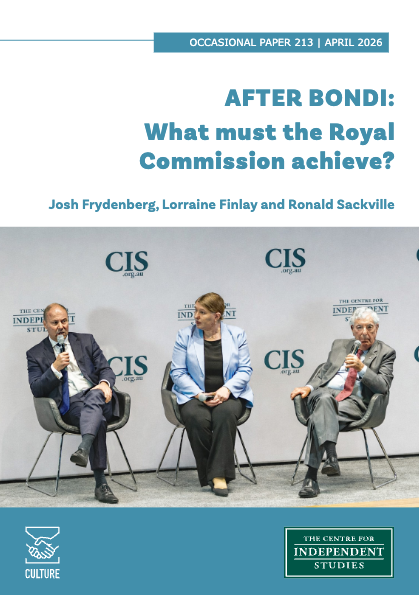
On Tuesday 31 March 2026, the Centre for Independent Studies hosted a forum at the NSW Parliament as part of its antisemitism research program, The New Intolerance. The event was convened at a moment of national significance to address the establishment of the Bell Royal Commission into Antisemitism and Social Cohesion. The Commission was called in the aftermath of the terror attack at Bondi Beach on 14 December 2025 – an event that exposed not only failures of security, but deeper strains within Australia’s civic compact.
The task of the Royal Commission, as set out in its terms of reference, is both focused and wide-ranging: to understand the nature and drivers of antisemitism in Australia today; to assess the adequacy of institutional responses, including law enforcement and prevention; to examine the failures surrounding the Bondi attack; and to document the impact on Jewish Australians and their confidence in public institutions. These are not discrete question, but interconnected ones and provide the context in which the following contributions should be read.
This publication brings together the opening remarks of three distinguished panellists– the Hon. Josh Frydenberg, Dr Lorraine Finlay and the Hon. Ronald Sackville AO KC. Each of them brought to the discussion a depth of experience across public life, law and human rights. Their remarks reflect both the gravity of the current moment and the complexity of the task now confronting the Royal Commission.
A central theme running through all three contributions is that antisemitism in Australia cannot be understood as a marginal or episodic phenomenon. As Josh Frydenberg argues, recent events point to a troubling normalisation of antisemitism across sectors of society, shaped in part by failures of leadership and of institutional resolve. Lorraine Finlay, in turn, emphasises that the challenge is not simply one of legal or institutional response, but of civic confidence – of addressing social division from a position of national strength rather than uncertainty. Ronald Sackville, drawing on his own experience as a Royal Commissioner, underscores the importance of the Commission’s evidentiary role: to bear witness to the lived experience of Jewish Australians and to bring that reality into clearer public view.
Taken together, these perspectives illuminate both the promise and the limits of the Royal Commission. As several panellists note, the Commission can be a vehicle for change but cannot substitute for it. Its findings may clarify, its recommendations may guide, but the responsibility for renewal ultimately lies beyond the Commission itself – with governments, institutions, and citizens alike.
The discussion also points to a deeper and more enduring question. How does a liberal democracy sustain both freedom and cohesion in conditions of moral and cultural pluralism? Where should we draw the line between legitimate expression and harmful conduct? And how can institutions maintain public trust when those lines are contested? These are not abstract questions. They go to the character of the country Australia seeks to be.
The strong engagement and thoughtful feedback from those in attendance on the evening underscored both the urgency of these issues and the value of open, serious discussion. It is in that spirit that this publication is offered as a contribution to a national conversation that must continue well beyond the life of the Royal Commission itself.
Peter Kurti
Director – Culture, Prosperity & Civil Society program
The Centre for Independent Studies
Josh Frydenberg
I think how we got to the point where we need a Royal Commission is a very pertinent question; because principally, I think it’s been a failure of leadership, a failure of political leadership, a failure of leadership across our civil institutions. Clearly it was a massive intelligence and law enforcement failure that led to the worst terrorist attack in Australia’s history at Bondi on the 14th of December.
Antisemitism has always been present in society, but you have to wind the clock back to October 8 and October 9 in 2023 after the Hamas atrocities; where we saw the appalling events on the steps of the Opera House, not far from here. We saw the celebration of those horrific attacks in Western Sydney. We saw subsequently, the firebombing of synagogues and childcare centres, the doxing of Jewish creative artists, the harassment and intimidation at schools, on campus, outside people’s homes and places of worship.
What happened at Bondi was all too predictable and preventable, as the hate cascaded across the country our leaders did not do enough. They did not set clear red lines for the public not to cross. And this failure of leadership contributed to the toxic and dangerous environment which saw the Bondi massacre occur on December 14.
Under great pressure, the government relented and called the Royal Commission. A royal commission is obviously a vehicle for change, but it’s not a guarantee of change. There’s a lot riding on this, and not just for Australia. I think many other countries, Western countries in particular, that have seen a rise in antisemitism, will be looking to the outcomes of this royal commission.
For me, I’ll be looking to the Royal Commission for two particular outcomes. The first is what they find. It’s clear to me — and many people in this room who have been calling out the rising hatred over the last two and a half years — that this is not the activities of a small, isolated, radicalised population that’s operating on the fringes. There’s something very mainstream about the antisemitism that is occurring in our country. So I will be looking to this Royal Commission to be taking the evidence and concluding that antisemitism in our country has been normalised. And that’s critical, because that will then pave the way for practical recommendations to effect real change.
And the second key outcome of the Royal Commission, the practical recommendations — and the terms of reference obviously cover this, law enforcement, intelligence, the level of coordination, resourcing, capability, the prioritisation of their activities — need to be in the spotlight and need to be improved. Need to be dramatically improved.
But it will not be enough. Dealing in a reactive way with antisemitism is insufficient. What we need out of this Royal Commission is practical recommendations that lead to a change in the country’s culture so that we do not see a repeat of Bondi and the hate of the last two and half years. The reason why we’re talking about this issue today is not because antisemitism is a Jewish problem. As an Australian this affects each and every one of us — the type of country — we want to live in.
We need this Royal Commission to come up with practical recommendations that elevate civic virtue, tolerance in our society and put in place systems and processes that ensure there is zero tolerance for hate in our institutions. And I’m talking here about universities of course, and the arts community, and the health sector, and the unions and other areas across society where we have seen an elevation of hate and antisemitism.
It’s not enough for people to simply be educated in understanding the past, the Holocaust, where antisemitism has led. That’s important. But what Australians need to understand better is the type of behaviour that is acceptable today. And I also think it’s important that this Royal Commission delves into the question of how a war thousands of kilometres away from our shores in the Middle East created such dislocation and division here at home.
The last time I looked, there were no widespread protests and walks across the Harbour Bridge when 30,000 to 80,000 people were slaughtered earlier this year in Iran, or a million people who have arguably been killed in the Ukraine war, let alone the hundreds of thousands in Yemen and Sudan and the gassing of innocents in Syria — all of which are crimes against humanity. But where is the outrage on our streets? There is something deeply, deeply wrong with social cohesion, with society itself, that Israel and by extension, the Jewish community, have been targeted in this violent and hateful way since October 7.
For me, that’s an issue for the Royal Commission. And we’ll get obviously to the definition of antisemitism later in this discussion. It’s legitimate to put forward criticisms of the way that war in Gaza was conducted, or of the Israeli government itself. If you visited Israel, you would hear Israelis voice very loud criticisms of their own government. But what we’re seeing in Australia is a double standard applied to Israel, and relevantly, for me and for others, is the way people have taken out their hatred towards Israel on proud Australian Jews.
My mother came to this country after surviving the Holocaust. She went through a displaced persons camp, and when she first arrived in Australia, her arrival card, next to the word nationality said ‘stateless’. Her son got to become treasurer of Australia. What a remarkable country we have and what a remarkable country we must preserve.
Our greatest citizen soldier was Sir John Monash. A proud Australian Jew. When he died, there were nearly 300,000 Melbournians who lined the streets to pay their respects out of a then population of around a million. Jews have created and contributed greatly to this country since their arrival on the First Fleet. We have never seen a conflict between our faith and our citizenship. Something has changed, and it’s the responsibility of everyone in this room to do something about it, because it’s not a Jewish problem. It’s Australia’s problem.
Lorraine Finlay
How should the Royal Commission navigate this tension between protecting Jewish Australians from harm and vilification, and preserving core liberal freedoms—particularly freedom of speech, association and belief?
In a liberal democracy, these aims should not be mutually exclusive. Both must be protected at the same time.
The starting point surely is that every single person, no matter their religion, race or background, should be safe from violence, fear and intimidation. That is the starting point for human rights – that each and every human being is born free and equal in dignity and rights.
From that perspective, we cannot accept there being an irresolvable conflict between protecting Jewish Australians and preserving liberal freedoms. The task before us is to navigate the real challenges that arise in the current context in a principled and resolute manner.
I want to pick up on something Josh said at the end of his remarks. While it goes beyond the formal remit of the Royal Commission, it really goes to the heart of the discussion that we need to have.
Josh’s story is a remarkable one. There are so many stories like that in Australia – stories of individuals that reflect the extraordinary opportunities that this country provides. Reflecting on these opportunities leads me to say something that should not be controversial, but perhaps has become so: I love Australia, and I am proud to be Australian. That is something we do not say often enough, and I think that is part of the problem.
This is a remarkable country. We should be genuinely proud of what we have achieved in building a stable, prosperous and free society.
One of the real challenges we now face – and I truly believe that both Australia and the world are at a genuine turning point – is that we are no longer approaching the question of how to manage division in a free and democratic society from a position of confidence. How do we manage pluralism in a free society? How do we draw the line between free speech and hate speech? Too often, we are not grappling with these questions from a position of strength.
I fear that – as a nation – we have retreated into a kind of weakness or hesitancy that fails to acknowledge the depth of our achievements. We are not perfect – no country is – but we have a strong democratic and civic story to tell. It matters that we respond to contemporary challenges from that position of strength and confidence in who we are as a nation.
Against that background, it is important to be clear about both what the Royal Commission will do, and what it will not do.
In terms of what it will do, the examination of institutions and institutional failures is critically important. That inquiry extends beyond intelligence, policing and law enforcement, and necessarily includes all institutions across society, including human rights institutions, cultural institutions, and educational institutions. That broader institutional analysis is really important.
Equally significant will be the Royal Commission’s examination of the lived, daily experiences of Jewish Australians in recent years, and their encounters with antisemitism.
The Commission will matter not only for its final recommendations – significant as those will be – but also for the evidence it presents to the general Australian public. Josh is right to say that antisemitism is not a fringe phenomenon; there has been a troubling normalisation of it. I do not believe that the majority of Australians are antisemitic. But I also do not believe that the majority of Australians truly understand the impact this has had, and is continuing to have, on Jewish Australians.
The evidence that will be heard – about how antisemitism has been normalised, about the forms it has taken, not only in highly visible incidents but also in the quieter, daily experiences endured by members of the Jewish community – needs to be publicly aired. Too often, these experiences are denied or dismissed.
Just this week, I received a letter responding to an opinion piece I wrote about the surge in antisemitism, asking: where is the evidence of that? How is that not obvious after everything that has happened in Australia over the last few years? How can people not see what has been happening in this country? The fact that people are still asking ‘where is the evidence’ itself illustrates the need for the Royal Commission – not only to examine institutional failings, but to establish, in a way that cannot be ignored, the reality of what Jewish Australians have experienced, and to make that reality visible to the broader Australian community.
But it is equally important to be clear about what the Royal Commission is not, and the limits of what it can achieve.
I genuinely believed that the antisemitic Bondi terrorist attack was a true shock to the conscience of the nation. That it would be the moment when we collectively recognised that we could not continue on the path we were on. There was an initial flurry of activity in response including with legislative reform and the establishment of the Royal Commission. Yet now we are seeing antisemitism creeping back, incidents continuing, and in some cases increasing again. There is a sense that this is again becoming normalised, and that people have begun to move on.
That is what cannot be allowed to happen. This is why understanding what the Royal Commission is not may be even more important than understanding what it is. The Royal Commission is not, in itself, the solution to antisemitism in Australia. What matters is what we do with its findings, and after it has concluded. Institutions and individuals alike must commit to acting on what emerges, rather than relying on the Royal Commission to solve the problem for us.
The Royal Commission has an important role to play, but it does not absolve the rest of us of our responsibility to address antisemitism, which we have allowed to become normalised in our society.
The final point that I think needs to be emphasised, and I absolutely agree with what Josh said earlier about this. Jewish Australians have been forced to bear the brunt of this problem, but it is not an issue for Jewish Australians to face alone. Antisemitism is a problem for all Australians to confront. It is something we cannot allow to remain normalised, and it needs to be addressed with urgency and resolve.
Ronald Sackville
To my mind, the most important thing that the Royal Commission can do is to bear witness to the nature and extent of antisemitism and, as the terms of reference say, to hear the everyday experiences of Jewish Australians of antisemitism. There seems to be a fundamental problem with the Royal Commission doing that as thoroughly as possible, because Commissioner Bell has said it is critical that she reports by 14 December 2026. In my opinion, it is not possible fully to complete the task of bearing witness to the nature and extent of antisemitism in Australia within the next nine months and also produce a comprehensive final report within that time. Perhaps in the end, the Commission will seek an extension of time in which to report.
The Disability Royal Commission, which I chaired, lasted for four and a half years, and part of our function was to try and bring home to the Australian community the nature of abuse and discrimination and neglect experienced by people with disability in this country. I do not think that can be done in the same way during the next seven or eight months or so during which the Antisemitism Royal Commission will conduct hearings. So that’s one problem the Royal Commission is going to face.
In judging the success of a Royal Commission, much importance is usually placed upon the recommendations and whether they have been fully accepted by the Government of the day. I’m not at all sure that making recommendations is necessarily the core function of this Royal Commission. Of course, it’s important that recommendations be made and implemented. But if we are looking for recommendations strengthening the criminal law as a means of tackling antisemitism, we need to remember that the criminal law is a very blunt instrument. For that reason, if we see the criminal law as providing answers to the spread of antisemitism, we won’t get very far. As Lorraine says, it’s a very difficult and delicate task to reconcile the concepts of free speech that we regard as important and also to protect communities —including, of course, the Jewish community — against hate speech.
My own view, for what it’s worth, is that the legal structures we have, as revealed by recent cases, are actually not too badly adapted to deal with the problems needing to be addressed. Judges and tribunals are generally finding their way through that morass pretty well, when cases are brought before them seeking civil remedies, rather than criminal prosecutions. To my mind, it’s the exposure of the nature and extent of antisemitism experienced by Jewish Australians which is the most critical element of this Royal Commission.
I think Josh is right when he says antisemitism has become normalised in recent times. But I think it also the case that antisemitism has nearly always been normalised in this country, although not in the ways it has manifested itself since October 7. I’m old enough to remember the nature of antisemitism in Australia that continued to be evident even in the aftermath of the Holocaust.
Josh has referred to Holocaust survivors who came to this country, were welcomed, rebuilt their lives and contributed greatly to the country. My paternal grandfather came to Australia pre-World War One, having personally witnessed persecution, including the killing of Jews, in a small town in what is now Poland or Belarus — depending upon the day of the week. That generation of survivors also rebuilt their lives. But antisemitism persisted.
I left a Church of England School because of antisemitism, along with the five other Jewish boys in my year. Years later, I was in a room with the then Vice Chancellor of the University of Melbourne and asked him how it was that he could be a member of the Australian Club which did not admit Jews. Zelman Cowen was in the same room. The Vice-Chancellor’s answer was: oh, we must be free to mix with whoever we like. The notion that antisemitism is something that has sprung up since October 7 (the Hamas attack) is wrong, although it never took the form we have recently experienced.
I think we have to bear in mind that historically much antisemitism, was religiously based. The antisemitism in the earlier years of this country — which of course was not virulent in the sense of encouraging violence, let alone massacres — was in part the result of religious discrimination against Jews. Jews were often called ‘Christ killers’. I experienced that at school, and it was a very common phenomenon for young Jewish people. One of the reasons for creating a Jewish educational system was to avoid Jewish children being exposed to non-violent, but hurtful antisemitism.
I think we’ve got to have realistic expectations of what this Royal Commission can achieve. I very much regret that the time frame seems to be so truncated for the tasks entrusted to it. I also very much regret that there will apparently not be the opportunity for individual Jewish people to have private sessions with a Commissioner. This opportunity was provided by other Royal Commissions, notably the Disability Royal Commission and the Child Abuse Royal Commission.
The principal advantage of private sessions — apart from being extremely helpful to individuals who participate — is that they provide a mechanism for a great range of personal experiences to be presented to the Royal Commission safely and with appropriate support, such as psychological counselling. Information gathered at private sessions can be summarized in de-identified form and, although not evidence in the strict sense, can inform the contents of the final report when ultimately produced. It appears that private sessions will not happen with this Royal Commission presumably because of the time constraints.
I have heard anecdotal reports that some Jewish students and Jewish academics at universities are too frightened of retribution to come forward to tell of their experiences to the Royal Commission. When they read the information published by the Royal Commission to assist people wishing to engage with the Royal Commission, they are reminded that freedom of information requests can be made after a Royal Commission finishes its work. That means that after this Royal Commission reports, somebody can make a Freedom of Information request and seek access to submissions, even confidential submissions. (Whether the request would be successful is another question.) But nobody should be surprised if some people are reluctant to recount their experiences of antisemitism if they run the risk of somebody in the hierarchy above them at a university might find out they have done so.
While I think the Royal Commission faces challenges, that doesn’t mean it will be prevented from doing very useful work. As has been pointed out, there are really two aspects to the Commission’s role. In a sense, the easier aspect is examining why intelligence agencies and police forces failed to prevent the Bondi massacre. That is a factual inquiry and the Royal Commission has the powers to obtain the material needed to determine how it was that the perpetrators were able to carry out the massacre.
Judging from public statements reported in the media, the Commissioner has a different view about how to conduct the factual inquiry, compared with the approach taken by Dennis Richardson (who has now resigned). Mr Richardson apparently considered that he could conduct the inquiry effectively by adopting a more cooperative approach with the agencies. The Royal Commission has indicated it will use its extensive powers of compulsion in relation to the agencies being investigated.
I think it is a more difficult task for the Royal Commission to expose to the Australian people the nature and extent of antisemitism in this country, including the role that organisations like universities, cultural institutions and the like have played in allowing antisemitism to flourish. Unfortunately, that does involve exploring the deep origins of antisemitism in our country.
As the well-known commentator. Jonathan Freedland, said recently in a presentation, we have to move away from binary conceptions of the world – a Manichaean view that sees the world as either black or white, right or wrong. For example, if you’re a Zionist, you must therefore be in favour of everything that the right-wing Israeli government is doing today, yesterday and tomorrow. Too often people are unable to understand nuances or to appreciate that there can be shades of grey.
These are not easy things to address, much less correct. The Royal Commission can certainly help by identifying the issues and explaining that tolerance requires people, as Freedland suggests, to hold in their minds more than one concept or idea at the same time. Tolerance is something that requires respect, understanding and the ability for people to engage respectfully with other people about their differences. These are the sorts of things that the Royal Commission can help with. But ultimately, as Josh says, it is a matter of leadership. This means not only political leadership, but leadership at all levelsat all levels in the community – faith leaders, leaders of cultural and educational institutions and other community leaders. They need to be able to absorb the messages that the Royal Commission will send and hopefully spread them to the wider Australian community.
One reason the seriousness of antisemitism is not as widely appreciated as it should be, is that most people in Australiahave never knowingly met a Jewish person. Jews are a minuscule part of the Australian population and are concentrated in a few suburbs of the major cities. Most people therefore have no particular reason to follow closely examples of antisemitism, short of violence or terror. Ideas about tolerance, understanding and respect need to be disseminated throughout the Australian community, a process in which the Royal Commission can play an important part.
It is true that these values have been part of the Australian ethos, but they have been sorely tested. Yes, this is a good country and for the most part the Jewish community has flourished. What you (Josh) say about this country is right. But there is an awful lot of work to do in an Australian society that is very different from the period from the post-War years to the 1980s, the time during which most people here would have grown up.
It’s a very different country, not least because we now have a substantial Muslim population, Obviously, most Muslims are not remotely antisemitic, but there are attitudes within some sections of that community that present an issue for the Jewish community.
There is a real issue concerning the perceived association between Jews, Zionism and what are regarded as the serious errors of Israel, a perception not confined to any one section of the Australian community. These issues that are not easy to address, but they need to be brought out into the open by the Royal Commission and in the discussions that undoubtedly will occur after it reports.