Home » Infinite possibilities from the dark side of the moon
Donald Trump’s threats to destroy the ‘whole civilisation’ of Iran this week jarringly contrasted with the out-of-this world American achievement of sending a four-member crew as far from Earth as any humans had gone.
The last time humans orbited the moon was in late 1972 with the Apollo 13 mission. That was months before Pink Floyd’s epic Dark Side of the Moonalbum, which admittedly was more about madness than space travel!
Viewed from 406,000 kilometres away this week, the earth was bathed in an infinity of darkness.
Similar awe-inspiring visuals from the Apollo missions of half a century ago raised the sense of humankind’s stewardship of a fragile planet that, in turn, encouraged the rise of the modern environmental movement and concerns over global warming.
The environmental framing of the Earth can take on a quasi-religious or sacred tone, with references to Gaia, perhaps comparable to how Artemis II pilot Victor Glover thanked God for creating the planet as a home for humans to love one another.
The previous lunar orbit also coincided with the first 1970s oil shock — an event of human conflict. But that ’70s oil shock also recalled the message from this year’s CIS scholar-in-residence, Cato Institute researcher Marian L. Tupy, about human ingenuity being the most precious resource. His work resulted in a number of CIS papers, including Humankind and the Infinite Resource Base.
The previous Middle East oil conflicts encouraged American entrepreneurs to invest in the human knowhow of ‘fracking’ oil and gas deposits otherwise trapped in dense rock.
This human ingenuity tapped oil and gas that previously was uneconomic to extract, turning the US into the world’s biggest producer and making it less dependent on Middle East oil.
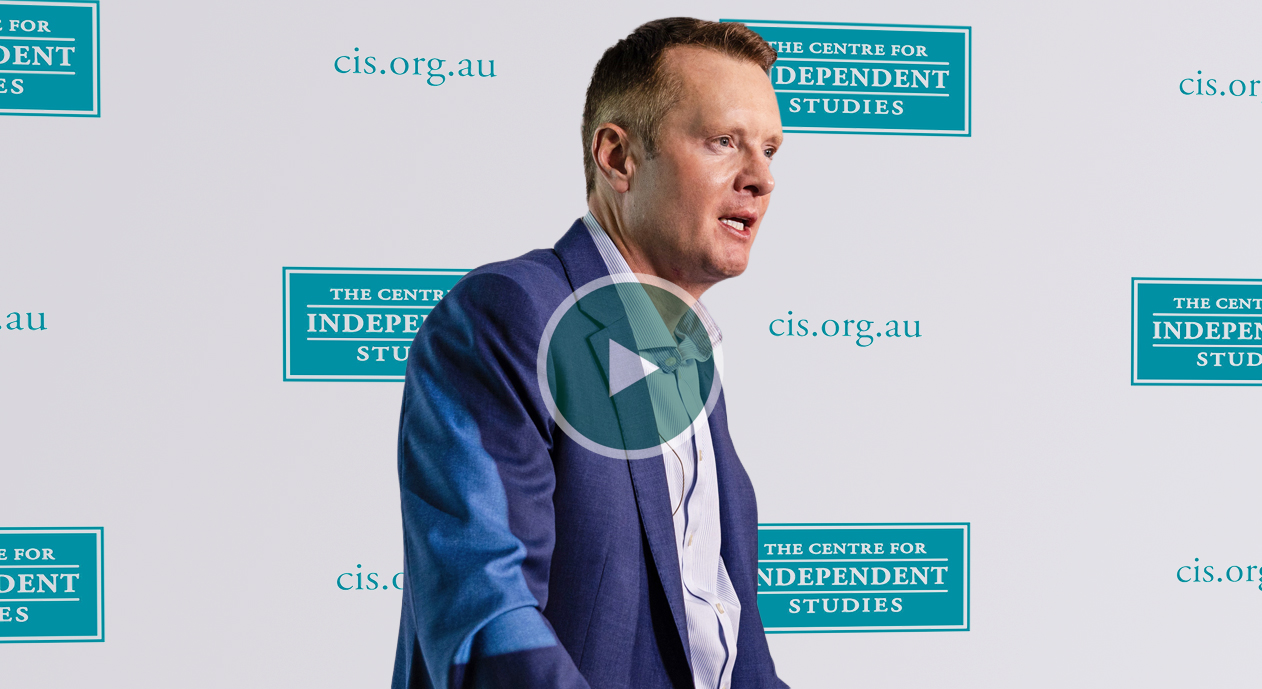
That may not sound ideal for the planet. But, as Tupy said during his time in Australia (see video below), this same ingenuity means that humans have the potential to generate infinite growth from the resources available to them.
Four thousand years ago, humans melted sand to create glass beads to wear as decoration, Tupy said in his presentations in Melbourne, Canberra, Sydney and Perth. Then sand was used to create ceramic bowls and glass windows. Now it’s used to create microchips that enable technological marvels such as generative AI.
Lithium once made ceramic glazes brighter, but today it is used in lithium-ion batteries to power Elon Musk’s Tesla cars.
China has unveiled the first mass-market EV with a sodium-ion battery — and sodium is one of the most abundant materials on the planet.
All the metals on Earth originated within the stars, continued Tupy. The Big Bang created hydrogen which was compressed within stars and turned into metals such as gold and iron. The oceans are full of hydrogen.
Today, artificial or lab-made diamonds are indistinguishable from natural stones. The resulting abundance means that the price of diamonds is collapsing. The supply of diamonds is not finite.
And if the Earth is not enough, Tupy notes that robotics, AI and solar technologies could transport an army of robots onto one of Musk’s starships to mine the asteroid belt.
Infinite possibilities from the dark side of the moon