
Executive summary
Over the past several decades, Australian society has undergone profound economic, social, and cultural change. Education pathways have lengthened, housing costs have far outpaced wages, family formation has been delayed or disrupted, and government intervention has expanded across nearly every stage of life. Public policy has attempted to keep pace with these changes. But there is a growing mismatch between the aspirations young Australians hold and the reality they experience.
This paper examines the lives, aspirations, values, and perceived barriers of Australians aged 18–34. Drawing on original qualitative interviews using conversational AI and quantitative research conducted by Spectre Strategy on behalf of the Centre for Independent Studies, it finds young Australians do not aspire to radically different lives than previous generations. Financial security, home ownership, meaningful work, family, and children remain core goals. What has changed is the degree to which these goals feel attainable.
This paper explores levels of life satisfaction, incorporating autonomy (the ability to pursue your own goals), agency (the ability to influence the world around you), self-determination (the ability to choose your path in life), empowerment (the ability to act on self-determination), and self-realisation (the fulfilment of individual potential).
Young Australians report higher levels of anxiety, lower life satisfaction, and a reduced sense of personal agency compared with older cohorts. Fewer than four in ten believe the barriers standing in the way of their aspirations are within their control. This loss of agency is strongly correlated with diminished life satisfaction and shapes how young people respond to constraint: some become resigned or disengaged, others angry and anti-establishment, while some shift toward short-term gratification at the expense of long-term planning.
A central finding of this research is that agency matters as much as material conditions. Young people who already have financial security experience a strong sense of autonomy and life satisfaction. Money becomes an instrument to express choice.
For young people who do not yet have financial security, a sense of control and choice is associated with higher life satisfaction. These young people might not yet have everything they aspire to, but they believe in their ability to shape their life course.
In each case, a sense of individual choice and agency is fundamental to life satisfaction.
In practical terms, this means that policies which focus on government transfers while narrowing choice or reinforcing dependency may fail to improve — and may even worsen — overall life satisfaction.
To deepen understanding, the research identifies six distinct ‘tribes’ of young Australians, differentiated by their values, circumstances, and perceived autonomy.
These are:
Progressive Identitarians
This group is committed to far-left progressive ideas and identifies as LGBTQ+ at much higher than average rates. They are disproportionally likely to be students, still living with parents or renting. They have given up on traditional goals such as home ownership and children, and focus instead on short-term fulfilment. They are highly politicised, anxious, and pessimistic, with low perceived agency and strong support for redistributive government action.
Dislocated Post-Traditionalists
This group are predominantly women with a low level of educational attainment. They tend to have children but be unmarried, identifying their relationship status as de-facto. They are economically anxious, anti-establishment, and exhibit the lowest life satisfaction and sense of control of all the tribes.
Natals
This group is predominantly male with a slightly lower than average educational attainment. They value traditional milestones but feel systematically blocked from achieving them. They are nationalist, anti-immigration, and deeply sceptical of government and institutions. They have a low sense of control and life satisfaction.
Strivers
This group aspires to traditional milestones and takes a pragmatic and hopeful approach to achieving them through hard work and application. But they are concerned that these milestones have become more difficult to achieve. They have a moderate sense of personal control and corresponding life satisfaction, but they may be at risk of becoming frustrated and losing their drive and sense of agency if their hard work doesn’t pay off.
Detacheds
This group is disengaged and optimistic by default, with weak forward planning and fragile foundations for future life satisfaction. They tend to be single but wish to be in a relationship. They have a ‘she’ll be right’ attitude which — while not exactly a sense of control — is connected to a moderate sense of life satisfaction.
Head-Starts
This group is affluent, likely to already own a home, and be married with children. They have already received, or expect to benefit from, family wealth transfer. They have a very high sense of autonomy and personal control, and strong life satisfaction. They regard institutions and government favourably and with trust, as they see them as having contributed to their success in life.
Across these groups, housing affordability, financial insecurity, and time scarcity dominate perceived barriers. While most young Australians have a low level of trust in government, most broadly favour reform from within the system rather than revolutionary change. Those who favour more drastic change are the most precarious, who feel they have little control over their destiny.
This paper argues that many current policy responses focus on treating symptoms — subsidising rent, expanding mental health services, or offering one-off financial relief — rather than addressing underlying structural constraints. These measures often substitute a narrower, government-defined vision of a ‘good life’ for the one young people would choose themselves if given genuine alternatives. This lack of agency reduces life satisfaction. Consequently, policy meant to help people can end up affecting them in negative ways.
The central policy implication is clear: improving the life satisfaction of young Australians requires expanding real choice and personal agency, not merely increasing transfers or services. Policies should be assessed not only on whether they provide support, but on whether they empower individuals to shape their own futures.
Without a shift in approach, Australia risks entrenching a generation marked by lowered expectations, disengagement, and political volatility. Addressing youth malaise is not a matter of electoral convenience but of long-term national renewal. The direction of current trends makes this task urgent.
Introduction
The problem
Over the past 70 years, life in Australia has changed dramatically. The 1950s ushered in a fundamental restructuring of society across the West, as women — liberated by their work during WWII and reliable contraception — explored new vistas. People began to travel more in search of job or lifestyle opportunities. The nuclear family first became the norm, as they chose to establish families far from where they were born, then was challenged as non-traditional family arrangements became more common. Household dynamics shifted. Australia grew by almost 20 million people. Migrants arrived from a wider range of countries. Education levels increased and many vocational professions began to require a university qualification. House prices rose significantly faster than average incomes.
As these changes took place, policymakers sought to manage and respond to the new ways of living that emerged. Some tried to hold back the tide of change, while others celebrated and embraced all change as positive. Successive governments attempted to provide assistance and support to voters adapting to new ways of living. In Australia, government social spending expanded, becoming enmeshed in every phase of life.
This lattice has caused some aspects of society to atrophy while allowing others to expand. The positive and negative effects and incentives the support structure creates are sometimes discussed by policy analysts but rarely questioned by the community, to whom the lattice is largely invisible. New extensions quickly come to feel indispensable.
If this structure were beneficial, we might expect the result to be a thriving society. But all is not well in Australia or the West. Life satisfaction is trending down in many developed countries.[1] Young people are now reporting the highest levels of misery of any age group.[2] The ‘deaths of despair’ among non-college-educated, middle aged, white Americans identified by Nobel laureate economists Anne Case and Angus Deaton have been joined by lives of despair, as young people start off more discouraged and with greater emotional and mental health challenges than any generation before them.
As the plight of young people has become increasingly electorally-salient, policymakers have attempted to respond to its symptoms and presumed cause. Home ownership — or at least access to cheaper rentals — has become a key focus, as most young people now consider buying a home an almost unattainable goal. Mental health services have proliferated. To help with the cost of living, governments have offered young people free TAFE and one-time rebates on already-discounted higher education loans.
Instead of making young people’s aspirations of young people more accessible, these policies offer a pacifier: a substitute vision for the future that governments believe is more within their power to deliver than the one young people imagine for themselves.
These short-term fixes and attempted redirections represent a failure to address underlying issues. More affordable rental housing is not as good as home ownership. Therapy and antidepressants are a poor substitute for a strong sense of purpose. Free or discounted education doesn’t remove the opportunity cost of credentialism, especially now that post-school qualifications attract a declining wage premium.[3]
The purpose of this paper
To address youth malaise, Australia and the West must look beyond electorally-expedient measures. Instead of asking whether people like a particular policy or not, whether they would be inclined to vote for a handout or quick fix if the question is posed as a binary — to have it or not — we have to discover whether they would choose it for themselves if they had a wider range of options. Existing policies can be judged by whether they contribute to, or detract from, fundamental life satisfaction.
To do that, we need to discover the aspirations of young people and what they conceive of as a good life, informed by their values. Their insights into the barriers to achieving their goals and their concerns about how society is currently ordered can help diagnose the real sources of their discouragement and despair.
Only by approaching the problem from this angle can we begin to establish which policies might need to be reversed, replaced, or adjusted for the next generations to thrive.
This information can be used to propose and champion better policy. Demonstrating bad policy’s harm recasts the narrative around removing it from a loss to a gain. Examining how new policy can maximise choice ensures Australians have the freedom to shape their version of a good life.
The task is urgent. The indicators for young people are pointing in the wrong direction. To continue on the current course of policy patchwork without questioning the framework would be to sacrifice the future of our nation on the altar of retail political convenience.
Why 18–34-year-olds are the subject of this paper
Rather than be guided by generational labels, which create broad and arbitrary groupings, this paper identifies young adults from 18 — the point at which an Australian is officially recognised as an adult — until 34, the age after which psychology generally recognises the transition from young adulthood to middle adulthood.[4]
This quantitative work further breaks down this cohort into 18–24 years (a period often referred to in psychology as emerging adulthood, during which people explore their identity and goals) and 25–34 years (a period conventionally recognised as a period of foundation building, defined by establishing relationships and careers, firming up life choices and taking on increasing responsibility).
The research approach
This paper is based on qualitative and quantitative research. One-on-one interviews conducted with a traditional research panel of young people using conversational AI furnished free-form qualitative insights into what young people state as their aspirations and barriers. This approach was used to inform the quantitative research design and ensure the questionnaire followed the lead of young people and didn’t miss any important areas of investigation. Quantitative research was then conducted on behalf of The Centre for Independent Studies by Spectre Strategy.
High-level findings
Young Australians do not have very different aspirations to the generations before them. They prioritise financial security, home ownership, families, and children.
But for many, these goals feel unachievable. The cost of rent and housing are a significant barrier to achieving their goals, and young people worry that they won’t earn enough money, have access to the right job opportunities, or have enough available time to achieve the things they aspire to. They also experience greater emotional and mental health challenges than previous generations have reported.
Moreover, they are less likely than Australians over the age of 35 to believe they are able to do something about the barriers they face. This lack of perceived agency correlates with lower life satisfaction.
The research finds that believing they will be able to influence the barriers to their aspirations is a determining factor in how young people respond to the challenges they face. Those with a greater sense of personal agency remain determined to overcome the barriers; those with less become quietly resigned, angry, or shift their focus to short-term pleasures at the expense of planning a future.
Breaking young Australians into groups, or tribes, makes the relationship between financial security and agency visible. For people with low perceived autonomy, financial security has a very large effect on life satisfaction. While for people with high perceived autonomy, financial security still matters, but much less.
That is: money matters most when people lack real freedom. For people with low autonomy, money is existential. For people with high autonomy, it is instrumental.
This means policymaking should not just focus on meeting the material needs of young people, but also factor in whether it limits choice and personal control or increases them.
The six tribes that emerged from our research allow us to analyse in detail the effect of a changing world on young Australians. Mapping their values creates a starting point for a conversation with groups of young people who are often drowned out by more assertive voices.
The six tribes: a high-level overview
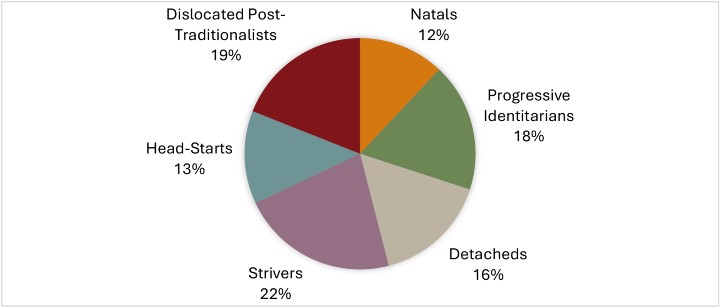
Figure 1: The six tribes
Progressive Identitarians
18% of 18–34-year-olds
Progressive Identitarians are a student and activist grouping, who tend to live at home with their parents. They are far more likely than average to identify as LGBTQ+ than other young Australians; in fact, with 40% of Progressive Identitarians nominating this category, they skew the overall average of young LGBTQ+ people upwards when the age group is viewed as a whole.
This politically-engaged group, which identifies strongly as left-leaning, has collectivist values. They very strongly believe the economic system unfairly favours powerful interests, and businesses and corporations make too much profit. They disagree strenuously that Australia should prioritise its own economic interests over international climate commitments, and that welfare does more harm than good by making people too dependent on assistance.
For Progressive Identitarians, the top markers of success (in descending order) are: having emotional and mental stability; having a strong network of friends and family; and having enough money to pursue their basic life goals. Of these three things, only the social goal of friends and family is seen as easy to achieve.
The top barriers Progressive Identitarians see to achieving their most important milestones are (again in descending order): the cost of housing and rent; earning enough money; and maintaining mental health. In interviews and vox pops, this group expresses the view that big companies should be taxed much more for the purposes of redistribution.
Progressive Identitarians are highly anxious, with poor emotional and mental health, and a low sense of personal agency. They report lower levels of life satisfaction than other groups. They perceive government policies as having a strongly negative impact on all of their areas of aspiration.
Progressive Identitarian case study
Holly and Matt are both 24 years old. They are urban, politically engaged, and identify as socialists.
Neither expects to own a home. Renting feels insecure but unavoidable, and while Holly has a degree, Matt is worried about the debt and uncertain returns of investing in higher education. They have a sense that society and the economy is rigged against them. They’ve replaced traditional aspirations with different priorities: personal fulfilment, mental health, strong social networks, and flexibility. Travel, meaningful work, and time outside traditional career ladders matter more than saving for the future.
Holly and Matt hold strong views on economic and intergenerational fairness, climate change, and gender equality. They believe wealth concentration, weak taxation of high earners, and privatised public services are central failures of the current system. They believe billionaires and big corporations are not paying a fair share of tax and should pay more.
They are not opposed to paying tax, but don’t like a lot of the things government spends on. They speak critically about foreign conflicts, military alliances, and Australia’s strategic positioning; questioning why public money is directed toward war and surveillance rather than housing, education, or social safety nets. There is a strong streak of conspiratorial thinking; they suspect powerful people and government of covering up or concealing interests in order to make profits and skew the system in favour of interest groups.
They follow politics closely, favouring socialist ideas such as wealth redistribution, public ownership, and stronger welfare provision. They dislike privatisation, especially of services they believe should be publicly owned and provided.
Like many in this cohort, they are socially progressive, cosmopolitan in outlook, and largely non-religious. They believe Communism has never been attempted properly, because the capitalist system always intervenes to destabilise its competitor ideology.
Dislocated Post-Traditionalists
19% of 18–34-year-olds
Dislocated Post-Traditionalists are a largely female tribe that skews to the older end of the 18–34 age bracket. They have children but have never been married. Most don’t have a post-school qualification. They are not thriving and don’t expect things to get better. As a result, they have become disillusioned with, and angry at, existing power structures.
Like Progressive Identitarians, Dislocated Post-Traditionalists consider attaining emotional and mental stability to be one of their top three personal definitions of success. All three (in descending order) are: becoming debt free or financially stable; having good physical health and fitness; and having emotional and mental stability. But financial and mental stability are considered hard to achieve. Physical health is also perceived to be much more out of reach by this tribe than others.
The cost of housing and rent, and earning enough money to pursue basic life goals are the top challenges for Dislocated Post-Traditionalists. Maintaining emotional and mental health comes in third place.
They are highly anxious, with nearly 7 in 10 worrying most, or all, of the time. They have the lowest sense of control over the barriers to their aspirations of any group — only 32% of Dislocated Post-Traditionalists believe the barriers are in any way within their control. They have the lowest life satisfaction of all of the tribes.
Unlike the Progressive Identitarians, Dislocated Post-Traditionalists do not display collectivist leanings. In fact, they are concerned that welfare spending doesn’t end up helping the people who need it and can do more harm than good by making people too dependent on assistance. They would prefer to keep more of their own money than pay tax for government services. They strongly believe Australia should prioritise its own economic interests over international climate commitments.
Dislocated Post-Traditionalists are not especially politically engaged — 69% follow public affairs occasionally or less. They identify as politically on the centre, or to the left, but they do not feel well represented in politics and are not committed to the parties they’ve voted for in the past.
Dislocated Post-Traditionalist case study
Emily is 31 years old and has five children. Her home life feels chaotic. Seven people share a three-bedroom house, and every day it feels smaller. The children are constantly under each other’s feet, tempers flaring, noise bouncing off the walls. The baby sleeps in her mother’s bed because there’s nowhere else for her.
Emily would like to move her family to Newcastle in search of something better. The plan exists, but she and her partner haven’t worked out how to make it happen yet. The Department of Housing won’t budge, she says. The waiting lists don’t move fast enough. In the meantime, the kids stay cooped up, fighting, restless, growing in a home that’s stretched beyond its limits.
When asked what government could do to make her life easier, the answer is immediate and practical: a bigger house. Emily doesn’t speak in policy language — she thinks of life in practical terms.
Her decisions revolve around her kids. One of her sons has been diagnosed as Level 3 autistic, which shapes every choice the family makes — from schools to housing to long-term planning. She talks about education carefully, weighing what’s right for each child rather than chasing abstract success. One daughter dreams of becoming a teacher. Another wants an apprenticeship. For Emily, just having them finish Year 10 would already feel like a victory — she didn’t make it herself.
Emily is very worried about the cost of living. The cost of food alone is staggering. She estimates close to $1,000 a week just to cover basics — and that’s before meat and fruit are added. Meat adds another $150. Fruit, another $150. There’s no slack in the budget. Her children are from different fathers and some don’t pay child support.
Planning ahead is a trap too. The family has a holiday to Queensland coming up. It’s already partly paid for and locked in. They can’t afford it anymore, but it’s too late to back out.
Rent is another source of anxiety. Emily and her family live in public housing, but the people close to her are struggling. Her sister pays nearly $800 a week for a modest three-bedroom home. “It’s ridiculous,” she says.
When asked about politics, Emily is vague. She doesn’t follow it closely. She usually votes Labor, but her faith in leaders is weak. She says the prime minister needs to focus on Australians before worrying about wars overseas. It’s not that she doesn’t care, she says. She cares deeply. Too deeply, sometimes. Stories of children dying in war zones hit her hard. She cries when she hears about them. She can’t separate those children from her own.
But care for what’s happening elsewhere in the world has limits when her own family’s survival feels precarious. Cost of living, housing, disability funding, hospitals, dominate her attention. She talks angrily about cuts to autism support, relieved only because her son’s higher diagnosis level still qualifies him for help. She talks about understaffed and overwhelmed hospitals. Her labour experience was traumatic: hours waiting for pain relief, pleading for help, an epidural that arrived too late to matter.
She doesn’t have much trust in institutions either. Banks feel unsafe after her account was hacked and her savings disappeared. The money hasn’t been recovered. The government feels distant and unreliable. Her partner was rejected for ‘dad pay’ when the latest baby was born, leaving the family without income for months during a period they needed stability most. He found work again just before Christmas, which was a relief.
Emily doesn’t frame her politics in left or right terms. She frames them around children. If a child is in trouble, she steps in. If kids are suffering — here or overseas — it matters to her. But she is tired. Tired of hearing about big global problems while families like hers struggle to get through the week.
Natals
12% of 18–34-year-olds
Natals are a small but vocal group. They tend to be in the older 25–35 year old bracket. They are fiercely protective of their Australian identity and worry that immigration is taking Australia in the wrong direction. Half the Natals nominate immigration as a top three priority issue. But Natals feel powerless; many feel the barriers to their aspirations are out of their control to influence, or that they can only influence them “slightly”. They are less happy with their financial situation than many others their age.
Natals are very mistrustful of government and institutions and nearly half think institutions and laws need to be completely rebuilt. They overwhelmingly identify as on the political right and 45% vote for One Nation.
The top markers of success for Natals (in descending order, though all three are very close in priority) are: having enough money to pursue basic life goals; owning a home; and having children and building a family. All these things strike the Natals as hard to achieve.
The barriers to achieving them are financial in nature — the cost of housing and rent, earning enough money and government policies and taxation. Natals believe government policies have had a negative impact on every measured aspect of their lives.
This tribe is less anxious than the Progressive Identitarians and the Dislocated Post-Traditionalists, but nearly half still worry some, or almost all, of the time. Their perception of personal agency is the third-lowest of the tribes. Their life satisfaction is low.
Natals yearn for agency and sovereignty. They believe a lot of government spending is wasteful, would prefer to keep their own money than pay tax for more government services, and strongly support Australia prioritising its own economic interests over international climate commitments. They think government welfare does more harm than good by making people too dependent on assistance.
Natal’s sense of powerlessness seems to be balanced out to some degree by their clear sense of what can and should be done in their view to address the barriers in the way of realising their aspirations. It should also be noted that young men in general tend to be more optimistic about their personal prospects than young women.
Strivers
22% of 18–34-year-olds
Strivers are the largest tribe and are almost evenly split across the age ranges within their cohort. They are slightly more likely to be based in Queensland or a regional area of Australia.
Strivers are divided on whether they have control over realising their aspirations, but slightly more felt they had a strong or slight ability to control them than felt they were slightly or strongly out of their control. They worry less than the three previous tribes and have slightly higher levels of life satisfaction. They are largely disengaged from public and current affairs. Half identify as politically centrist. The remaining half are distributed to the left and right, with slightly more on the left. Their vote is overwhelmingly uncommitted.
The most important things for Strivers’ personal definition of success (in descending order, but close) are: becoming debt free or financially stable; having enough money; and having good physical health and fitness. Of these, they perceive the first two as relatively difficult, and the last as reasonably easy to achieve. Their top barriers are the cost of housing and rent, earning enough money, and having enough available time.
Strivers say the government has had a negative impact on their financial goals, but a neutral to mildly positive effect in some other areas of life. They are most concerned about wasteful government spending, taxation, and believe Australia should prioritise its own economic interests over international climate commitments.
Striver case study
Andrew is 21, and he’s clear about what he wants from the next five years of his life: He wants to make money.
He’s an apprentice shopfitter and believes in hard work. His plan is to keep showing up on time, put in the hours and finish his apprenticeship. He doesn’t talk about passion or purpose, he’s a practical guy. He wants to earn well and buy a house eventually. Then start a family at some point. He doesn’t have a girlfriend at the moment — he believes there’s still plenty of time to find the right woman.
But Andrew knows things aren’t going to be easy. Everything is expensive now, he says — houses in particular. What once felt achievable now seems distant, pushed further out of reach by rising prices.
When asked what he thinks the government should do about it, his answer is simple: drop prices. He’s not quite clear on how. Politics isn’t something Andrew follows closely. He doesn’t spend time thinking about policy or ideology, and he doesn’t pretend to. What he knows comes from experience.
Tax is a sore point. Andrew remembers his first pay cheques as an apprentice: $11 an hour, nine-hour days, roughly $400 a week. Paying tax on that felt wrong to him. Apprentices, he argues, should be tax-free. They already earn little, still have to buy tools, and are trying to get established. Taking tax out of that income feels like punishment for effort.
More broadly, Andrew believes tax should be flat. If someone works hard and becomes successful, he doesn’t see why they should pay more than anyone else. To him, higher taxes on higher incomes feel unfair — a penalty for getting ahead. Everyone should pay the same amount, he says. Success shouldn’t come with extra cost.
He’s not hostile to government services. He values workplace safety and the health system and thinks, broadly speaking, those things work well. But he’s sceptical about where a lot of tax money goes. “No one knows,” he says, expressing a sense common among his peers that taxes aren’t always well spent.
Andrew doesn’t describe himself as politically engaged, and doesn’t follow debates about inflation or economic policy. He just knows that things cost more every year. His conclusion is blunt: it’s because the government wants more money.
His frustrations are practical rather than political. In his line of work, jobs are delayed because approvals come in stages. Clients change their minds mid-project. Other tradies don’t show up on time. It slows everything down. It’s inefficient. But it’s also just how things are.
Asked whether he’ll become more politically engaged as he gets older, he shrugs. Maybe. For now, his focus is narrower. Finish the apprenticeship, earn more and try to get ahead in a system that already feels expensive and unforgiving.
Andrew’s worldview is shaped less by ideology than by pay rates, rent prices, and tax deductions. He doesn’t question the system deeply, but he is affected by it. At 21, he believes in work, effort, and fairness — defined simply as keeping what you earn.
Detacheds
16% of 18–34-year-olds
Detacheds are a politically-disengaged tribe of young Australians who tend not to think much about the future. They don’t worry a great deal, leaning towards a ‘she’ll be right’ attitude. Their opinions on most issues are neutral or uncertain, but one aspiration stands out: 70% of Detacheds are not married or in a de-facto relationship, yet many would like to have a family and children. Detacheds have a weak but positive sense that the barriers to their aspirations are within their control, but their life satisfaction is moderate to low.
Detacheds don’t follow politics closely. Just over half identify as centrist, while 3 in 10 consider themselves left-leaning and 2 in 10 say they’re right-leaning. They don’t feel well represented and many are politically undecided, with over half ‘soft’ in their voting commitment.
They are not strongly attached to any measures of personal success beyond family, but the three most important for this group (in descending order) are: having enough money; having good physical health and fitness; and having children and a family. Their opinion of how difficult they expect these things to be is characteristically uncertain; but in general, they consider their financial and family goals to be somewhat harder to achieve than having good health and fitness.
The barriers to achieving their goals are the cost of housing and rent, earning enough money and having enough available time. Finding a suitable partner/spouse is the next greatest barrier and this group sees it as more of a barrier than other tribes do.
Detacheds see the impact of government policy as neutral to moderately positive, but believe governments have a negative effect on the cost of housing and rent.
It is hard to draw strong conclusions based on the indecisive answers given by this tribe, but the unfulfilled desire for a relationship or family points to social challenges as the key systemic barrier to the life satisfaction of this group.
Detached case study
Daniel has simple goals: start his own car-detailing business; own a house; build something stable. But he hasn’t quite got it figured out. He doesn’t yet have a driver’s licence or an ABN. Still, he’s confident these things should be pretty easy to overcome.
He’s more worried about housing. He’s currently homeless and has been on a public housing waiting list for six years. Every month, he checks in. Every month, they tell him the list is long and there’s nothing available. He’s sought priority housing, which he’s entitled to as a result of his Indigenous background, but there’s a backlog there too.
He doesn’t blame government for how he ended up homeless. He says family issues were the cause. But he does believe government could do more to prevent people from staying homeless once they are there. He thinks they should build more houses, provide more services and offer cheaper rents. He wants the system to move faster.
Asked what Australia should fix, he starts with infrastructure. Maybe roads. Maybe tax. He says he pays too much and others don’t pay enough — though he doesn’t dwell on who those people might be. The imbalance, he says, feels obvious.
Despite the significant challenges he faces, Daniel is hopeful. He imagines a future that looks ordinary in the best possible way: work; home; family; and the chance to stand on his own feet.
Head-Starts
Head-Starts have an extremely high sense of personal agency and corresponding life satisfaction. They are the least anxious tribe, with two thirds worried only sometimes or less.
Benefiting from inheritances and family wealth transfers, they already possess a high degree of financial security. Reflecting this, their top three aspirations (descending order) are: having good health and fitness; owning a home; and having enough money to pursue basic life goals. All these — with the exception of home ownership, which is experienced as mildly difficult — have felt easy to achieve.
They experience barriers far less than other tribes, but the cost of housing and rent, earning enough money, and access to job opportunities register as their top barriers. Their experience of government policy is that it has overwhelmingly had a positive impact.
This tribe is very comfortable with redistributive policies and is progressive in its life outlook from a position of security. It feels in control of life and certain that things will only improve.
Head-Start case study
Tom is 31 and is clear about his future. He wants to “work hard and buy a house — the Australian dream.” He’s confident he’ll achieve the goal, which feels “moderately close”. He’s saving for a deposit, climbing the corporate ladder, ticking off the milestones. He’ll be there in a few more years, he reckons. With a house, a couple of kids, and a “house in the ’burbs”.
He laughs when his boss walks past mid-interview. He’s a bit embarrassed, but clearly trusts the relationship is strong.
Tom is on the path his parents laid out for him. They invested heavily in his education, sending him to private school. He studied law, then completed his graduate certificate in finance. He works hard, which is what he always expected to do. There’s a good chance he’ll get financial help from his parents, but they also expect him to put in effort himself.
Politically, Tom is a centrist. He has “moderate confidence” in Australian institutions and is not strongly aligned with any major party. Governments, he says, have to accommodate the moderate middle. On economic policy, he supports a strong social safety net but draws a line at universal basic income. Redistribution has its place, he believes, but government should be measured rather than expansive.
Tom’s worldview is structured, disciplined, and incremental. Doing the right thing has paid off so far and so he’s confident that if he continues to apply himself, he’ll achieve all the traditional milestones he aspires to. They don’t feel out of reach. Life is pretty good.
Changing norms, frozen policy
Achieving goals seems harder to young Australians
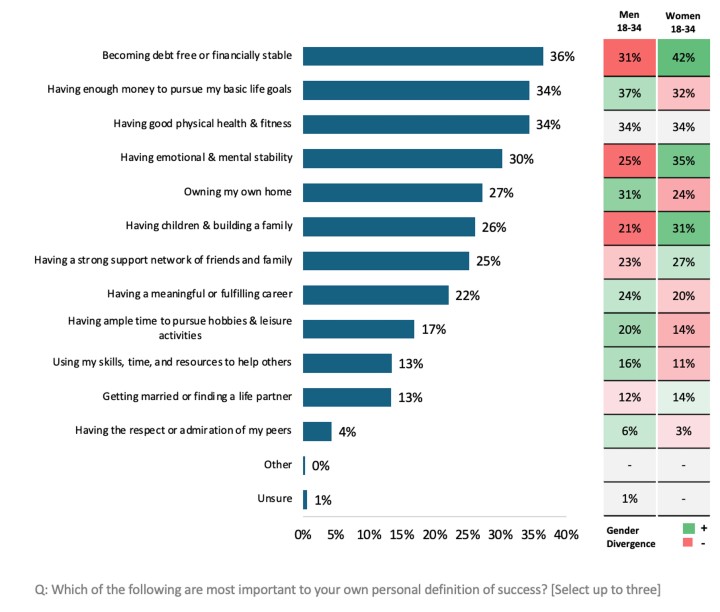
Young Australians are finding it harder to achieve key financial and social milestones than older Australians did. Research by Spectre Strategy on behalf of the Centre for Independent Studies found their greatest challenges are buying a home, becoming debt free or financially stable, and having enough money to pursue basic life goals.
While over-35s are more likely to consider emotional and mental health, achieving a meaningful or fulfilling career, and having children and building a family as achievable, to under-35s, achieving these goals seem hard.
Figure 2: Personal definitions of success – aggregate and gender divergence
Young Australians feel less able to influence the barriers they perceive to achieving their goals
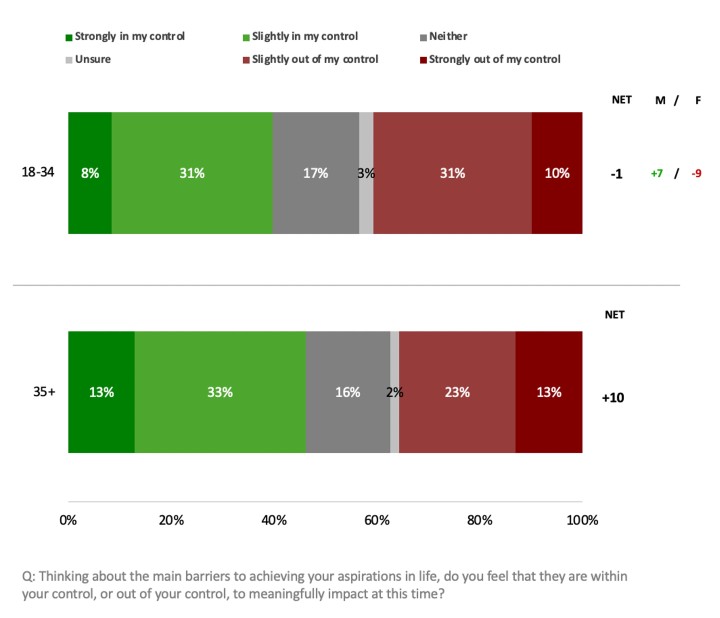
Under 35s also feel less able to influence the barriers they encounter to achieving their aspirations. Only 39% feel the barriers to achieving their aspirations are strongly or slightly within their control. By way of comparison, 46% of over-35s feel barriers are strongly or slightly within their control, with more selecting “strongly in my control” than their younger counterparts.
Figure 3: Young Australians have a lower sense of personal control than Australians 35 and over
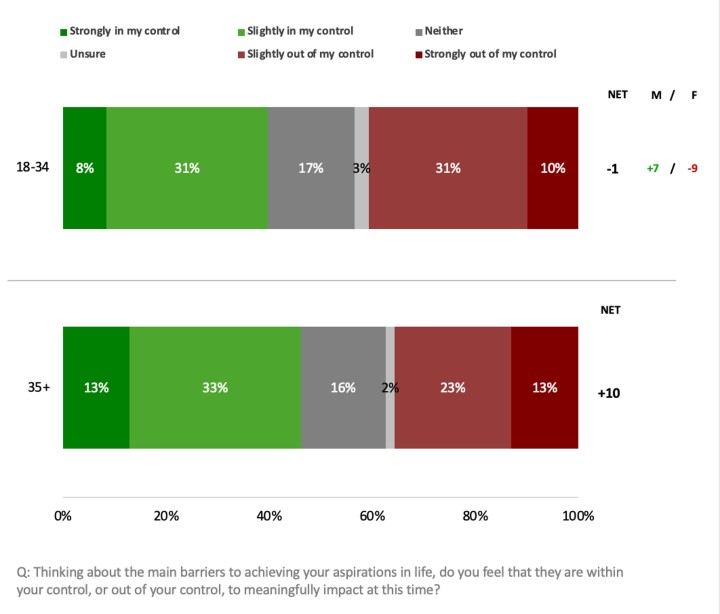
The confirms the 2023 Monash Australian Youth Barometer of just over 500 18–24-year-olds, which found that “for many young Australians, their sense of control over their own lives is slipping through their fingertips”,[5] suggesting this sense has been taking hold among young Australians over some time.
But it is an inversion of how in control older and younger people feel around the world. A study of free will and control perceptions across age groups in several different countries with a combined sample size of nearly 500,000 undertaken in 2023 finds “free will and control perceptions were higher among young adults and lower among older adults”.[6] This perceived lack of control is often observed alongside heightened anxiety.
The future is a source of anxiety for young Australians
Australians under the age of 35 feel anxious or worried about the future at much higher rates than those over 35. Nearly half worry about the future almost all the time (20%) or most of the time (28%). Only 10% of over-35s worry almost all the time and 17% some of the time.
“What isn’t there to be scared about? We have a government who cares more about themselves over what’s right and matters. The economy is horrifying, healthcare systems that do nothing but take money and send you in circles because no one listens to the problems, we’re dealing with climate change, potential wars, animals are going extinct constantly because of overpopulation and lack of resources. Also due to my health issues. I couldn’t bring a child into the world knowing there’s a high risk of them getting it as well. I couldn’t bear putting the things I’ve been through on my child.” — 19-year-old woman, Minto, NSW.
The Australian Bureau of Statistics confirms that anxiety disorders are significantly higher among young Australians. A 2020-2022 found that almost 1 in 3 people aged 16-24 have an anxiety disorder, and 25–34-year-olds are much more anxious than Australians 35 and over.[7] An analysis using HILDA data found that people born in the 1990s have poorer mental health for their age than any previous generation and do not show the improvements in mental health as they age, as experienced by earlier generations.[8]
Figure 4: Young Australians are significantly more anxious than Australians 35 and over
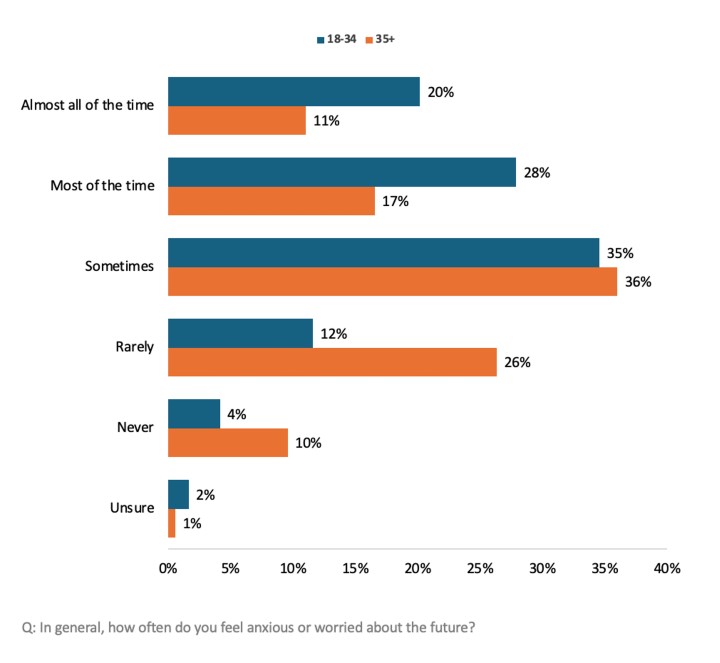
This tracks a global trend identified by economists in a 2025 paper published in PLOS ONE,[9] which found young people around the world are now experiencing the highest levels of unhappiness linked to mental ill-health, including distress, fear and anxiety of any age group. If their patterns of distress over a lifetime following the typical ‘hump’ shape which sees life dissatisfaction peak in middle age, unhappy young people will only become more unhappy as they reach their middle years, creating a life of despair.
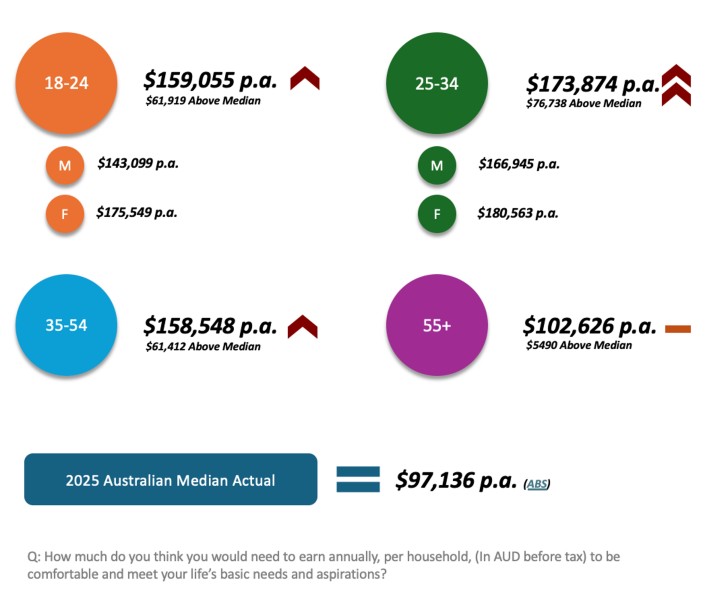
Young people think they’re going to have to earn significantly more than the median wage to enjoy a comfortable life
Asked to estimate the household income required to be comfortable and meet their basic needs and aspirations, only people 55 years and over selected a number close to the national median.
People in the establishment phase of young adulthood — 25–34 years old — selected the highest figure. The discrepancy points to a source of anxiety: the median wage is no longer seen as even close to adequate for Australians to achieve a comfortable life in which their needs and aspirations are met.
Figure 5: Most Australians estimate they will need to earn more than the median wage to meet their basic needs and aspirations
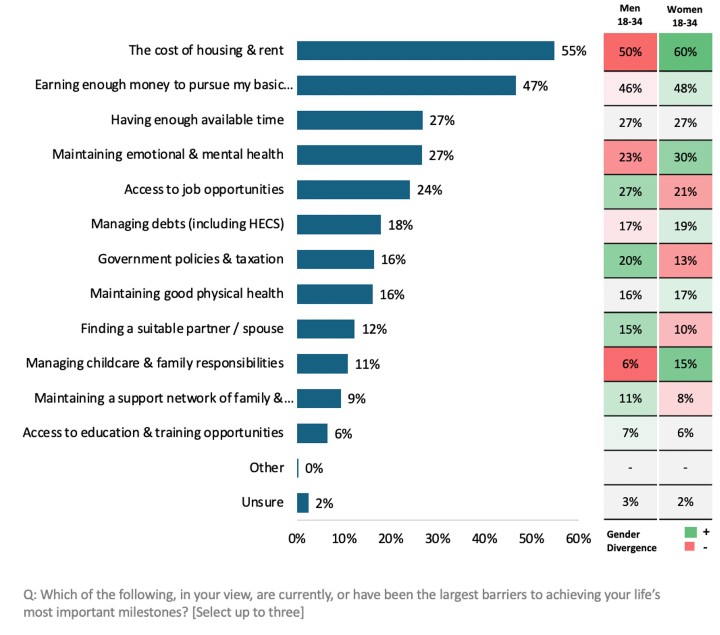
There are notable differences between the barriers perceived by young men and women
While both young men and women consider the cost of housing and rent to be the largest barrier to achieving their goals, there is a significant gap in how much of a challenge these costs are perceived to be. 60% of young women see them as a barrier to achieving their aspirations, compared with 50% of young men.
Young women also struggle more with emotional and mental health and managing childcare and family responsibilities. Young men worry more about access to job opportunities, government policies and taxation, and their ability to find a suitable partner or spouse.
Figure 6: There are significant differences in the barriers young men and women identify to achieving important milestones
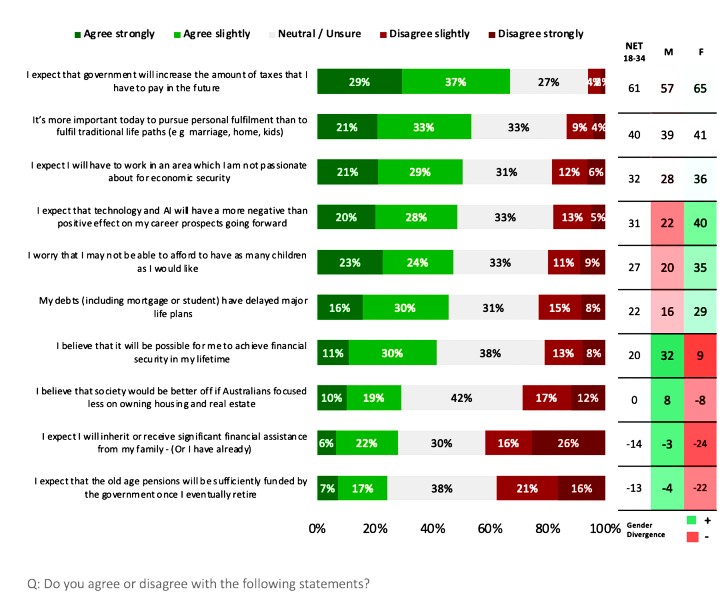
Young women are more pessimistic than young men about their future outlook
Both young men and young women expect the government will increase the amount of taxes they have to pay in the future, but women are more strongly inclined to this view.
Women are also significantly more likely to expect to have to work in an area they are not passionate about for economic security, and they worry more that technology and AI will have a negative effect on their career prospects going forward. They are far more likely than men to say that they won’t be able to have as many children as they would like and feel their debts (including mortgages and/or student loans) have delayed major life plans.
Young men are far more pessimistic about achieving financial security, receiving an inheritance or financial assistance from their families, and are far less likely to believe they will be able to rely on the age pension being sufficiently funded by the government when they eventually retire.
The large differences between men and women on which issues are most important to them warrant further elaboration, to be undertaken in a separate paper.
Figure 7: Young women and men have different expectations of what the future will hold
Young people have a reduced sense of agency
Young Australians feel less able to influence the barriers to achieving their aspirations than previous generations (see Figure 8, below), with young women feeling the least in control. Given the established connection between a sense of agency and life satisfaction, this should be considered a key indicator of worsening wellbeing; requiring the urgent attention of policymakers.
Figure 8: Young Australians feel less able to influence the barriers to achieving their aspirations than previous generations
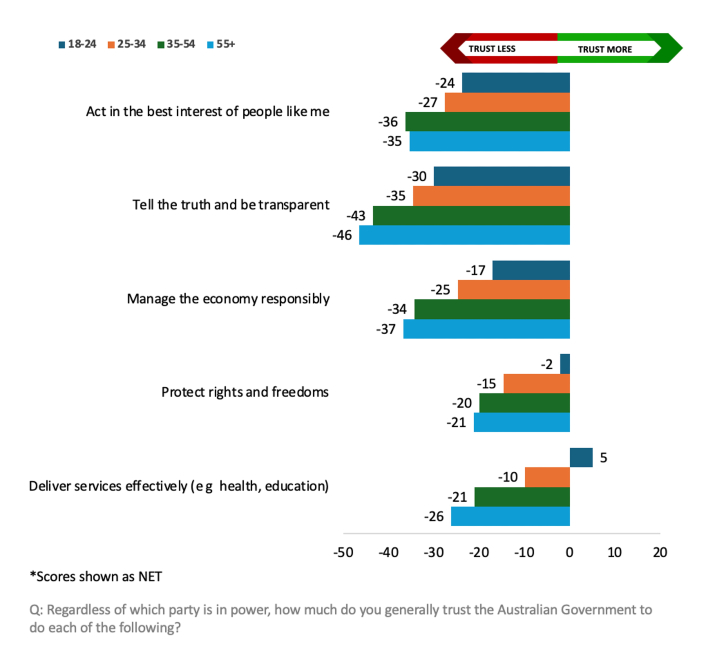
Mistrustful of government, but not of government information
Grouped together, Australians of all ages exhibit low trust in government (though as our segmentation into tribes has shown, this aggregated view fails to tell the whole story).
The youngest Australians (18–24) mistrust government the least and, unlike their older cohorts, tend to have a positive view of government ability to deliver services like health and education effectively.
They also believe the government is bound to tell the truth in official communications. In qualitative research, Australians in this age bracket explained they would check the veracity of claims made on social media by referring to government websites.
“I trust government websites, because obviously they can’t lie.” — Brisbane-based male, aged 18–22
Figure 9: Trust in government is low across all age groups, but young Australians are the least mistrustful
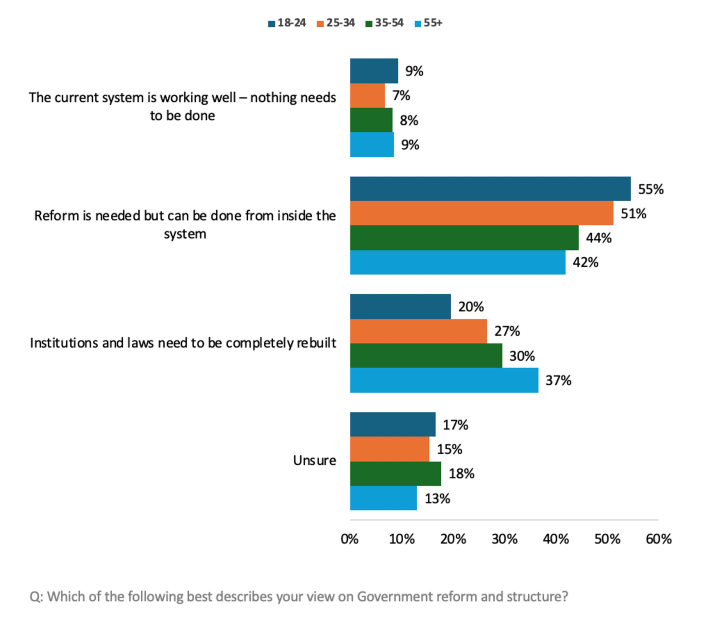
Young Australians are also less revolutionary than their older counterparts, believing in reform from within the system, while older Australians are more inclined to believe institutions and laws need to be completely rebuilt.
Figure 10: Young Australians are more likely than older Australians to believe reform is possible from within the system
Frozen policy
Given that the aspirations of young Australians do not differ markedly from previous generations, the reasons for the declining life satisfaction of young Australians must be sought in the — real or perceived — increase in the difficulty of achieving those milestones.
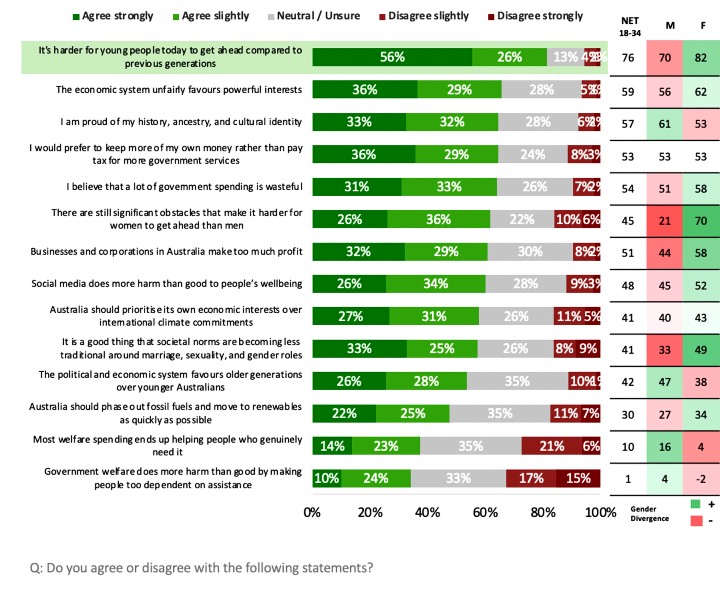
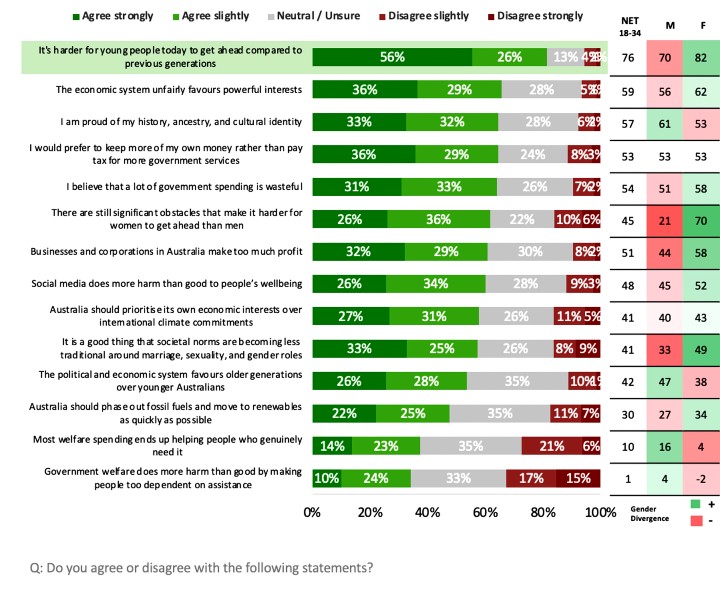
Both young men and women believe it’s harder for young people today to get ahead compared to previous generations (see Figure 11, below), but young women feel this more strongly. They perceive significant obstacles that still make it harder for women to get ahead than men, are more likely to believe that the economic system unfairly favours powerful interests and to feel that businesses and corporations in Australia make too much profit.
At the same time, young women incline more than young men to the position that a lot of government spending is wasteful and are less likely to believe that most welfare spending ends up helping people who genuinely need it. (However, there is nuance to be teased out in these views, as they are also less likely than men to agree with the proposition that welfare can do more harm than good by making people too dependent on assistance.)
Young men are more concerned that the economic system favours older generations over younger Australians. They are more confident that welfare spending ends up helping people in genuine need.
Figure 11: While young men and women differ on some assessments of society, both strongly agree it is harder for young people to get ahead compared to previous generations
A new set of aspirations?
How powerlessness skews life models
Just as their parents before them, most younger Australians do not want a radically different society, but aspire to financial security, home ownership, a relationship, and many want children as well. But the realities they face as they start their lives skew their behaviour. A sense of limitation leads to short-term hedonistic thinking in some, despair and anger in others.
The former reaction is particularly visible in one of our six tribes: Progressive Identitarians, a left to far-left identifying group that is engaged in tertiary education and likely to live at home with their parents while they study. This group has a low sense of personal agency combined with very high perceived barriers to goals like home ownership. They have turned away from traditional milestones like having children and emphasise personal identity and short-term gratification.
Their mindset is well articulated in a column written by a law student for The Sydney Morning Herald toward the end of 2025:
“The rising cost of living has warped my concept of instant versus delayed gratification. Sydney’s median house price rose by $104,130 in the year to September. Assuming the average fancy coffee/gelato/pastry costs about $10, that’s about 28 treats a day between me and keeping pace with the housing market. Forgive me for thinking I’ve got bigger barriers to home ownership than splurging on an iced yuzu long black.”[10]
Another low-agency tribe, the Natals, blames immigration for the challenges they encounter in realising their hopes. Politically engaged at similar levels to the Progressive Identitarians, this group identifies as right or even far-right, and is often referred to in public discourse as the ‘populist right’. Natals are very concerned about immigration and connect it with their inability to achieve their aspirations. This group has become extremely anti-establishment and believes laws and institutions need to be completely rebuilt.
Dislocated Post-Traditionalists have the lowest sense of personal agency of all the tribes. Their aspirations are quintessentially traditional, and many of their values align with a small-government — even classically-liberal — outlook, but they feel they have been failed by government and institutions. They identify themselves as centrist to somewhat left-leaning, but are not very engaged with public affairs and are not committed to the parties they have voted for in the past. This overwhelmingly female group tend to be in de-facto family arrangements. Dislocated Post-Traditionalists have children but worry that they won’t be able to have as many as they would like. While they support non-traditional family models, which are their lived reality, their personal stability and aspirations are most affected by the disruption of the traditional family as a default social expectation. They have no faith that they will achieve financial security. Their powerless despair has kindled into a sense that reform is not possible within the system and institutions must be completely rebuilt.
Personal agency increases life satisfaction
Young Australians with a greater sense of personal agency have higher life satisfaction, even if they still perceive considerable barriers in the way of achieving their aspirations.
There is also a small cohort of young Australians that is financially secure as a result of family wealth and/or inheritance. They are most likely to already have a family and children; underscoring that, when financial concerns are removed or reduced as a barrier to achieving aspirations, young people still tend to choose traditional life paths.
This group is the Head-Starts. They are overwhelmingly male, employed, and on higher incomes. Just over half expect to receive, or have already received, an inheritance or significant financial assistance from their families. Almost half own a home and some have no mortgage on that asset. Life is comparatively easy for them and they perceive the barriers to achieving their aspirations as surmountable and within their control to influence. They have the lowest levels of anxiety of all the tribes and a high sense of life satisfaction. They are the group most likely to identify as on the right of politics, with 7 in 10 describing themselves as centrist, right, or far-right. Unlike all other tribes, a significant number of Head-Starts believe the current system is working well and nothing needs to be done to change it. They are pro-institution and incline towards big government.
Unlike Head-Starts, Strivers don’t expect to inherit or receive significant financial assistance. They tend to feel that achieving their aspirations is strongly, or at least slightly, in their control. They have higher levels of life satisfaction than those who feel they have less ability to influence their challenges.
However it is conceivable that people in this tribe could move to one of the other tribes, if their aspirations prove harder to achieve than anticipated. If they were to lose hope and their sense of agency, they might become Progressive Identitarians, Natals or Dislocated Post-Traditionalists, depending on the life experiences the next few years bring.
Finally, the Detacheds are largely disengaged from politics and current affairs, and don’t have strong opinions on how government and institutions affect society. They don’t give the future a great deal of thought. Detacheds tend to say that the barriers to achieving their goals are in their control and their life satisfaction is marginally higher than that of tribes who feel they have less control. However there is one aspiration that consistently eludes them: they express the desire to build a family and have children but have little success in relationships. This suggests members of this tribe might lose their optimism if things don’t work out for them; and end up part of a less-contented tribe.
The role of agency in life outcomes
Breaking down young Australians into groups, or tribes, makes the relationship between financial security and agency visible.
Research on the effects of autonomy and agency on life satisfaction conducted by Leonie Steckermeier — who studied the connection between autonomy and life satisfaction in Europe — can be used to deepen our understanding of the universality of this relationship. In a study analysing the levels of autonomy experienced across Europe and matching these with citizens’ life satisfaction, Steckermeier found people with a high level of perceived autonomy experience higher levels of life satisfaction.[11] Even duties and responsibilities weigh more lightly on people who have chosen to take them on than those who have them foisted upon them.
To paraphrase Steckermeier’s research, for people with low perceived autonomy, financial security has a very large effect on life satisfaction. While for people with high perceived autonomy, financial security still matters, but much less.
Expressed another way, the least expensive way to improve life satisfaction at a population level is to give people more choice.
Home ownership — a powerful symbol of control and agency
Over the past decades, house prices have increased as a share of income, making the dream of home ownership out of reach for many Australians. Many commentaries have connected the unattainability of this milestone with lower family formation and fertility. Though there is no definitive evidence of this connection to life events that have a complex set of inputs, it is often cited by young Australians as an important contributor to decisions of this sort.
Home ownership is also sometimes considered in the context of mental health. Some studies have found that owning a home can have mental health benefits deriving from a sense of stability[12], while others point to mortgage repayments as sources of stress and anxiety.
A 2010 paper analysing longitudinal data from HILDA studies found that while there is “evidence that home ownership leads individuals in couples to have higher overall life satisfaction and satisfaction with their family relationships …the magnitude of these impacts are less than 1% of mean scores on these domains”.[13] That is, negligible.
However, the quantitative research undertaken for this paper found that almost all young Australians disagreed with the statement “I would be comfortable with renting a home for the rest of my life”. Whether or not home ownership is connected to wellbeing, it is something young people want. The sense that it is out of reach is therefore likely to lower the perception of personal agency and life satisfaction.
The exception was the Head-starts, who were, on balance, mildly agreeable to the idea of renting for the rest of their lives. This would accord with a study which found that people on lower incomes have greater wellbeing associated with home ownership than those on higher incomes.[14] For many Head-starts, the proposition is also merely theoretical, as this group is much more likely to already own a home.
Systemic constraints
In qualitative research, young Australians repeatedly said that they didn’t feel government was helping them very much or very well, but were resigned to the fact that this was the only help on offer. This is the lens through which to understand their perception of systemic constraints and the apparent contradictions which emerge in the quantitative research.
All young Australians believe it is harder to get ahead now than it was for previous generations (see Figure 11).
Most young people believe the system as a whole needs reform from the inside. However a significant number of low-agency young people believe institutions and laws need to be completely rebuilt (see Figure 10).
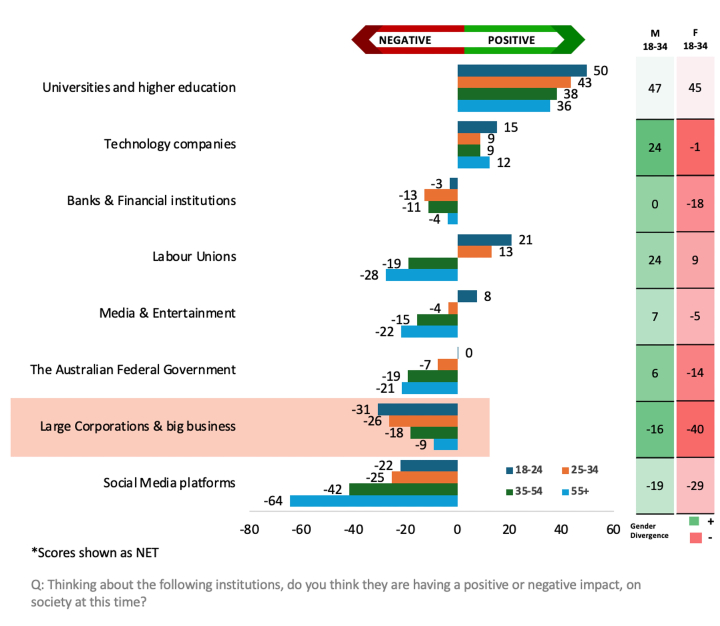
Young Australians as a whole tend to be more positive about the impact of institutions on society than their older counterparts. The exception to this is large corporations and big businesses, which they mistrust more than older Australians. Overall, young women are much more distrustful of both governments and institutions than young men. The most trusted are universities and higher education institutions.
Figure 12: Young Australians mistrust large corporations and big businesses more than older Australians
Systemic barriers and political leanings
In drilling down further into the values of young people, an apparent contradiction emerges. Despite holding what would conventionally be described as classical liberal, conservative, or small-government views, our polling corroborates other polls in finding young women describe themselves as considerably more left leaning than any other group, including men their own age.
Young women are (on average) more likely to say they believe a lot of government spending is wasteful, that Australia should prioritise its own economic interests over international climate commitments. They are more likely to doubt that most welfare spending ends up helping people who genuinely need it and that government welfare does more harm than good by making people too dependent on assistance.
Figure 13: Young people’s attitudes do not always match the values of the political alignment they identify with
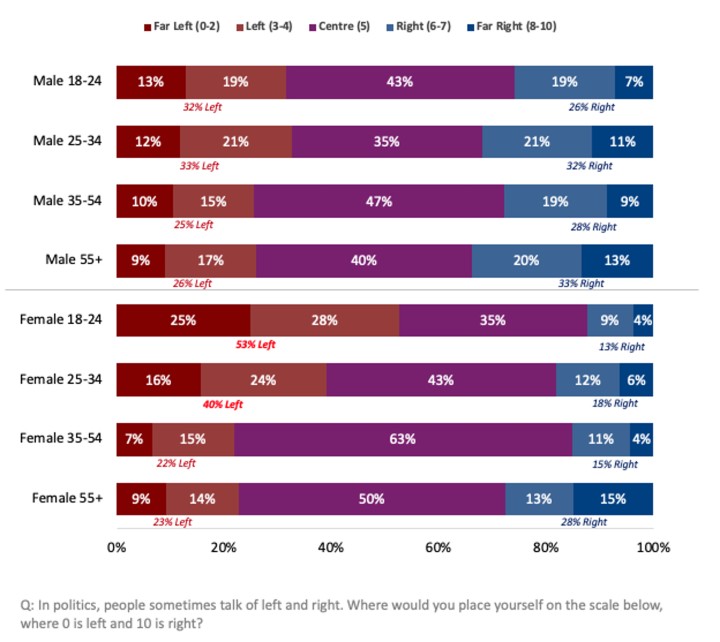
Yet a quarter (25%) of women 18–24 years old describe themselves as ‘far-left’ and 28% describe themselves as ‘left’, meaning more than half of women in this age bracket view themselves as on the left of politics, while only 13% identify as on the right.
The reasons for this might be found in women’s more progressive perceptions that there are still significant obstacles that make it harder for women to get ahead than men, that businesses and corporations make too much profit, and higher support for Australia to phase out fossil fuels and move to renewables as quickly as possible.
By drilling down further and examining attitudes at a tribe level, we can obtain further insight into this apparent contradiction. Dislocated Post-Traditionalists identify themselves as on the left or centre and more than half say they would vote for Labor or the Greens but are very soft in their voting preferences. Their attitudes suggest economic disillusionment rather than a progressive mindset (they lean towards free markets and prefer a system in which people get to keep more of what they earn, while valuing traditional markers such as children).
Strivers identify as centrist with a leftward tilt, but are also soft in their voting preferences. Like the Dislocated Post-Traditionalists, they are socially progressive in the sense they believe there are still significant obstacles that make it harder for women to get ahead, and it’s a good thing that societal norms around marriage, sexuality and gender roles are becoming less traditional. But they also believe a lot of government spending is wasteful and would prefer to keep their own money rather than pay for more government services. They are worried government welfare can do more harm than good, by making people dependent on assistance. Qualitative research suggests that the combination of a socially liberal outlook and transactional voting for temporary assistance measures may be driving the lean to the left in this group. This warrants further investigation.
By contrast, only a third (32%) of men the same age identify as ‘far-left’ (13%) or ‘left’ (19%), less dramatically different from men in older age brackets. Yet young men are more likely to lean towards ‘big government’ attitudes. This suggests young men on the right are more inclined towards a conservative nationalist statism than small government solutions.
Figure 14: Young women are further to the left compared to older generations than young men
Defining left and right
It is frequently noted that the terms ‘left’ and ‘right’ are as much a hindrance as a help in trying to understand modern political alignments.
This paper uses the terms ‘left’ and ‘right’ as currently understood in Australia, acknowledging the imprecision which this encompasses. The ‘left’ in Australia today is broadly in favour of bigger government, some public ownership of essential services, regulation of speech, and prefers corrective equity. The ‘right’ broadly favours smaller government, is market-oriented, prefers personal autonomy, and equality of opportunity.
However it should be noted that these policy- and values-focused definitions cannot fully explain the affinity of low engagement voters for one ‘side’ or another.
The six tribes — a descriptive chapter
To create a deeper understanding of young Australians that goes beyond their superficially-observable habits and voting patterns, we asked them a series of questions about their aspirations, the barriers they see to achieving these, and their values.
This process yielded six distinct groups, or ‘tribes’, with different aspirations and values, often connected to their life circumstances.
Figure 15: The six tribes
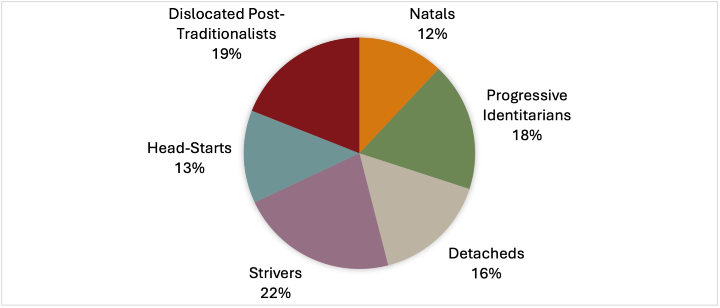
The six tribes
Progressive Identitarians
Progressive Identitarians make up 18% of the 18–34 year old cohort. They are slightly more likely to be at the older end of the age bracket. Their political identity is core to their understanding of themselves — 87% identify as left-wing, within which 52% consider themselves far-left.
This tribe is overwhelmingly urban (81%) and not religious (81%). They are relatively politically engaged, with over half (52%) following public affairs some or most of the time. Four in ten identify as LGBTQ+, a rate roughly four times higher than other cohorts. Their responses in some areas are so atypical that in an aggregated view of the age group, they skew the statistics — for instance, without the Progressive Identitarians, the average LGBTQ+ identification in this age group would be 9%. With them, it is 15%.[15]
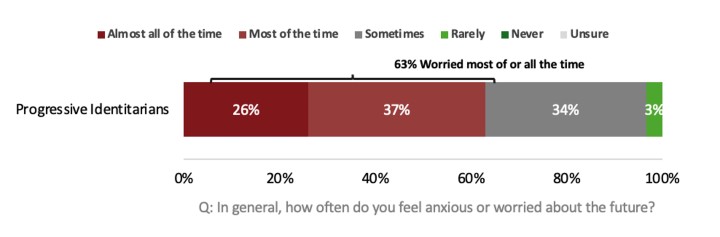
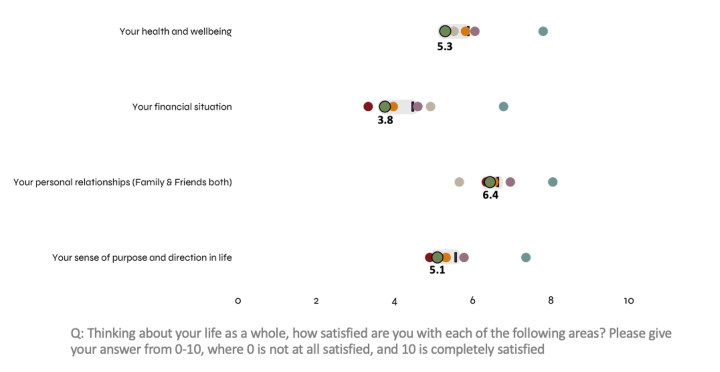
They are very worried about the future. 26% worry almost all of the time and 37% worry most of the time. They have lower than average life satisfaction.
Figure 16: Progressive identitarians are highly anxious about the future and have low levels of life satisfaction
Employment
Only 33% of Progressive Identitarians work full time, far fewer than in other tribes, and 24% work part time. They are much more likely to be students, with 27% currently undertaking tertiary education.
Milestones and lifestyle
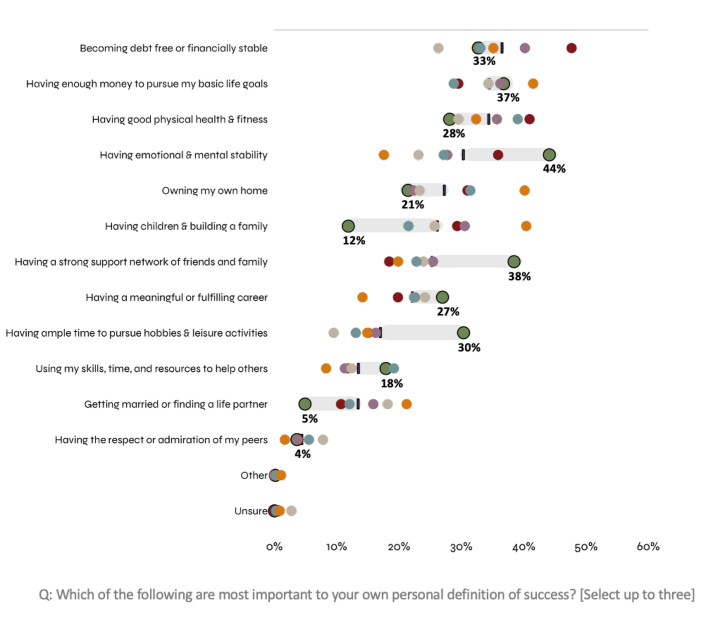
Progressive Identitarians live rent-free with parents (36%) or in rental accommodation (47%). They have given up hope of owning a home and are less likely than all other cohorts to be home owners, either with or without a mortgage. They emphasise having enough time to pursue hobbies and leisure activities over traditional milestones like financial stability, home ownership and children. 76% say it’s more important today to pursue personal fulfilment than to fulfil traditional life paths. Achieving mental and emotional stability is more important to them than to any other cohort, while physical health and fitness is less important. They value a strong network of friends and family.
Figure 17: Progressive Identitarian definitions of success
Barriers to aspiration
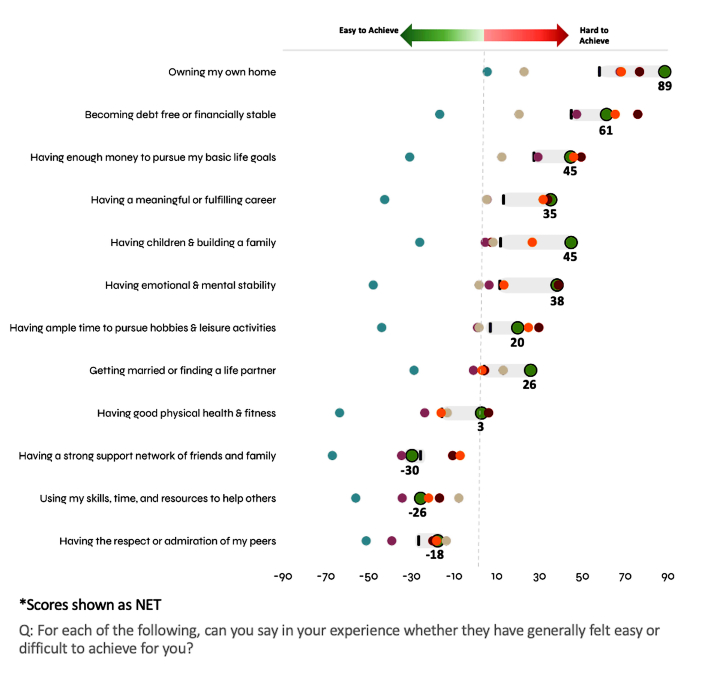
Compared to others in their age group, Progressive Identitarians feel all markers of success are hard to achieve. Home ownership is viewed as nearly impossible and they are pessimistic about having enough money to pursue their basic life goals. The majority of Progressive Identitarians believe the barriers to their aspirations are out of their control to influence.
“The cost of living has changed everything. I used to feel like I could actually save up to buy property. Now it feels pointless. I’d rather make memories and travel.” — 23 year old woman, North Parramatta, NSW
Figure 18: Progressive Identitarians perceive all markers of success as hard to achieve
The role of government
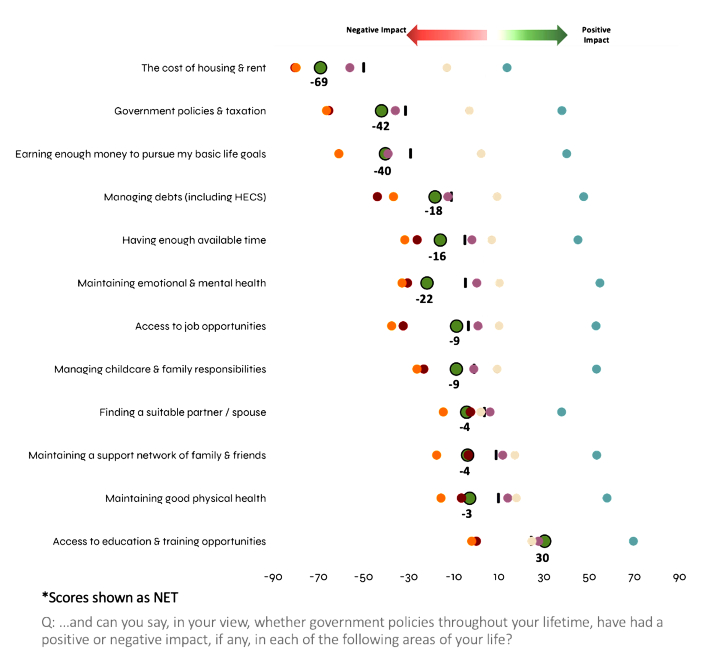
They believe government policies have had a negative impact on their life milestones, particularly on the cost of housing and rent, however they are slightly more likely than others to note government as having a positive impact on access to education and training opportunities.
Figure 19: Progressive Identitarians believe government policies have had a negative impact across most areas of their lives
Views
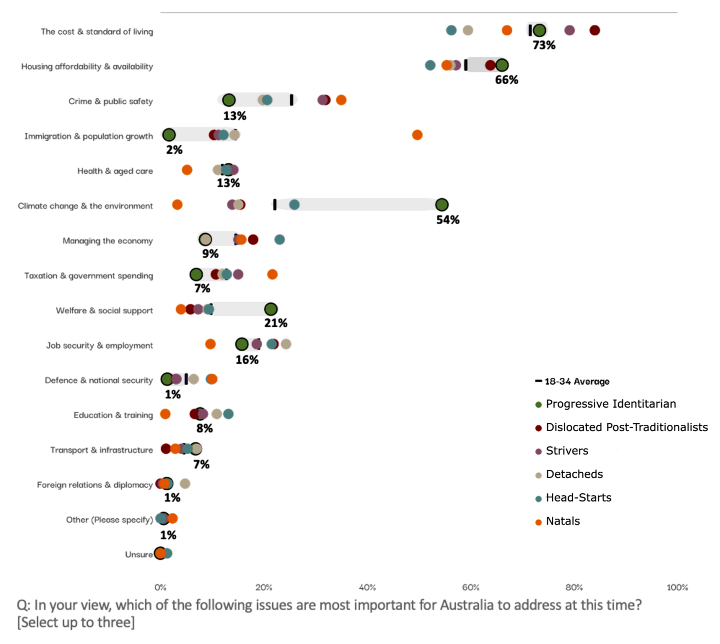
Progressive Identitarians have strong, to extreme, views on social issues, economic and intergenerational fairness, climate and the environment, while much less concerned than other cohorts about crime and immigration. Their three top issues for Australia are the cost of living (73%), housing affordability (66%), and climate change (54%). They are much more likely than other cohorts to believe welfare and social support are a national priority (21%).
Figure 20: The top three issues of Progressive Identitarians
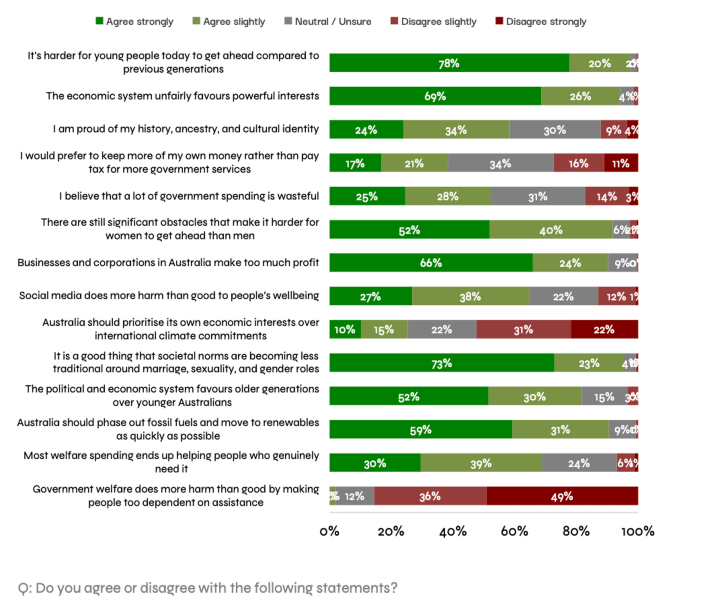
They are also more likely than others their age to believe it is harder for young people get ahead compared to previous generations, that the economic system unfairly favours powerful interests, that businesses and corporations in Australia make too much profit, and that there are still significant obstacles that make it harder for women to get ahead than men.
They are opposed to the idea that Australia should prioritise its own economic interests over its international climate commitments and strongly in favour of Australia phasing out fossil fuels and moving to renewables as quickly as possible.
They are extremely positive about social norms becoming less traditional around marriage, sexuality and gender roles. They are in favour of welfare and believe most welfare spending ends up helping those who genuinely need it. They strongly reject the idea that government welfare can do more harm than good by making people too dependent on assistance.
Figure 21: Progressive Identitarian views on social and economic issues
Trust in government and institutions
Along with most other 18–34-year-olds, Progressive Identitarians strongly disagree that the current system is working well. One in five (22%) believe institutions and laws need to be completely rebuilt, but the majority (61%) believe reform can be effected from within the system.
They have low to moderate trust in government, but feel well represented by the political parties they vote for. Progressive Identitarians vote Green (64%) or Labor (24%) and identify strongly with the party they vote for. Only 9% consider themselves centrists. They describe their support for their parties of choice as deep.
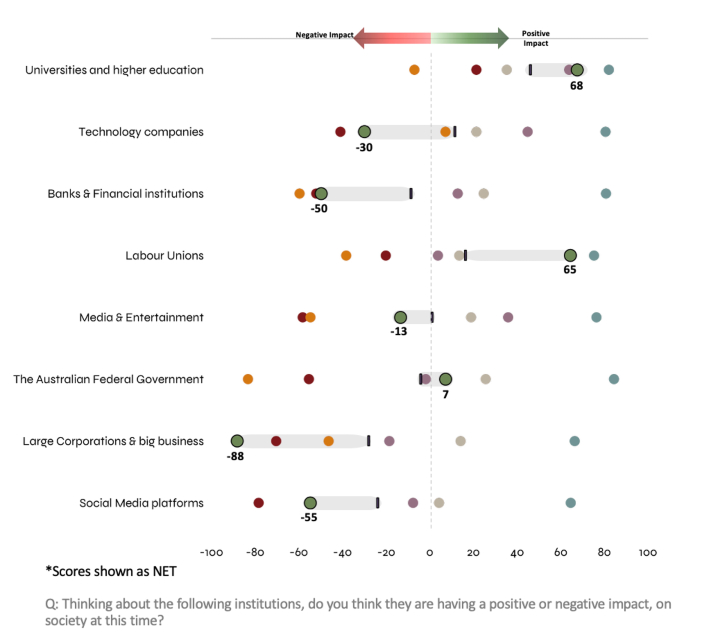
They believe that labour unions, universities and higher education institutions have a very positive impact on society, but that large corporations and big businesses have a strongly negative impact. They are also quite negative about the impact of social media platforms, banks and financial institutions, and to a lesser extent that of technology companies.
Figure 22: Progressive Identitarian views on the impact of institutions
Values
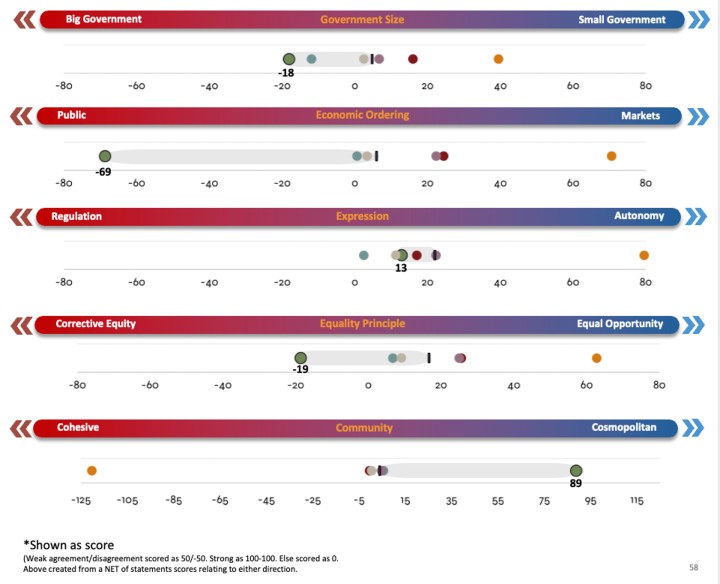
Progressive Identitarians prefer larger government and strongly favour public ownership. They believe society works better when government plays a larger role in administration and providing services. They are less likely than most other cohorts to believe that local communities, businesses and charities deliver better results than large central government programs. They strongly subscribe to the idea that today’s challenges are best solved by strong government leadership and coordination.
They disagree that businesses are better at creating prosperity than governments and think it should be a government priority to reduce inequality, even if it requires increasing taxes and redistribution.
Progressive Identitarians are more likely than all other cohorts to believe adults should be free to make lifestyle choices that may negatively impact their lives or health, but also slightly more likely than most other cohorts to say there should be limits on personal freedoms and lifestyle choices if they undermine the wellbeing of the community.
They are conflicted on corrective equity, believing the law should treat all people as individuals without favouring groups in any way, but at the same time that quotas, targets, or extra funding are justified where social gaps persist. They very strongly believe the government has a responsibility to give more help to those who start with less.
They are also convinced open borders and cultural exchange make Australia a more dynamic and creative society and that Australia is stronger because of its cultural diversity. They are least likely to say people who come to Australia should make an effort to adapt to local customs and ways of life, though notably they do still somewhat agree with that proposition. They disagree that rapid social and cultural change risks weakening the sense of community Australians share.
Figure 23: Progressive Identitarian views on the size of government
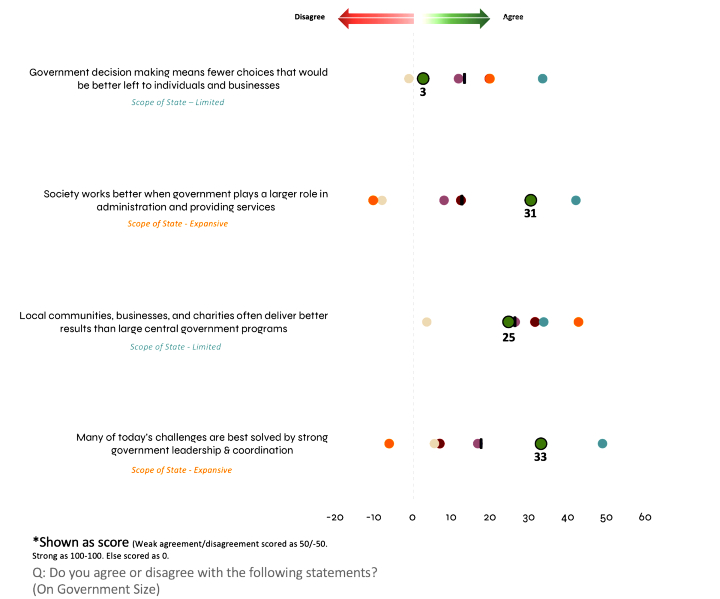
Figure 24: Progressive Identitarian views on economic structure
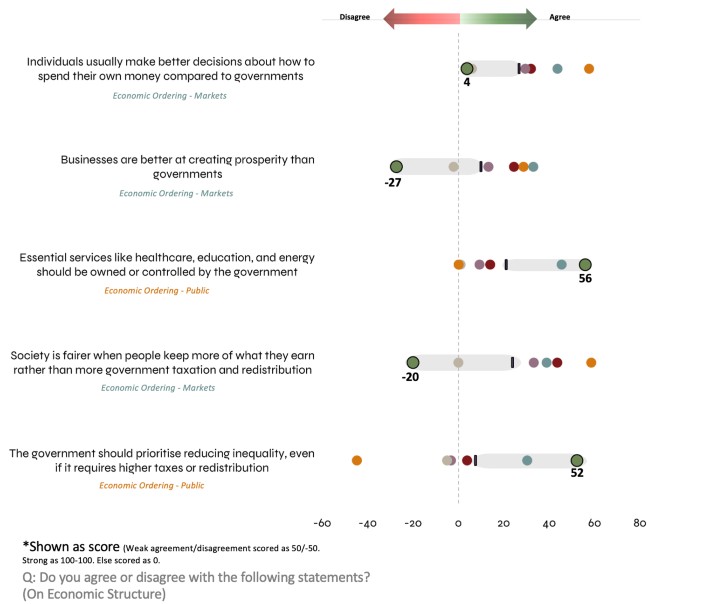
Figure 25: Progressive Identitarian views on freedom of expression
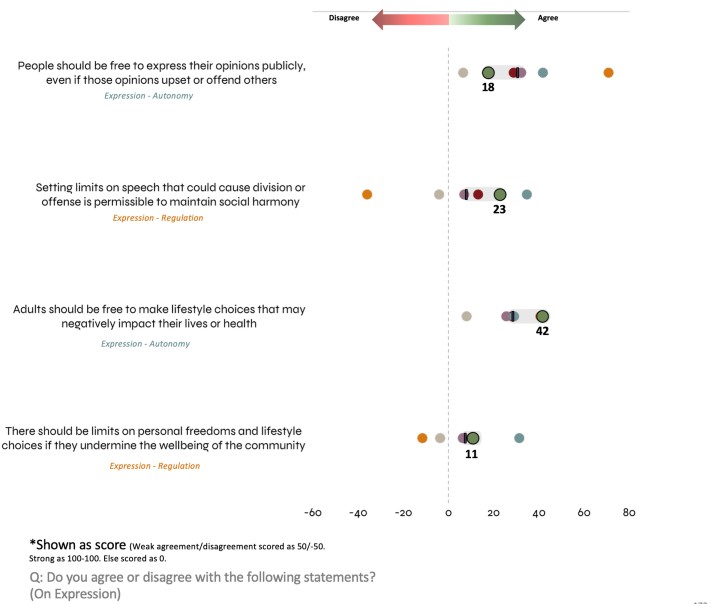
Figure 26: Progressive Identitarian views on equality
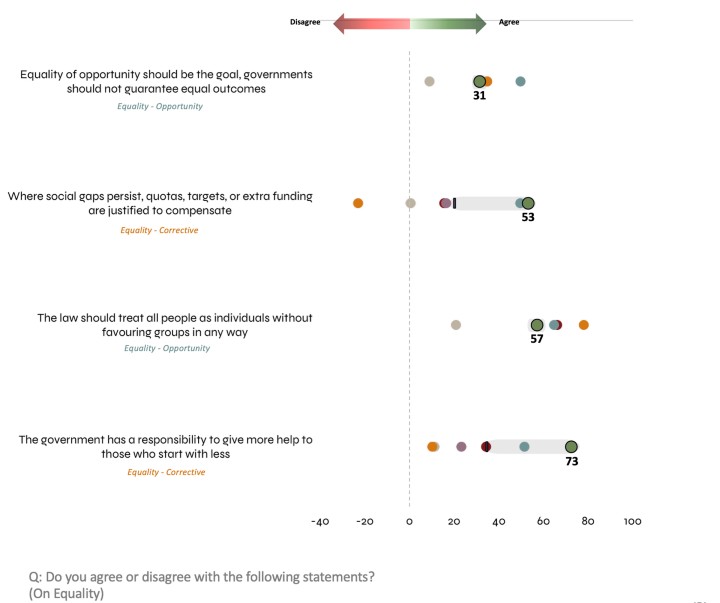
Figure 27: Progressive Identitarian views on community
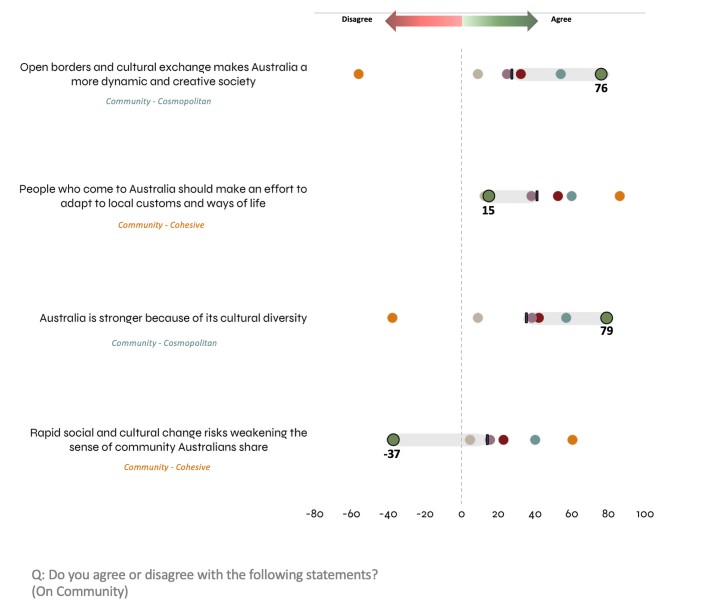
Figure 28: Overview of Progressive Identitarian values
Dislocated Post-Traditionalists
Dislocated Post-Traditionalists are the second-largest of the six tribes, at 19% of the 18–34 year old cohort. They are majority female (67% female, 33% male). 67% fall into the older end of the age spectrum, from 25–34 years old. Only one in five (20%) have a university degree and they are much less likely than other tribes to be currently studying (5% versus an age cohort average of 13%). Almost half (46%) have children, but only 21% are married, while 28% are in a de-facto relationship. 67% say they are anxious about the future all, or most, of the time. They have the lowest levels of life satisfaction across almost all metrics. Dislocated Post-Traditionalists are losing faith in the ability of the system to be reformed from the inside. A third (34%) say institutions and laws have to be completely rebuilt.
Political leanings
The majority of Dislocated Post-Traditionalists are disengaged with politics. 31% say they follow public affairs only occasionally, while 28% say rarely and 10% never. Only a quarter follow what the government of the day is doing, with 24% saying they follow what’s going on “some of the time”.
They identify as being in the political centre (54%) or on the left (24% left and 9% far-left). Only 1 in 10 identify as being on the right. They lean towards independent and minor parties: 31% vote Green, 8% One Nation and 10% for another independent party. When they vote for a major party, they prefer Labor, with 23% voting for the ALP and only 13% for the Liberal National Coalition at the last election.
They don’t feel well-represented politically. 30% say none of the candidates represents their views well, far more than any other tribe. Their vote is very soft, with 62% saying they’re not committed to their choice.
Employment
Dislocated Post-Traditionalists are slightly more likely to be unable to work (9%) than their wider age cohort (4%) and are more unemployed (16%) than others (average 13%). They have a very pessimistic view of the trajectory of the Australian economy, with 69% saying they expect it to worsen a little or a lot over the next 12 months. They are also the least hopeful about the prospects for their personal finances — only 31% believe their situation will improve a little or a lot, while 37% believe it will worsen.
Milestones and lifestyle
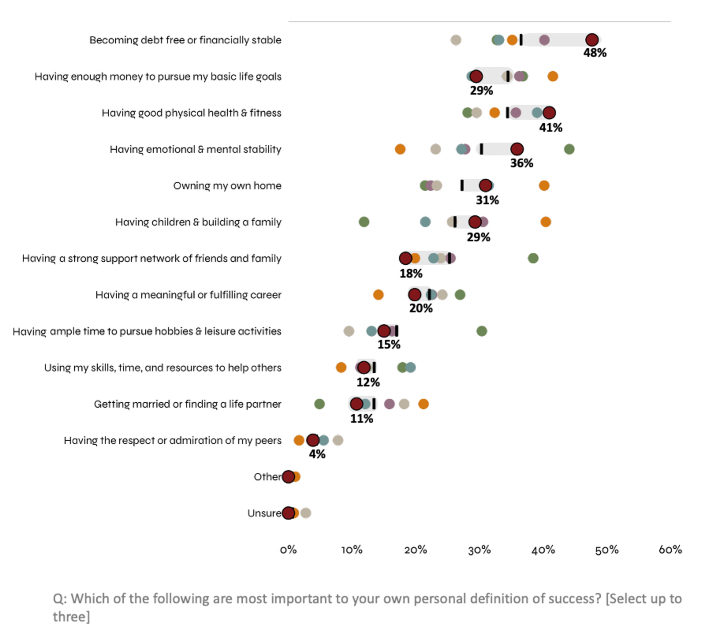
Dislocated Post-Traditionalists primary definition of success is becoming debt free or financially stable (48%) — something they value far more than any other tribe. Other top aspirations of this group are having good physical health and fitness (41%), as well as emotional and mental stability (36%).
Owning a home (31%) and having children and building a family (29%) are the next most important markers of success.
They are less preoccupied with present gratification and self-actualisation than others their age, with fewer emphasising time for leisure activities (15%) or having a meaningful or fulfilling career (20%).
Figure 29: Dislocated Post-Traditionalist definitions of success
Barriers to aspiration
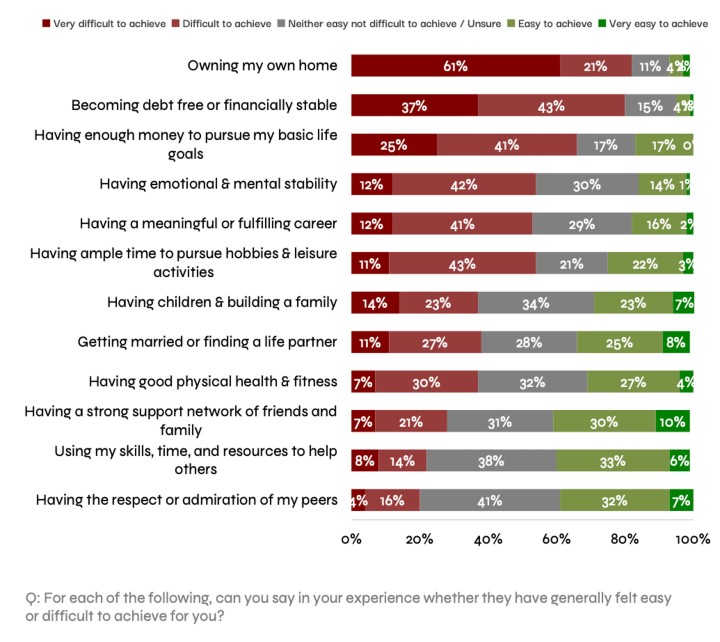
Dislocated Post-Traditionalists are notable among the tribes for the extremely high difficulty they attribute to achieving their top markers of success. 82% believe home ownership is difficult or very difficult to achieve, followed by becoming debt free and financially stable on 77%. 66% say it will be hard to have enough money to pursue their basic life goals. Notably, while Dislocated Post-Traditionalists highly value emotional and mental stability, over half (54%) consider it quite difficult to achieve.
Figure 30: Dislocated Post-Traditionalists perceive their top markers of success as extremely hard to achieve
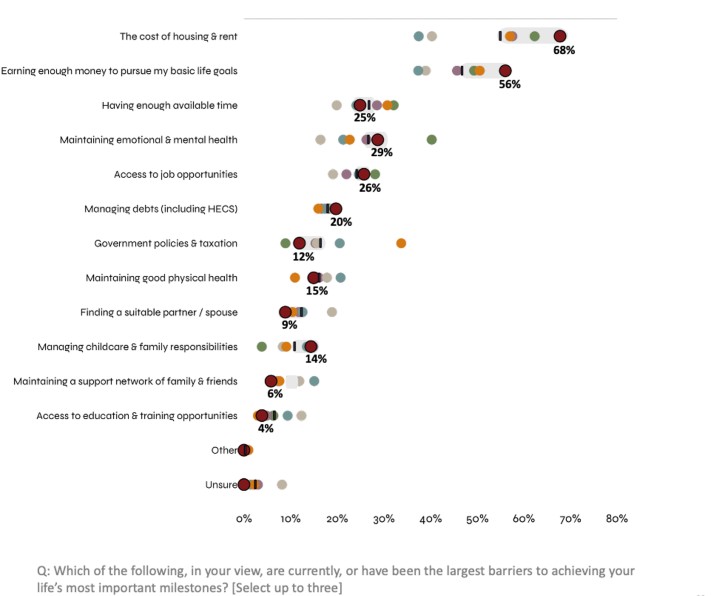
The top barriers they see to realising their aspirations are the cost of housing and rent (68%), and having enough money to pursue their basic life goals (56%). Dislocated Post-Traditionalists were more likely to single out these barriers than any other tribe, indicating the very high impact they believe these factors have in holding them back from their goals. Mental health (29%) again features as a barrier to achieving milestones for this tribe, as does access to job opportunities (26%).
Figure 31: The top three issues of Dislocated Post-Traditionalists
The role of government
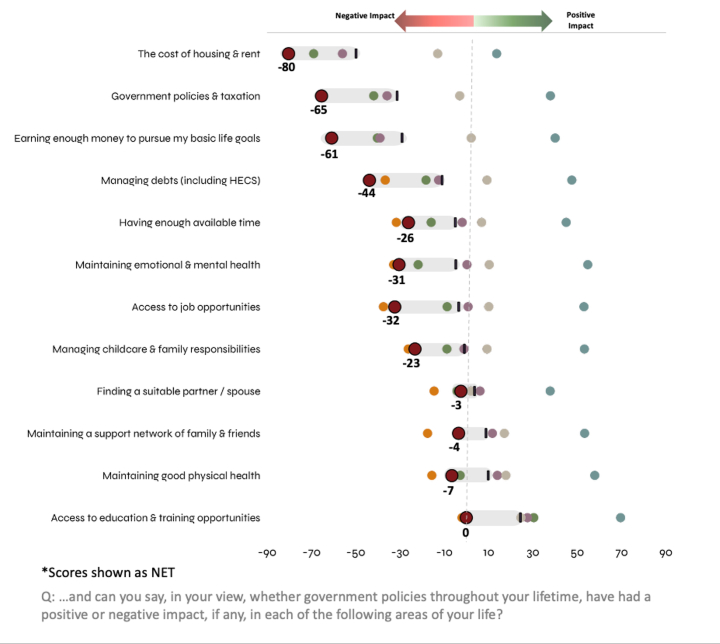
Dislocated Post-Traditionalists are angry with the government. They believe government policies have had a negative impact across almost all areas of their lives, in particular the areas related to the things they value most. They are particularly scathing — more so than any other tribe — of the effect of government policy on the cost of housing and rent, government policies and taxation, their ability to earn enough money to pursue their basic life goals, and managing debts.
They are also much more negative than average for their age cohort about the effect of government policy on their available time, emotional and mental health, access to job opportunities, and managing childcare and family responsibilities.
They even mark government harder than their peers where it comes to its impact on their ability to maintain a support network of family and friends and sustain good physical health.
Figure 32: Dislocated Post-Traditionalists believe government policies have had a very negative impact across most areas of their lives
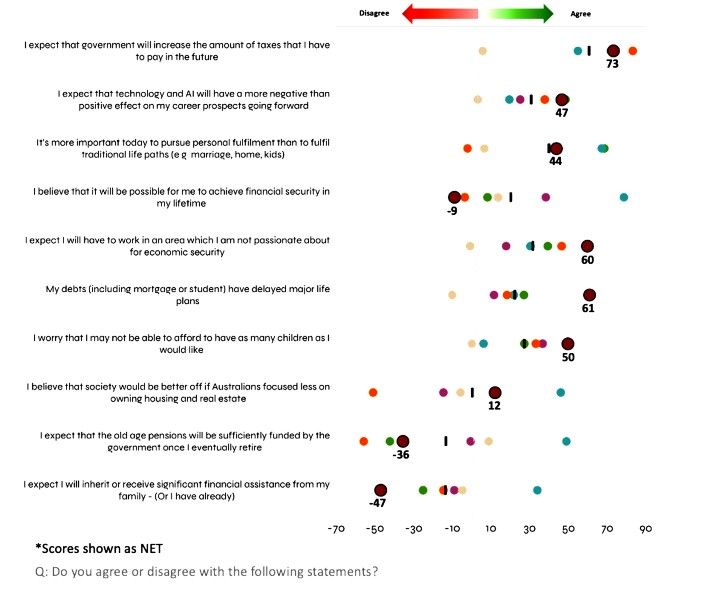
Compared with others their age, Dislocated Post-Traditionalists have much lower expectations that they will receive an inheritance or other form of financial assistance from their family, and they are more likely to believe they will never achieve financial security in their lifetimes. They say their debts have delayed major life plans.
They also have more generally-negative expectations of what their future holds. They believe the government will increase the amount of taxes they have to pay in future, that they will have to work in an area which they are not passionate about for economic security, and they are worried they may not be able to afford to have as many children as they would like. They doubt the old age pension will be sufficiently funded by the government to support them when they retire.
Figure 33: Dislocated Post-Traditionalists have very negative expectations of the future
Views
In line with their own disappointed aspirations, Dislocated Post-Traditionalists are extremely worried about the cost and standard of living. 84% nominate this as the top issue facing Australia at this time — more than any other tribe and well above the average for their age cohort (for whom, however, it is also the primary concern). Their next most-pressing concerns are housing affordability and availability (64%), and crime and public safety (32%).
Despite more than a third of Dislocated Post-Traditionalists identifying as on the political left and 31% voting Green at the last election, they believe climate change and the environment is less a priority for Australia than others their age (15% — behind cost of living, housing affordability, crime and public safety, job security and employment, and managing the economy).
Figure 34: The top three issues of Dislocated Post-Traditionalists
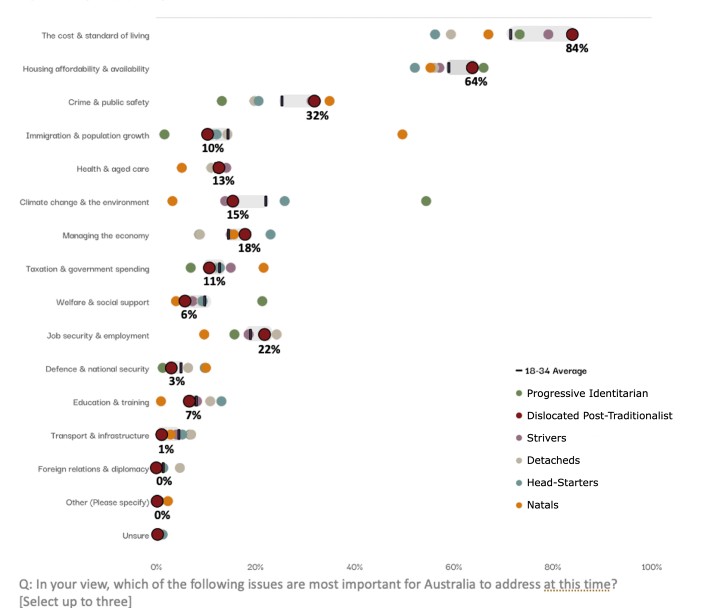
Dislocated Post-Traditionalists share the view of their age group that it is harder for young people to get ahead today, compared with previous generations (94%) and believe the economic system unfairly benefits powerful interests (71%). They are almost as persuaded as the Progressive Identitarians that businesses and corporations in Australia make too much profit (82%), suggesting Dislocated Post-Traditionalists lean left on economic grounds.
They are convinced a lot of government spending is wasteful (84%) and would prefer to keep more of their own money rather than pay tax for more government services (79%). 39% disagree that most welfare spending ends up helping people who genuinely need it, while only 23% agree. 44% worry that welfare does more harm than good by making people too dependent on assistance.
Figure 35: Dislocated Post-Traditionalist views on social and economic issues
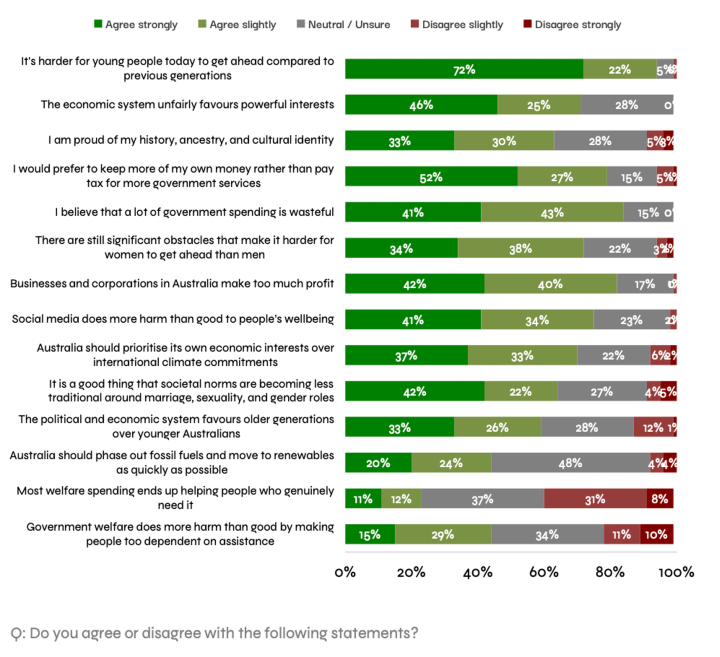
They believe women are disadvantaged socially, and there are significant obstacles that make it harder for women to get ahead than men. They agree it is a good thing that societal norms are becoming less traditional around marriage, sexuality and gender roles.
They are aligned with others their age in believing Australia should phase out fossil fuels and move to renewables as quickly as possible but are more likely to want the country to prioritise its own economic interests over international climate commitments.
Figure 36: How Dislocated Post-Traditionalists compare with other tribes on social and economic issues
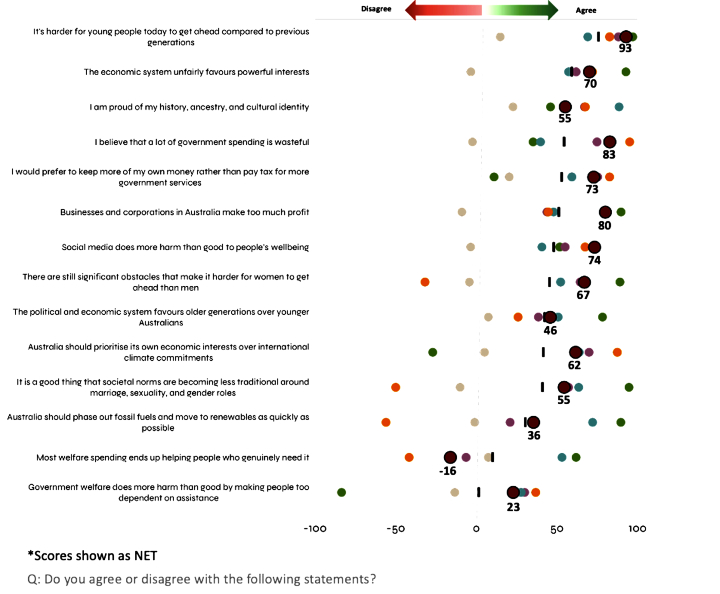
Trust in government and institutions
Dislocated Post-Traditionalists’ trust in governments of any stripe is lower than any other tribe except for the Natals. They doubt the government will tell the truth and be transparent, or act in the best interests of people like them. They also don’t believe the government will manage the economy responsibly, protect rights and freedoms, or deliver services like health and education effectively. Only 1% say the current system is working well and nothing needs to change.
Figure 37: Dislocated Post-Traditionalists have very low trust in government
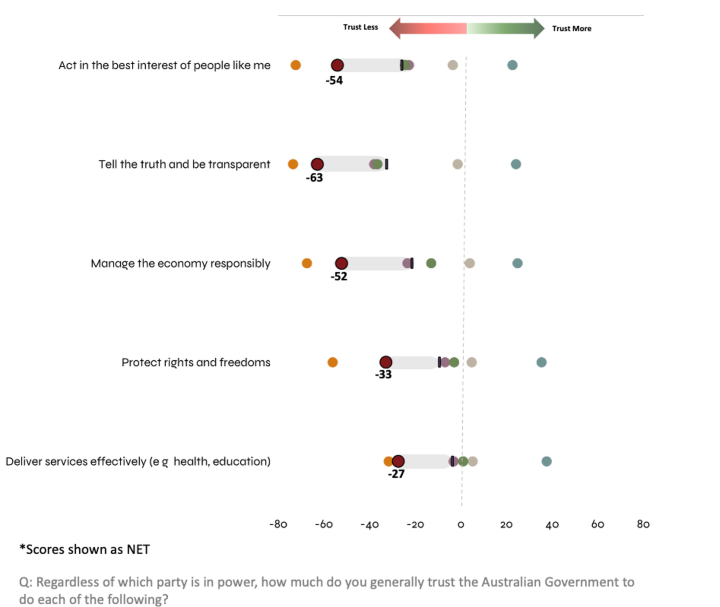
Dislocated Post-Traditionalists believe most institutions — including technology companies, banks and financial institutions, media and entertainment, social media platforms, large corporations and big businesses, and the federal government — have a very negative impact on society. They are slightly less negative about unions, but still think on balance their impact is not positive. The only institutions they believe have a positive effect are universities and higher education — though they think worse of them than all other tribes except for the Natals.
Figure 38: Dislocated Post-Traditionalist views on the impact of institutions
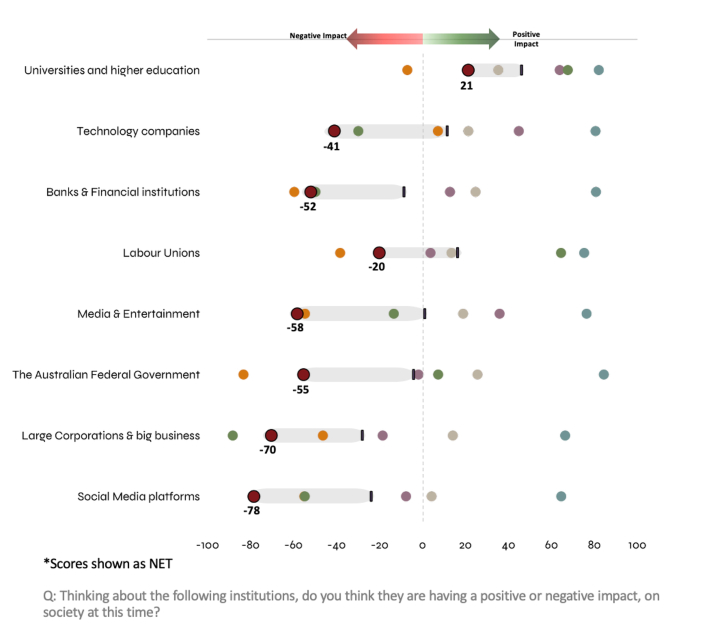
Values
Despite saying they lean left, a high-level view of the Dislocated Post-Traditionalists shows they tend to prefer free markets over public ownership, and equal opportunity over corrective equity. They are on the fence about an open society, along with many of their peers.
They believe government decision-making means fewer choices that would be better left to individuals and businesses, and disagree more than most others that most of today’s challenges are best solved by strong government leadership and coordination.
They most strongly agree that society is fairer when people keep more of what they earn rather than more government taxation and redistribution.
Figure 39: Dislocated Post-Traditionalist views on the size of government
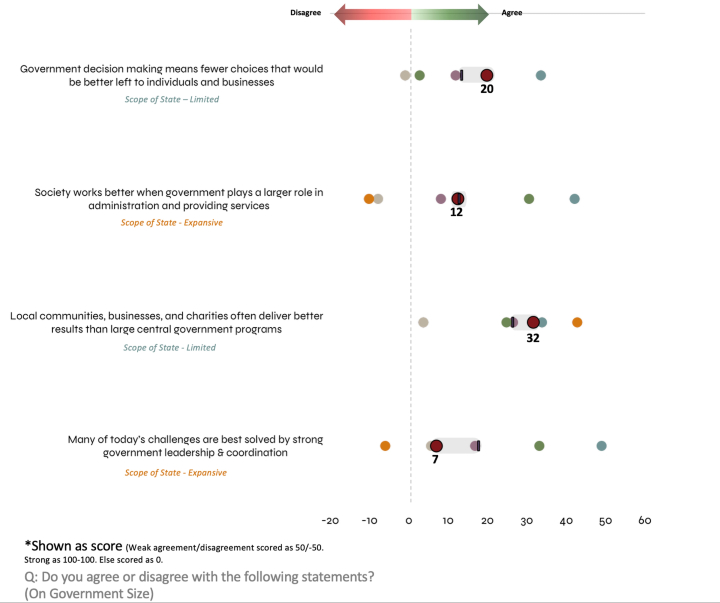
Figure 40: Dislocated Post-Traditionalist views on freedom of expression
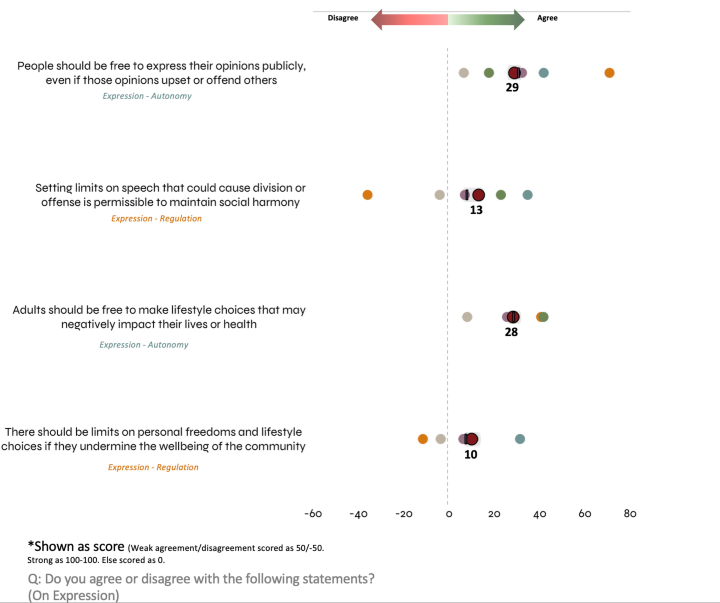
Figure 41: Dislocated Post-Traditionalist views on equality
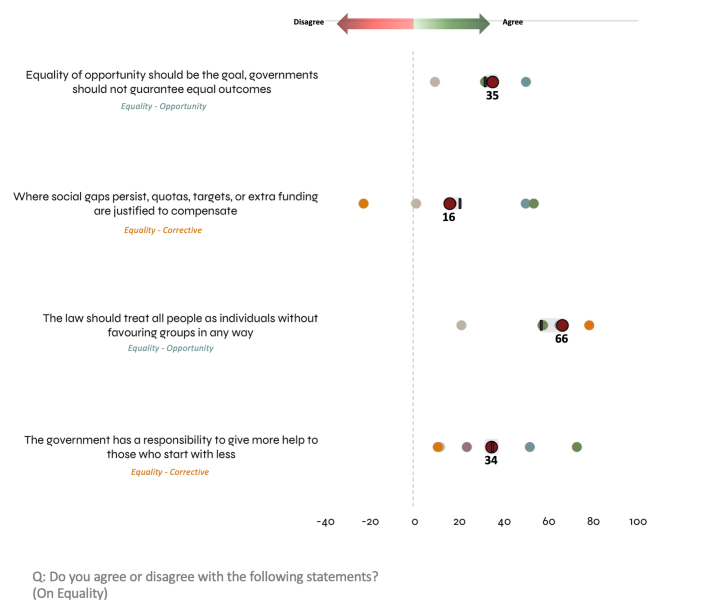
Figure 42: Dislocated Post-Traditionalist views on community
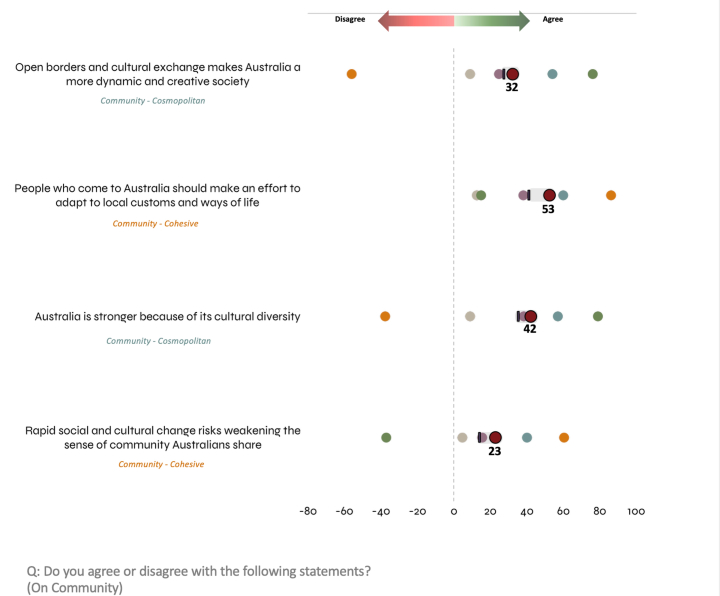
Figure 43: Overview of Dislocated Post-Traditionalist values
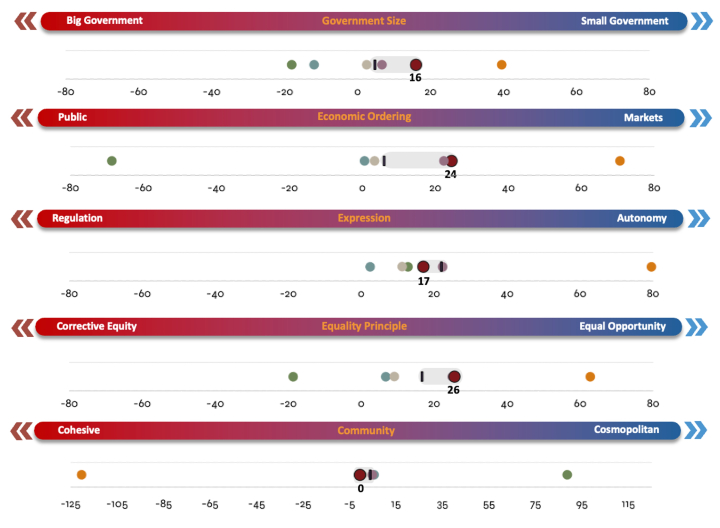
Natals
The Natals are the smallest of the six tribes, at only 12% of 18–34-year-olds. Along with other tribes, the top concerns of Natals are the cost and standard of living (67%) and housing affordability and availability (55%). But this group is also much more concerned about immigration and population growth (50%) and crime and public safety (35%).
They tend to be at the older end of the age bracket, with 68% falling in the 25–34 year old bracket and more are male (61%) than female (39%). 79% have no university degree. The overwhelming majority of 98% were born in Australia. They are the least likely cohort to identify as LGBTQ+, with only 4% putting themselves in that category, less than a third of the overall 18–35 year old average of 15%.
Natals value traditional life pathways, aspiring to make money, build a family, have kids, and own a home. They have very low levels of trust in government and don’t feel represented in the current system.
They feel the barriers to achieving their aspirations are strongly (14%) or somewhat (33%) out of their control. They have low life satisfaction. They tend revolutionary in outlook, with nearly half (46%) believing institutions and laws need to be completely rebuilt.
Political leanings
Natals are more likely to place themselves to the far-right (21%) or right (37%) of the left-right political scale, but 35% identify as centrist and 7% as far-left or left-wing. They are relatively engaged with public affairs, with 45% following politics most or some of the time. 45% voted for One Nation and 23% for the Liberal National Coalition at the last election. 42% say they are ‘soft’ in their voting tendencies. 30% feel no candidate represents their views well; considerably above the mean for their age cohort.
Employment
Natals are the most likely of the six tribes to be unemployed (19%). They are far more negative about the economic situation than other tribes, with 78% believing it will worsen over the next 12 months, 38% of whom expect it to worsen a lot. They are less negative about their personal outlook, with 38% believing their situation would improve in that timeframe. (NB: This should be understood in the context of research which has found that young men in general tend to have an optimism bias about their future prospects.[16])
Milestones and lifestyle
Natals value traditional markers of success. 42% want to have enough money to pursue their basic life goals, 40% want to own their own home, 40% to have children and build a family. They are less satisfied with their financial situation than the mean for their age group.
They are much less likely to value emotional and mental stability (18%), having a meaningful or fulfilling career (14%), time to pursue hobbies and leisure activities (15%) and using their skills, time and resources to help others (8%). Just under half (46%) worry about the future most or all of the time.
Of all the cohorts, they are the least likely to value the respect and admiration of their peers (2%).
Figure 44: Natal definitions of success
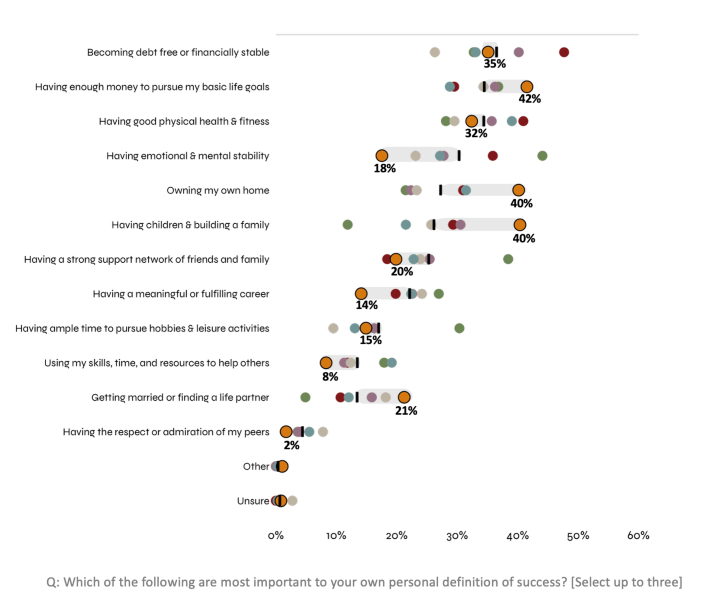
Barriers to aspiration
While it is their primary aspiration, 80% of Natals expect owning a home to be difficult or very difficult to achieve. They also believe becoming debt free or financially stable will be a significant challenge (73%). Along with most other 18–34-year-olds, they see having enough money to pursue their basic life goals (60%), and having a meaningful or fulfilling career (48%) as hard to achieve. While having children and building a family is an important aspiration for this group, they are more likely to believe it will be difficult to achieve (49%) than any other tribe, with the exception of the Progressive Identitarians, who have decided to focus their energies elsewhere.
In sum, this means that Natals see all of their most important goals as prohibitively hard to achieve.
Figure 45: Natals believe their most important goals are all hard to achieve
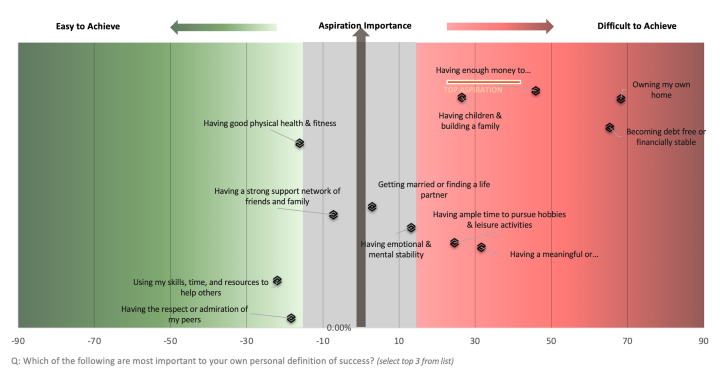
Natals say the cost of housing and rent (57%) and earning enough money to pursue basic life goals (51%) are among the greatest barriers to achieving their aspirations. Government policies and taxation are singled out by this group, with 34% identifying them as a major barrier to achieving their aspirations — the highest of any tribe.
The role of government
Natals see government as having an overwhelmingly negative impact across all measured areas of their lives. In particular, they believe government policy has negatively impacted on their priority areas, including the cost of housing and rent (84%), government policy and taxation (73%), and having enough money to pursue their basic life goals (68%).
Views
Natals strongly expect government to increase the amount of tax they will have to pay in future (86%) and are very sceptical that the old age pension will be sufficiently funded by the government once they retire (67%). Despite believing home ownership is difficult to achieve, they very strongly reject the idea that society would be better off if Australia focused less on owning housing and real estate.
They are more likely than any other group in the 18–34 year old cohort to reject the idea that short term personal fulfilment is more important than following a traditional life path (36%). They are also strongly opposed to the idea that it is a good thing that societal norms are becoming less traditional around marriage, sexuality and gender roles.
Figure 46: Natal expectations for the future
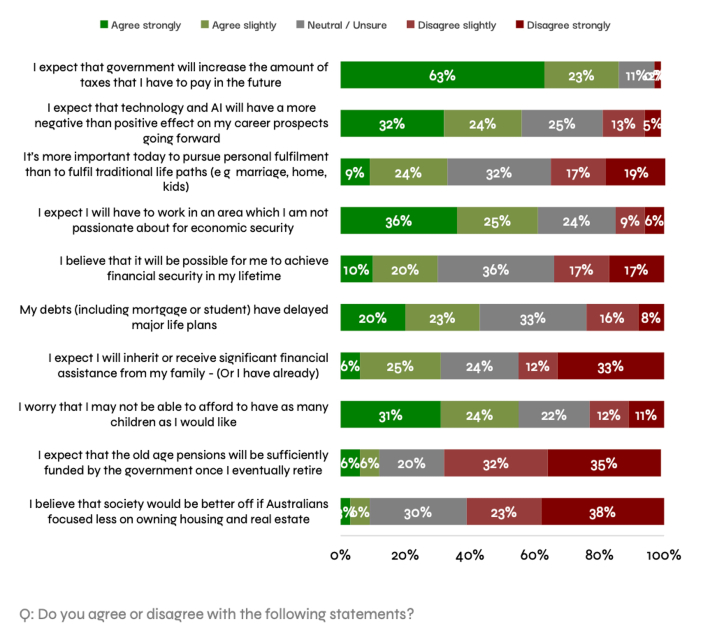
Natals strongly agree that a lot of government spending is wasteful (96%) and would prefer to keep more of their own money rather than pay tax for more government services (86%). They are sceptical that the most welfare spending ends up helping people who genuinely need it (61%). They are the most worried of all the tribes that government welfare does more harm than good by making people too dependent on assistance (59%).
They very strongly believe Australia should prioritise its own economic interests over international climate commitments (91%) and disagree with the proposition that Australia should phase out fossil fuels and move to renewables as quickly as possible (64%).
Figure 47: Natal views on social and economic issues
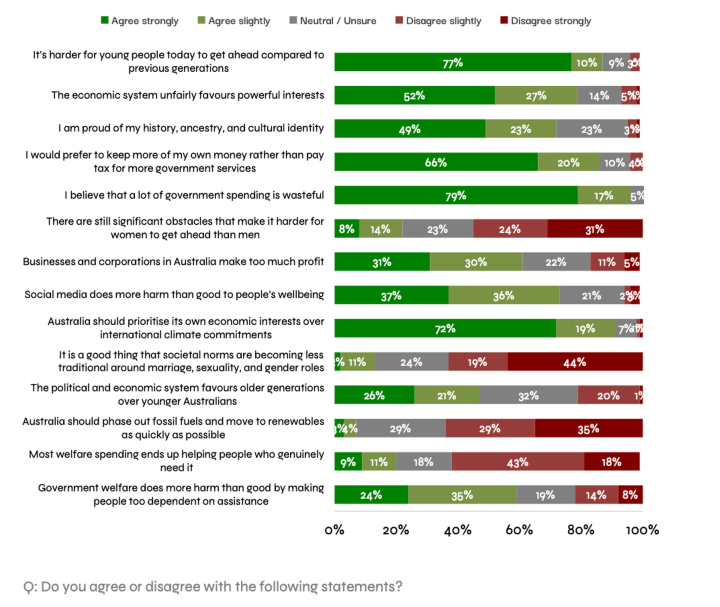
Trust in government and institutions
Natals have extremely low trust in government to act in the best interests of people like them or to tell the truth and be transparent. They also have little faith in the government to responsibly manage the economy or to protect their rights and freedoms. They have more trust in government to deliver services like health and education effectively, but still less than all other tribes and firmly in negative territory.
Figure 48: Natals have the lowest trust in government of any tribe
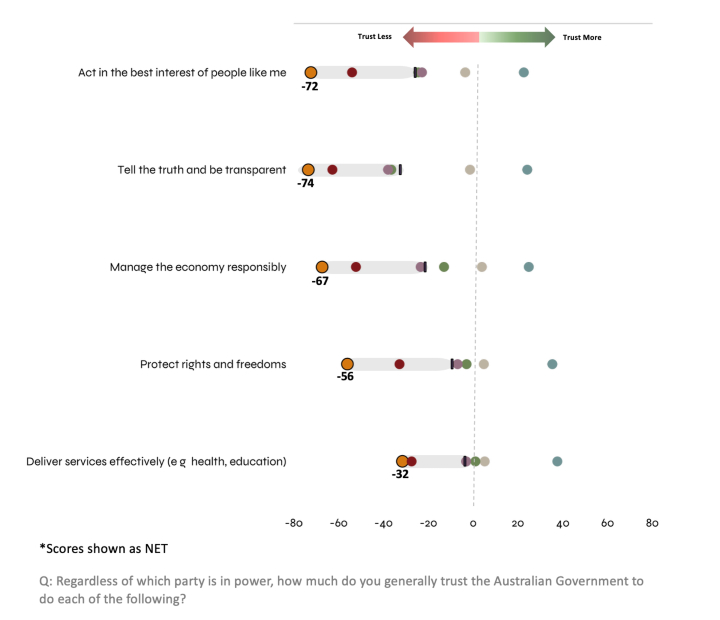
They have much less faith than other 18–34-year-olds that reform can be done from within the system (35%). More than any other group, they want institutions and laws completely rebuilt (46%).
Natals are largely negative on all institutions, overwhelmingly believing that the federal government has a negative impact on society, along with banks and financial institutions, media and entertainment, and social media. They also think labour unions have a negative impact and are mildly sceptical toward universities and higher education. However, they are slightly inclined to believe technology companies have a positive impact on society.
Figure 49: Natal views on the impact of institutions
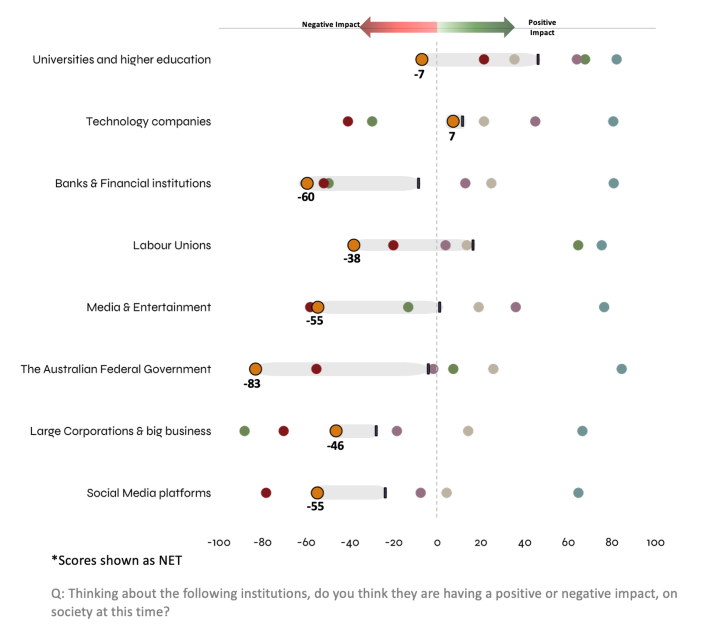
Values
Natals are the most disposed of all cohorts to small government; believing in personal autonomy, markets and equal opportunity. They feel government decision-making means fewer choices that would be better left to individuals and businesses. They reject the idea that society works better when government plays a larger role in administration and providing services. They are opposed to solving challenges through government coordination and very much favour services delivered through local communities, businesses and charities, which they believe often deliver better results than large central government programs.
They very strongly believe society is fairer when people keep more of what they earn rather than when that money is redistributed by the government via tax, because they’re adamant that individuals usually make better decisions about how to spend their own money than governments. Consequently, they strongly disagree that government should reduce inequality via redistribution. They are also less likely than all other groups to believe government should control essential services like healthcare, education and energy.
They are extremely freedom-oriented, believing people should be free to express their opinions publicly, even if those opinions upset or offend others. This makes them outliers in their age group, as they strongly oppose setting limits on speech that could cause division or offence in order to maintain social harmony.
Their libertarian-style ideals also extend into the realm of personal choice. They believe adults should be free to make lifestyle choices that may negatively impact their lives or health and are more likely to oppose limits on personal freedoms and lifestyle choices, even if they undermine the wellbeing of the community.
Unlike their wider age cohort, Natals do not support quotas, targets or extra funding to address persistent social inequality. They are also less likely than others their age to believe government has a responsibility to give more to help those who start with less — though it should be noted they are still mildly positively-inclined towards agreeing with some assistance.
They are most extremely at odds with others their age on the matter of immigration. While the rest of their age cohort is, to varying degrees, supportive of the idea that open borders and cultural exchange make Australia a more dynamic and creative society, and that Australia is stronger because of its cultural diversity, Natals strongly disagree.
While others their age tend to agree people who come to Australia should make an effort to adapt to local customs and ways of life, and that rapid social and cultural change risks weakening the sense of community Australians share, Natals are by far the strongest in holding these attitudes.
Figure 50: Natal views on the size of government
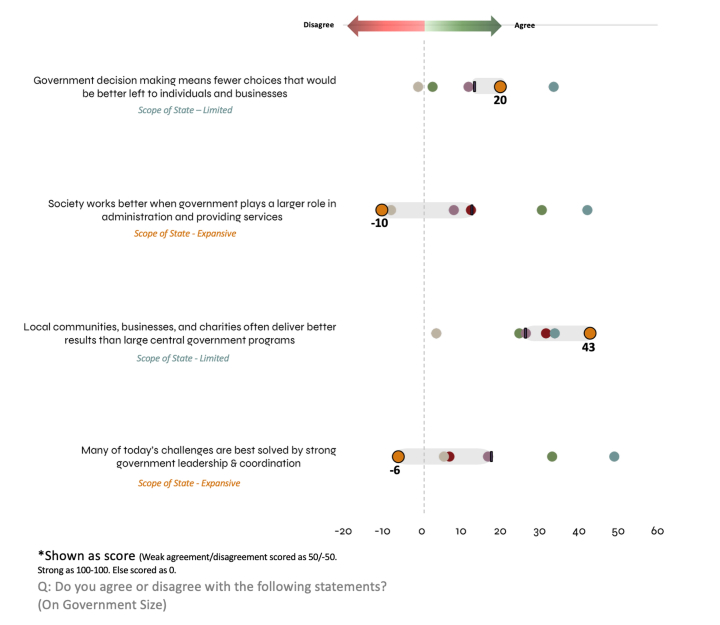
Figure 51: Natal views on economic structure
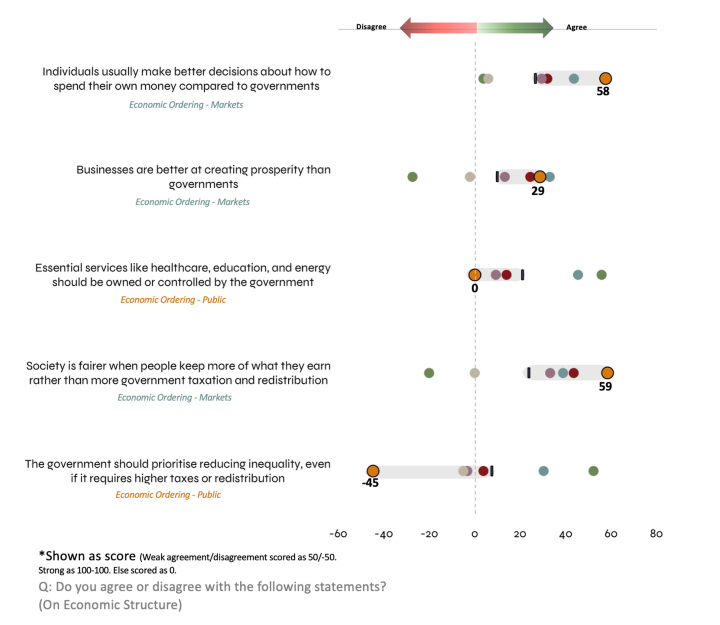
Figure 52: Natal views on freedom of expression
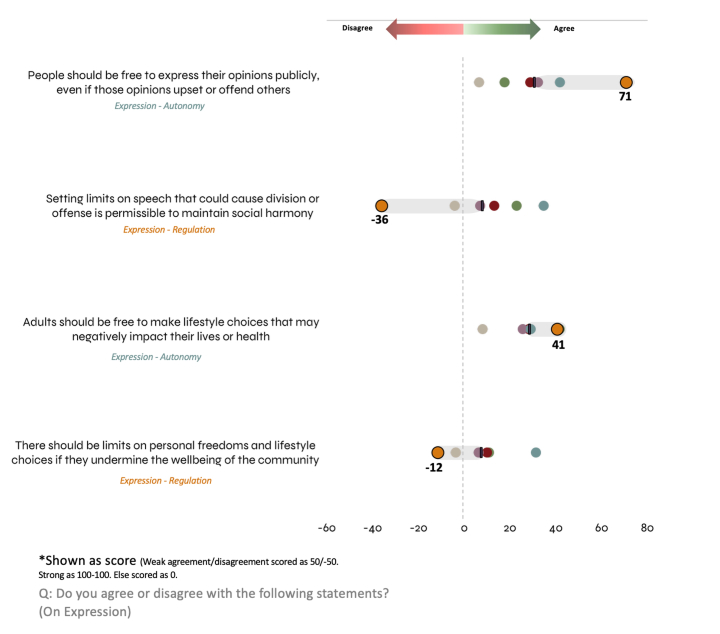
Figure 53: Natal views on equality
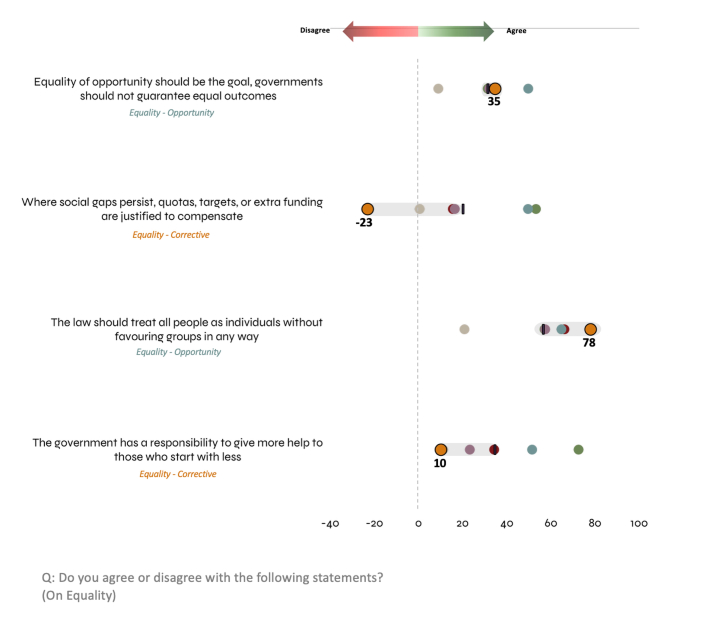
Figure 54: Natal views on community
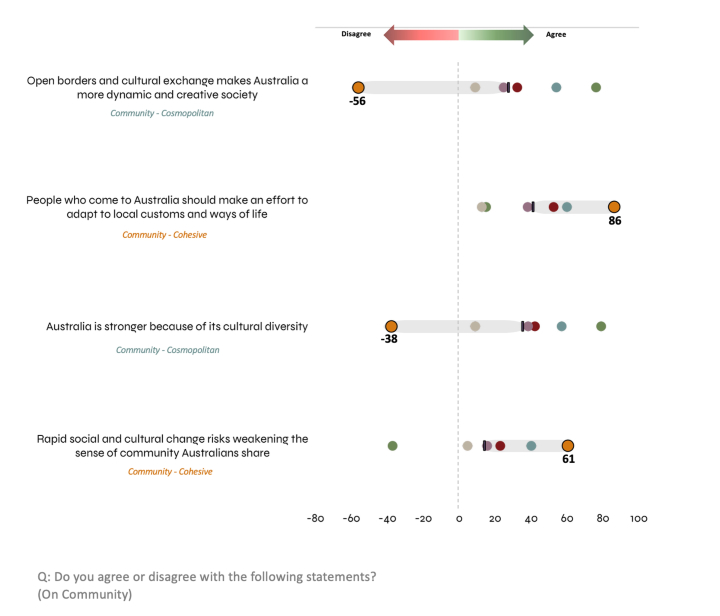
Figure 55: Overview of Natal values
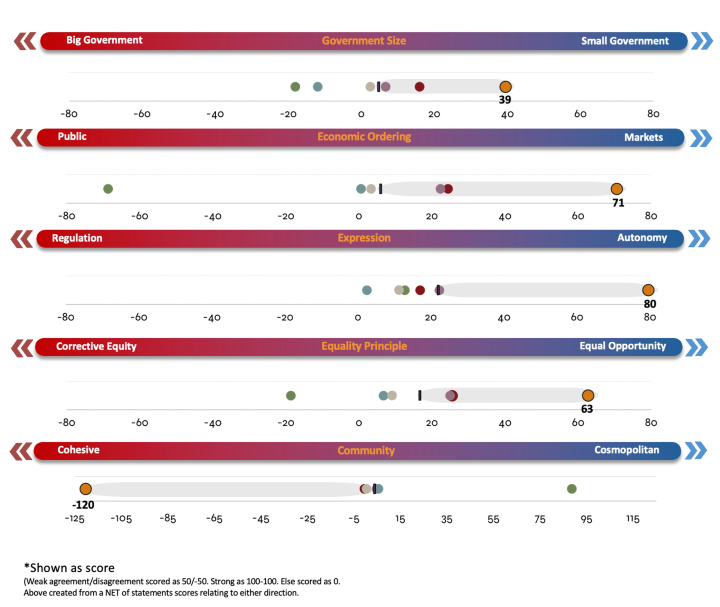
Detacheds
Detacheds are 16% of the 18–34 year old age group and are scattered across every state and territory, with slightly more in Queensland than other places. They are a bit more likely to be male (57% male, 43% female), renters (48%), and 70% are not married or in relationship. They are generally disengaged and apathetic towards the world around them, with 71% saying they follow public affairs occasionally or less.
They have a weak bias toward believing that things will somehow work out for them, and are moderately inclined to think institutions and the federal government have a positive impact. 70% worry about the future sometimes or less.
Slightly more Detacheds believe the barriers to achieving their aspirations are in their control (34%) than not (29%). Their life satisfaction is overall somewhat positive; they are more satisfied with their financial situation than most other tribes, but less with their personal relationships.
Political leanings
Half of Detacheds consider themselves centrist (51%), while the other half are distributed to the left (29%) and right (20%). In the past, they have tended to vote for major parties (59%).
Employment
Detacheds have similar rates of employment to the average for their age group, but are somewhat more likely to be on the lower end of the income scale, with one in five (19%) earning less than $40,000 a year.
Milestones and lifestyle
Detacheds have no standout ambitions in life. Their top definitions of success are having enough money to pursue basic life goals (34%), and having good health and fitness (30%). Becoming debt free or financially stable ties with having children and building a family as the next top aspiration at a relatively weak 26%, making the strength of their desire to achieve the financial goal much weaker, and their hope for the social goal in the middle for their age group. They are more likely to value getting married or finding a life partner than most others (18%) and rate having the respect and admiration of their peers slightly higher than others (8%).
Figure 56: Detached definitions of success
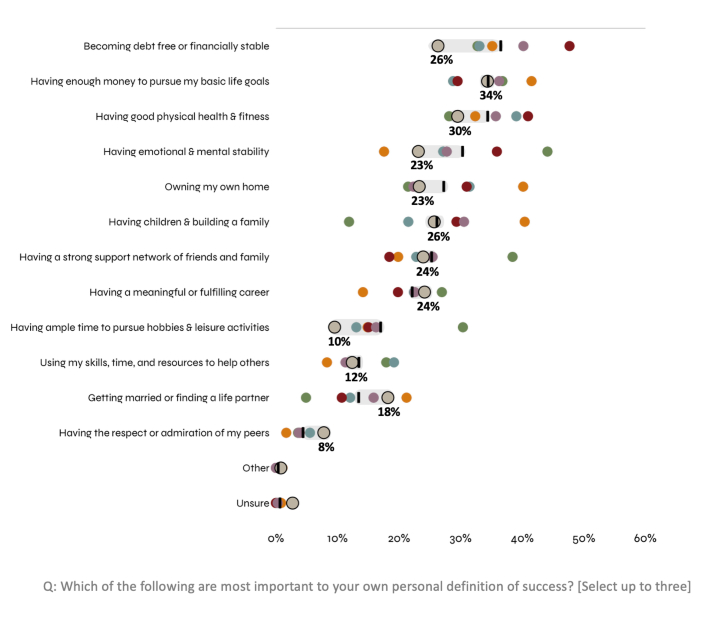
Barriers to aspiration
Like most others their age, Detacheds feel that owning a home (23%), becoming debt free and financially stable (20%) and having enough money to pursue basic life goals (12%) are difficult to achieve, but the degree of difficulty they attribute to them is weak, in line with their neutrality and detachment in other areas. Largely single, they are slightly more likely than average to consider getting married or finding a life partner difficult (13%).
They are much softer than others their age on the cause of difficulty. They nominate the cost of housing and rent (40%) and earning money to pursue their basic life goals (39%) at similar rates to Head-Starts, who are much more likely to have achieved key goals. Detacheds feel that available time (20%) and maintaining emotional and mental health (16%) are less of a barrier than other groups, while finding a suitable partner or spouse (19%) and access to education and training opportunities (12%) are more of a barrier than for others.
Detacheds have a very high ‘unsure’ rate, with almost 1 in 10 saying they don’t know what is in their way.
The role of government
Detacheds believe government has had a mildly positive impact on most areas of their lives, but a moderately negative impact on the cost of housing and rent (net -13).
Figure 57: Detacheds have very high ‘unsure’ rates in surveys
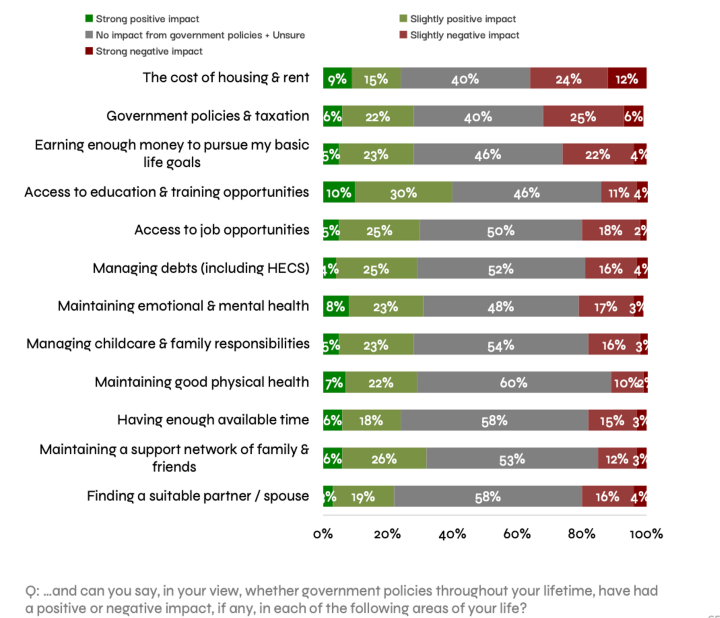
Views
In line with their tendency to detachment, Detacheds hold weakly-considered views on most issues related to their future, though with a slight lean toward optimism.
Detacheds are similarly much more likely to be neutral on social issues. They most strongly agree with the propositions that they are proud of their history, ancestry and cultural identity (37%) and would prefer to keep more of their own money than pay tax for more government services (35%).
They most strongly disagree with most others their age on the proposition that it is a good thing that societal norms are becoming less traditional around marriage, sexuality, and gender roles (28%), putting them closest to the Natals on this issue. They are also less likely to identify as LGBTQ+ (9%) than any other group other than the Natals (4%).
Figure 58: Detached views on social and economic issues
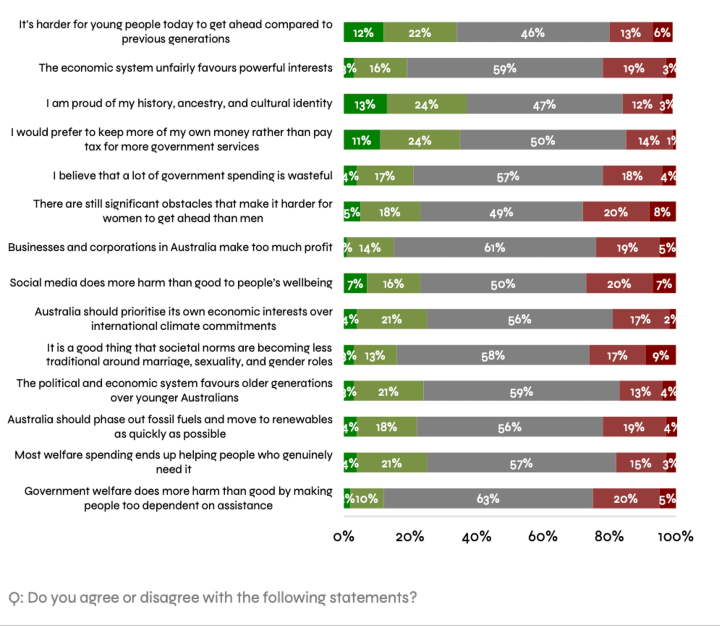
Trust in government and institutions
Detacheds are less sceptical about measures of trust — such as truth and transparency and managing the economy — than their peers, once again occupying an overall neutral position.
Detacheds generally support the idea that reform is needed but can be done from inside the system (53%) and are less likely than average to say institutions and laws need to be completely rebuilt (14%); but a large number are unsure (22%).
On balance, Detacheds view the impact of institutions on society as positive, but these results are qualified by a large number of unsures. Netted out, they are a bit softer on the positive impact of universities and higher education, though these are the institutions they are most positive about. They are out of step with others (except the Head-Starts) in considering the impact of the federal government to be positive.
Figure 59: Detached views on the impact of institutions
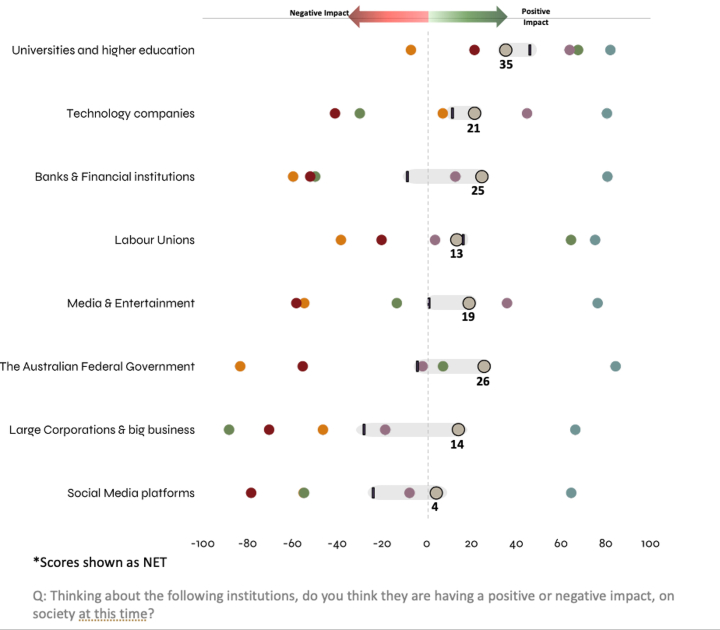
Values
Unlike the other tribes, Detacheds do not have strong opinions on matters of government size, economic ordering, autonomy, equality, or community, creating a neutral ‘balanced’ values profile that is indicative of disengagement.
However, there are some indications of preferences when answers are disaggregated. Here we find they somewhat disagree that society works better when government plays a larger role in administration and providing services, and are mostly not supportive of the idea that today’s challenges are best solved by strong government leadership and coordination. They are much less likely than others their age to believe local communities, businesses and charities often deliver better results than large central government programs; according with a bigger picture of a tribe that is happy to let the government make decisions on its behalf.
This is supported by their views on economic ordering. They only very weakly agree individuals usually make better decisions about how to spend their own money compared to governments, but they are also not actively statist, as demonstrated by their low level of agreement that essential services like healthcare, education and energy should be owned or controlled by government.
Compared with most others their age, Detacheds are less enthusiastic about free speech but also less enthusiastic about limits on free speech to preserve social harmony. A similar pattern emerges where it comes to the question of whether adults should be free to make lifestyle choices that may negatively impact their health, which is contradicted by mild disagreement that there should be limits on personal freedoms and lifestyle choices if they undermine the wellbeing of the community. Their views on corrective equity and open border similarly negate each other.
Figure 60: Detached views on the size of government
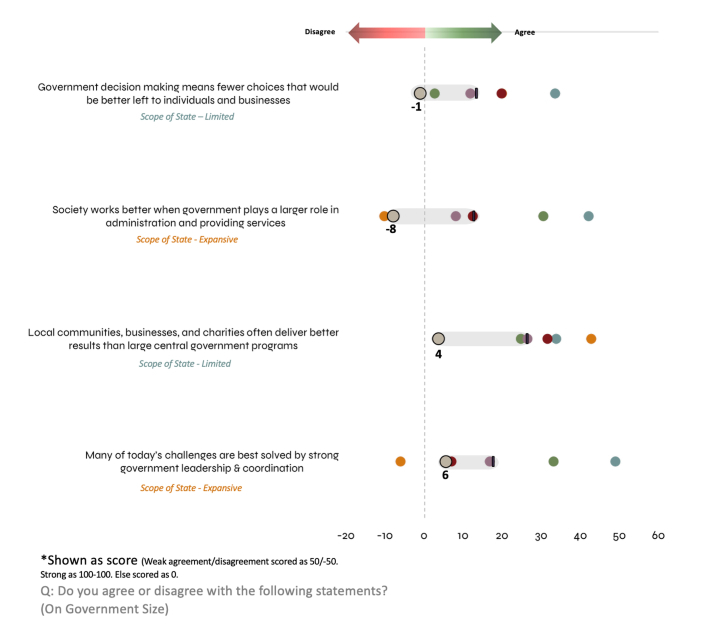
Figure 61: Detached views on economic structure
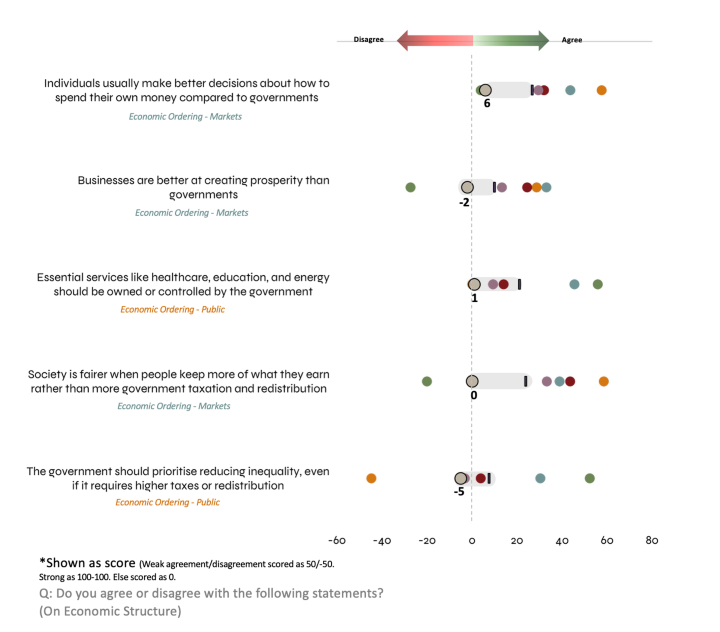
Figure 62: Detached views on freedom of expression
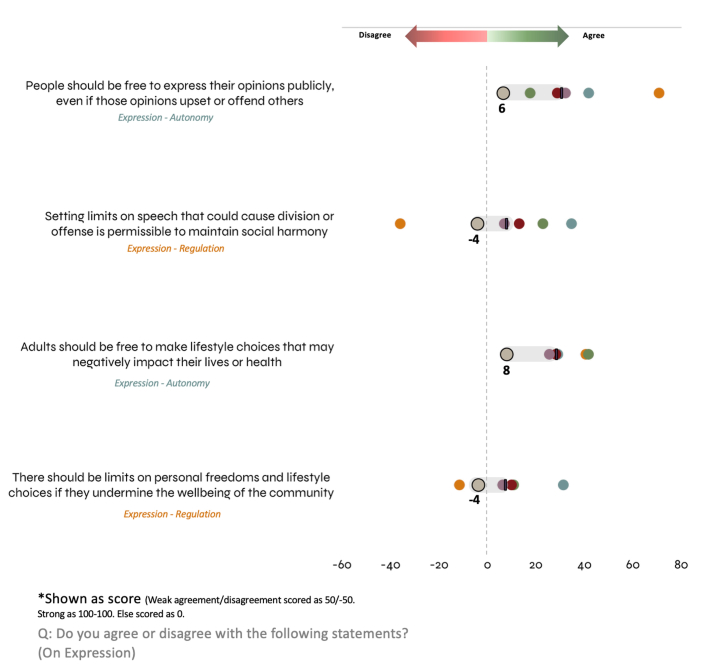
Figure 63: Detached views on equality
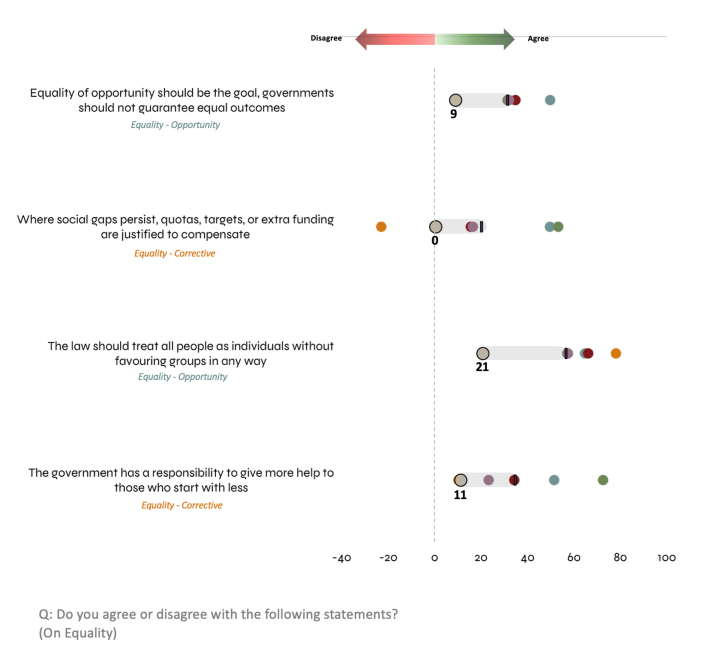
Figure 64: Detached views on community
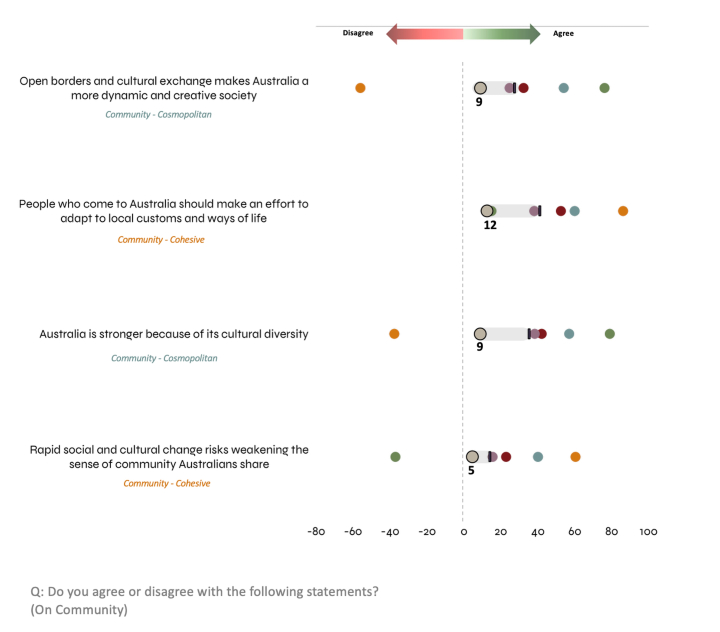
Figure 65: Overview of Detached values
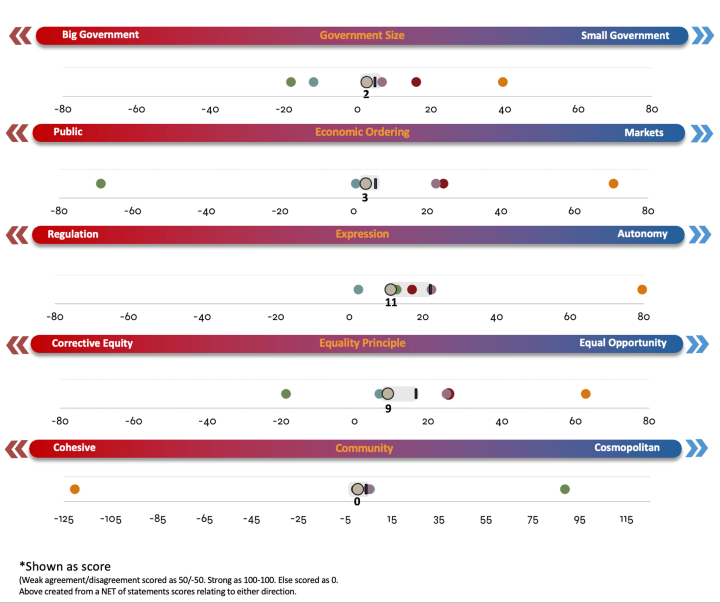
Strivers
Strivers are the largest single group among the six tribes, making up 22% of the 18–34 year old cohort. They skew slightly to the younger end of the age cohort, are more female than male (44% male to 56% female) and many are still living with their parents (35%). They are somewhat more likely to be based in the regions (38%) and in Queensland (25%).
Cost and standard of living is by far the top issue for this tribe, with 79% saying it is important to them — more than every other cohort except the Dislocated Post-Traditionalists. Their other two issues are housing affordability and availability (57%) and crime and public safety (31%), which is almost as important to Strivers as it is to Natals. They are much less concerned about climate change than others in their age group.
Strivers are reasonably confident in their ability to influence the barriers to achieving their aspirations. 7% believe these barriers are strongly in their control and 35% believe they are at least slightly in their control. Strivers have marginally-higher life satisfaction than all tribes, other than the Head-Starts.
Political leanings
Strivers don’t follow the news closely, with 73% saying they only follow what the government is doing occasionally or less. Politically, they largely identify as in the political centre (50%) with 21% placing themselves on the left and 18% on the right of politics. A small number identify as far-left (8%) or far-right (3%).
59% voted for major parties at the last election: 23% for the Liberal National Coalition and 36% for the Labor Party. They are changeable in their political choices, with 61% saying their commitment to parties is soft.
Employment
Strivers have comparative employment levels to the age cohort average, with 43% employed full-time or self-employed, and 27% employed part-time, or in casual or gig work. Their earnings are also in line with cohort averages.
Milestones and lifestyle
Strivers have traditional aspirations, for the most part. 40% say their primary aspiration is to become debt free and financially stable, 36% want to have enough money to pursue their basic life goals, 36% want good physical health and fitness. They are more likely than others their age to want children and a family (31%). They are less likely to prioritise owning their own home (22%).
Their top two goals feel hard to them and just over half (51%) believe they will be able to achieve financial security in their lifetime. 43% worry about the future most or all of the time.
Nonetheless, they tend to have an optimistic outlook, with 48% believing their personal financial situation will improve over the next 12 months, despite having a much more negative expectation for Australia’s overall economic situation.
Barriers to aspiration
Strivers’ low desire to own a home may come as a result of the perceived difficulty of achieving this goal. They see home ownership as harder to achieve than average for their age group, with 75% saying it would be difficult or very difficult to achieve.
Despite deprioritising home ownership, they disagree society would be better off if Australians focused less on owning housing and real estate. In line with the average of their peers, they said they would not feel comfortable with renting a home for the rest of their lives.
Their perception of the difficulty of achieving other financial goals is more or less in line with their age cohort. They see fewer barriers to achieving social goals, such as getting married or finding a life partner and having a strong support network of friends and family. They are slightly less likely to consider helping others or commanding the respect or admiration of their peers as measures of success, but more likely to feel that these things are easy to attain.
They see the cost of housing and rent as the highest barrier to achieving their goals (58%) as well as earning enough money (46%) and having enough available time (28%). In line with their family-orientation, they are more likely than all others in their age group to believe managing childcare and family responsibilities are a barrier to achieving their most important life milestones (15%).
Figure 66: Strivers are concerned that some their core goals will be difficult to achieve
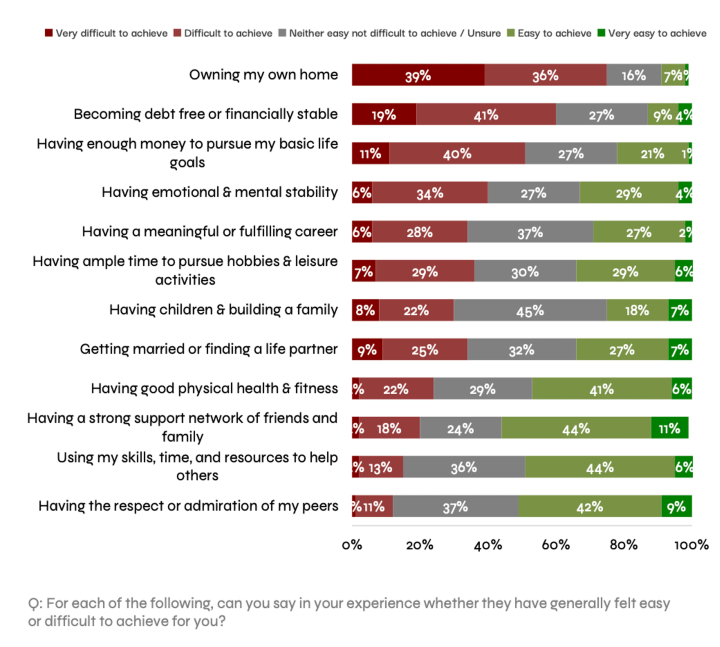
The role of government
Strivers see the government as having a negative impact on the cost of housing and rent (68%), their ability to earn enough money to pursue basic life goals (54%) and government policies and taxation (52%). The greatest perceived positive impact of government in their lives is in the area of access to education and training opportunities, in which they are aligned with the average for their age group (47%).
Views
Strivers are moderately optimistic about achieving financial security in their lifetimes (51%) but are also convinced the government will increase the amount of taxes they will have to pay in future (68%). They worry more than others that they might not be able to afford to have as many children as they would like (52%).
Figure 67: Strivers are moderately optimistic but expect to encounter set-backs
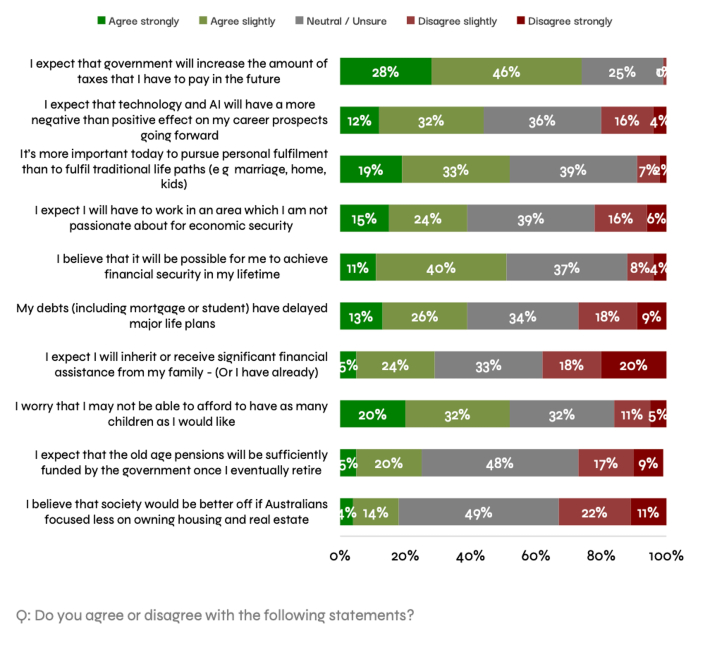
They overwhelmingly believe it’s harder for young people today to get ahead compared to previous generations (91%), say a lot of government spending is wasteful (78%) and would prefer to keep more of their own money rather than pay tax for more government services (80%). While split on the issue, they are slightly more inclined to disagree that most welfare spending ends up helping people who genuinely need it — 27% believe it goes to the right people, while 33% disagree. Strivers are more likely than almost all other cohorts (other than the Natals) to suspect government welfare does more harm than good by making people too dependent on assistance (47%).
“The government try to do good but many times they have done negative things, especially in not utilising tax payers money in a better way. They only focus on special people that get benefits.” — 25 year old male, Queensland
Strivers have a strong sense of cultural inheritance, with most being proud of their history, ancestry and cultural identity (71%). They strongly believe Australia should prioritise its own economic interests over international climate commitments (74%). They are less likely than average to think Australia should phase out fossil fuels and move to renewables as quickly as possible (38%).
At the same time, they have progressive social values. They are more likely than many others their age to believe there are still significant obstacles that make it harder for women to get ahead than men (73%) and say it’s a good thing that societal norms are becoming less traditional around marriage, sexuality and gender roles (66%).
Figure 68: Striver views on social and economic issues
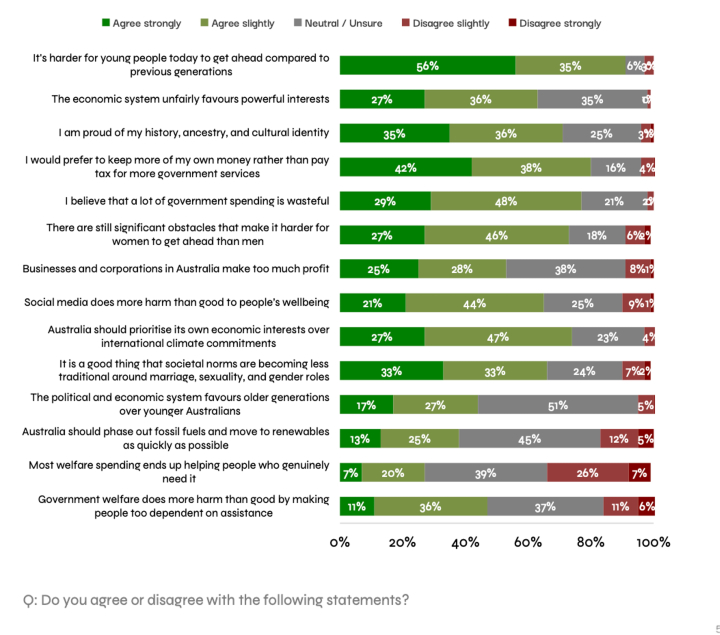
Trust in government and institutions
Strivers are ambivalent towards politics and politicians. Just under half (45%) believe there is at least one candidate who shares most of their views. In line with their age cohort, they are sceptical that government will act in the best interest of people like them, tell the truth and be transparent, or manage the economy responsibly.
On balance, they are mildly mistrustful that government will protect their rights and freedoms and deliver services like health and education effectively.
They are reformists rather than revolutionaries. Only 20% believe .institutions and laws need to be torn down and rebuilt. They strongly believe that reform is needed but can be done from inside the system (59%).
Strivers have a high degree of trust in institutions. They are very likely to believe universities and higher education have a positive impact on society, as well as technology companies, and media and entertainment. They are less positive about the impact of labour unions, the federal government, and large corporations and big businesses.
Figure 69: Striver views on the impact of institutions
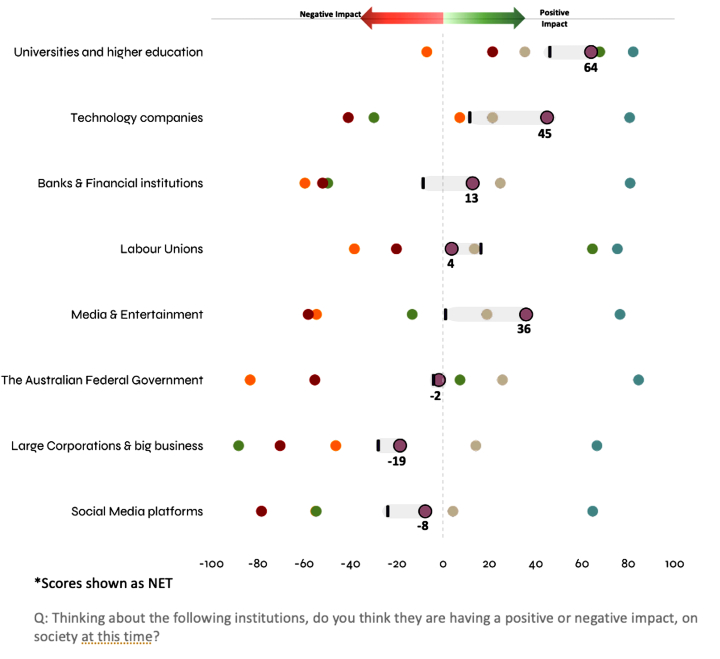
Values
Strivers sit in the middle of their age group on the benefits of strong government leadership and coordination, leaning somewhat in favour. However they are softer on whether society works better when government plays a larger role in administration and providing services, leaning slightly more to the idea that government decision-making means fewer choices that would be better left to individuals and businesses. They are more inclined to agree that local communities, businesses, and charities often deliver better results than large central government programs.
They also tend to agree that individuals usually make better decisions about how to spend their own money compared to governments and that society is fairer when people keep more of what they earn rather than handing it to government by way of tax for redistribution. They are less likely than others their age to believe essential services like healthcare, education and energy should be owned or controlled by the government, and incline towards the idea that businesses are better at creating prosperity than government.
They are more likely to believe people should be free to express their opinions publicly, even if those opinions upset or offend others than that speech should be limited to maintain social harmony. Like most of their age cohort, they tend towards the idea that adults should be free to make lifestyle choices that may negatively impact their lives or health, though they admit there should be some limits on personal freedoms and lifestyle choices if they undermine the wellbeing of the community.
Strivers prefer equal opportunity over government-guaranteed equal outcomes and laws that treat all people as individuals without favouring groups in any way. But they don’t entirely reject addressing persistent social gaps with quotas, targets, or extra funding. While less supportive than the average for their age cohort, they also agree somewhat that government has a responsibility to give more help to those who start with less.
They are both relatively cosmopolitan in their attitudes and protective of the Australian way of life. While they tend to agree open borders and cultural exchange make Australia a more dynamic and creative society, they believe people who come to Australia should make an effort to adapt to local customs and ways of life. They are less worried than some other tribes that social and cultural change will weaken the sense of community Australians share.
Figure 70: Striver views on the size of government
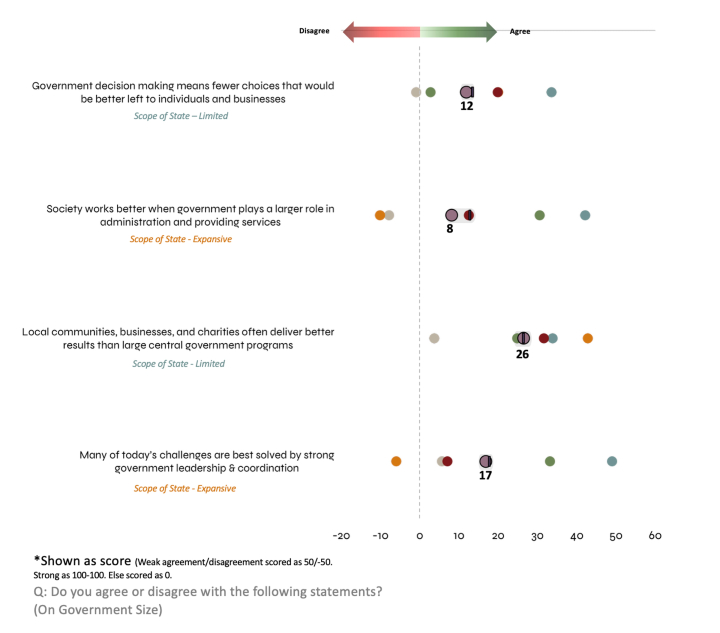
Figure 71: Striver views on economic structure
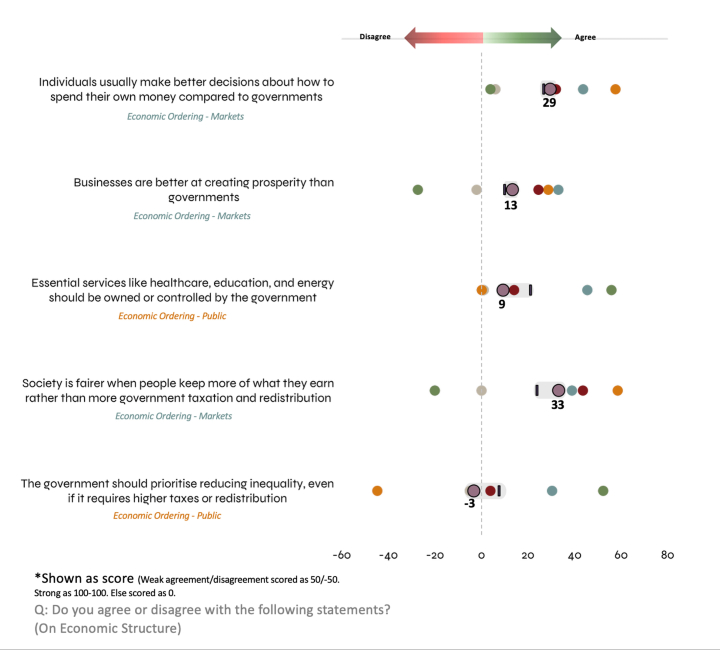
Figure 72: Striver views on freedom of expression
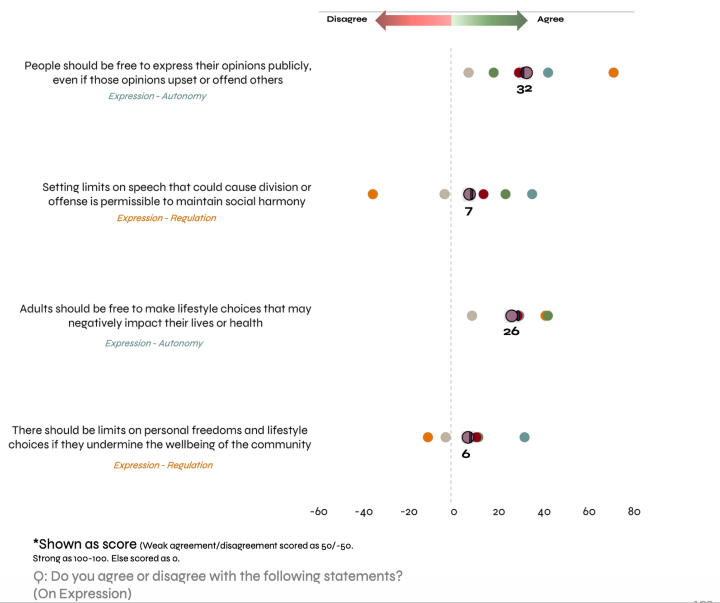
Figure 73: Striver views on equality
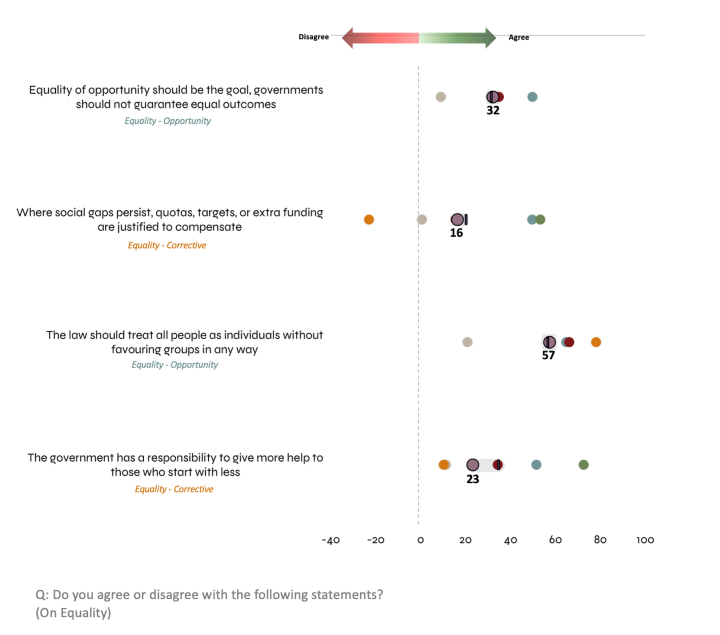
Figure 74: Striver views on community
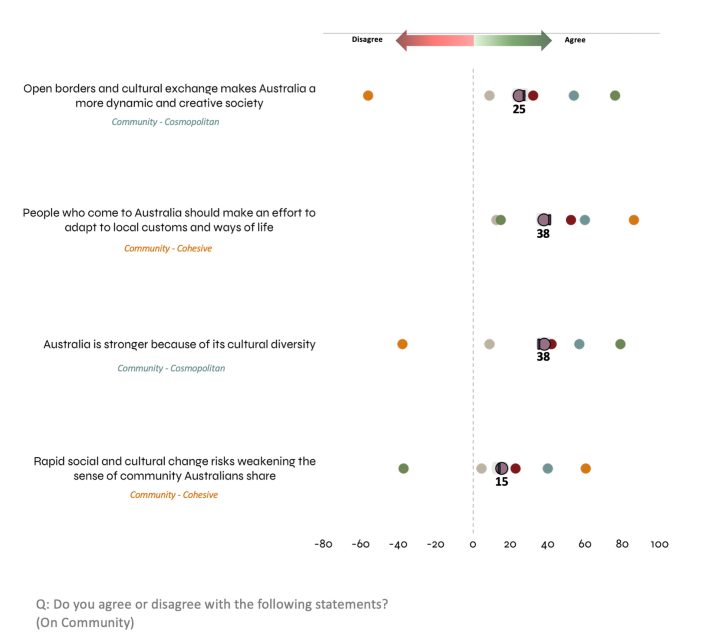
Figure 75: Overview of Striver values
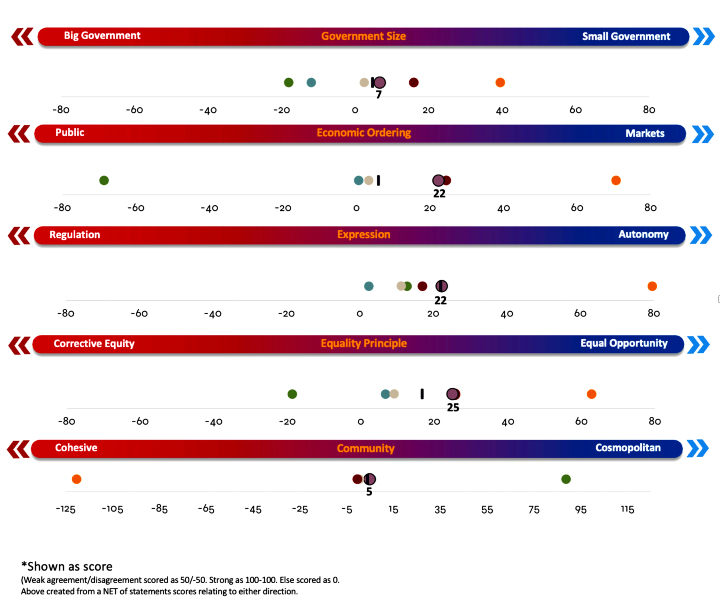
Head-Starts
Head-Starts are the second smallest of the six tribes, representing 13% of 18–34-year-olds (just 1% more than the Natals). They are overwhelmingly male (73% male, 27% female) and almost half (49%) hold a university degree. They are more likely to be home-owners than any other tribe; 29% own a home with a mortgage and 16% own a home outright. They are twice as likely to be married (38%) than the average for their age group (19%). More than half (53%) have children. 52% expect to receive, or have already received, an inheritance or significant financial assistance from their family.
Head-Starts have a strong sense of agency, feeling that the barriers to achieving their aspirations are strongly (23%) or slightly (36%) in their control, while only 24% say they are slightly out of their control, or strongly (5%) out of their control.
They have very high levels of life satisfaction, and feel confident in their sense of purpose and direction in life, their personal relationships, their financial situation and their health and wellbeing. They are less anxious than other tribes, with 68% worried only some of the time, rarely, or never.
Political leanings
Head-Starts follow public affairs closely, with 24% saying they follow most of the time (24%), some of the time (44%), or at least occasionally (24%). The largest proportion identify as centrist (28%) or right-wing (24% right, 19% far-right), with a smaller number placing themselves on the left (21%) or far-left (8%). They overwhelming prefer major parties. A significant majority voted Labor at the 2025 election (57%) with only a minority leaning to the Liberal National Coalition (29%) or the Greens (12%). They are less likely to be soft in their voting intention than most others their age, though 39% are still not committed to their political choice.
Employment
67% of Head-Starts are in fulltime employment. They tend to have higher incomes than others their age — 32% are earning between $80,000 and $125,000, 28% between $125,000 and $200,000, and 14% earn $200,000 or more.
58% believe the Australian economy is likely to improve a little or a lot over the next 12 months and 74% expect their personal financial outlook will improve a little or a lot over that timeframe.
Milestones and lifestyle
This financially secure cohort aspires above all to good physical health and fitness (39%), becoming debt free (33%), and home ownership (31%). With their fundamental needs met, they are far more likely than others their age to aspire to use their skills, time, and resources to help others (19%).
Head-Starts have a great sense of ease in achieving life milestones, setting them far apart from others their age. The gap is widest on financial goals and narrows slightly on social goals, such as getting married or finding a life partner, and having the respect or admiration of their peers, but even these things are perceived as far easier by this tribe than by others.
Figure 76: Head-Starts perceive all markers of success as easy to achieve

Barriers to aspiration
Along with others their age, Head-Starts say the greatest barriers to achieving their aspirations are the cost of housing and rent (37%) and having enough money to pursue basic life goals (37%), but these challenges are far less prohibitive to this group than others. They consider government policies and taxation (20%) and maintaining physical health (21%) greater barriers than other tribes.
The role of government
Head-Starts are very pro-government, believing government policies have had an overwhelmingly positive effect throughout their lifetime. They differ most from others their age on the effect of government policies and taxation, and having enough money to pursue their basic life goals. In both cases, Head-Starts feel government has played a positive role in helping them achieve their aspirations, while other tribes rate government’s influence far more negatively. Head-Starts are most positive in absolute terms about how government policy has supported them in accessing education and training opportunities (78%), emotional and physical health (61%), job opportunities (62%), managing childcare and family responsibilities (62%) and maintaining a support network of family and friends (56%). They even credit government policies with having a positive impact on their ability to maintain good physical health (66%) and find a suitable partner or spouse (43%). They are less enthusiastic about the impact of government policy on the cost of housing or rent, but still generally consider it a positive influence (49%).
Figure 77: Head-Starts believe government policies have had a positive impact across most areas of their lives

Views
Head-Starts are slightly less likely than others their age to believe government will increase the amount of taxes they have to pay in the future (65%). Already in possession of all the trappings of a successful traditional life path, they are more likely than other groups to say that it’s more important to pursue personal fulfilment than to fulfil traditional life paths (74%) — on par with the Progressive Identitarians. They are much less likely than others to worry they won’t be able to afford to have as many children as they would like (41%).
Despite high rates of home ownership, they are far more likely than others their age to believe that society would be better off if Australians focused less on owning housing and real estate.
Head-Starts have the most in common with extremely redistributionist Progressive Identitarians on some aspects of government spending, welfare and the move to renewables, sharing the lowest levels of agreement that a lot of government spending is wasteful (though 56% do still tend to this view). They believe welfare spending ends up helping people who genuinely need it (61%). Unlike Progressive Identitarians, though, they worry that government welfare does more harm than good by making people too dependent on assistance (49%).
Head-Starts also have a high level of support for less traditional social norms (70%) and are also almost as keen as Progressive Identitarians to see Australia phase out fossil fuels and move to renewables as soon as possible (78%). Still, unlike Progressive Identitarians, they strongly believe that Australia should prioritise its own economic interests over international climate commitments (72%). They also differ from Progressive Identitarians in feeling a strong sense of pride in their history, ancestry and cultural identity (89%).
Figure 78: Head-Start views on social and economic issues

Trust in government and institutions
Head-Starts feel well represented in the political system. Unlike all others in their age group, they trust in politics and politicians, who they believe deliver services like health and education effectively, protect their rights and freedoms, manage the economy responsibly, tell the truth and are transparent, and act in the best interests of people like them.
Figure 79: Head-Starts have the highest trust in government of any tribe
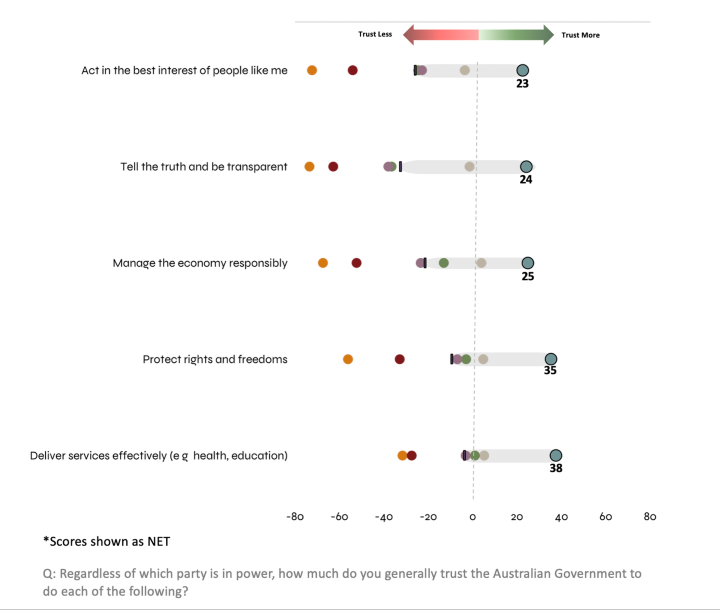
While this tribe generally thinks the system needs reforming from the inside (58%), a significant number are happy with the status quo (29%).
Head-Starts also have a very high level of confidence that all institutions have a positive impact on society. They even trust labour unions and universities and higher education institutions more than Progressive Identitarians. The greatest gaps between them and their peers are on trust for banks and financial institutions, large corporations and big business. and the federal government, which they trust much more.
Figure 80: Head-Start views on the impact of institutions
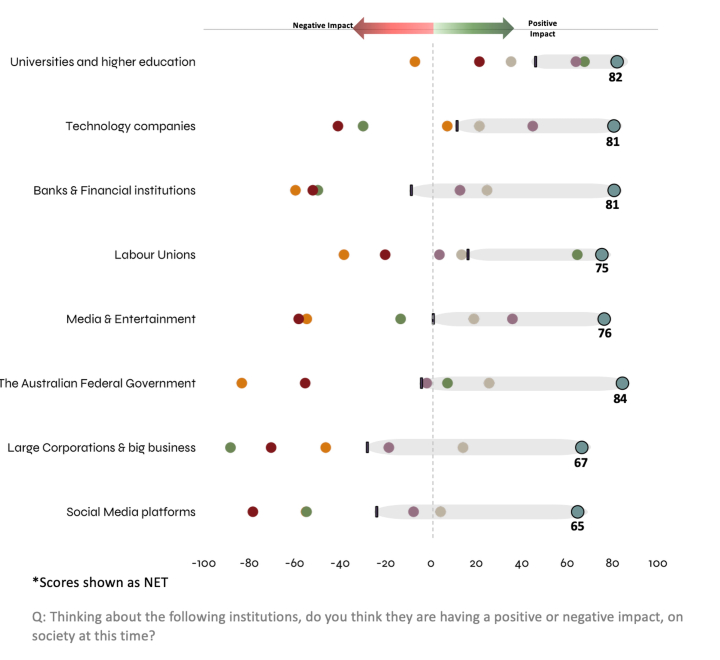
Values
Head-Starts lean slightly towards big government and their views on other topics balance out, creating a status quo bias on questions of market orientation, autonomy, open borders, and equal opportunity versus corrective equity.
They agree government decision making means fewer choices that would be better left to individuals and businesses, but also strongly believe society works better when government plays a larger role in administration and providing services. In general they also agree local communities, businesses and charities often deliver better results than large central government programs, but more strongly believe many of today’s challenges are best solved by strong government leadership and coordination.
These contradictions continue where it comes to economic ordering. Head-Starts believe individuals usually make better decisions about how to spend their own money than governments, and businesses are better at creating prosperity than governments, while at the same time backing public ownership or control of essential services like healthcare, education and energy, and believing the government should levy higher taxes and redistribute taxpayer money to reduce inequality. Yet they are closer to most of their peers and further from the Progressive Identitarians in believing society is fairer when people keep more of what they earn rather than taxing more for the purposes of redistribution.
They are much more supportive than others their age of the idea of setting limits on speech which could cause division or offence in order to maintain social harmony, and believe there should be limits on personal freedoms and lifestyle choices if they undermine the wellbeing of the community.
They are much more strongly in favour of quotas, targets or extra funding to compensate for social gaps (just behind the Progressive Identitarians) but in line with their peers in agreeing that the law should treat all people as individuals without favouring groups in any way.
While their attitudes to immigration are generally very positive, they do worry more than all others, except for the Natals, that rapid social and cultural change risks weakening the sense of community Australians share.
Figure 81: Head-Start views on the size of government
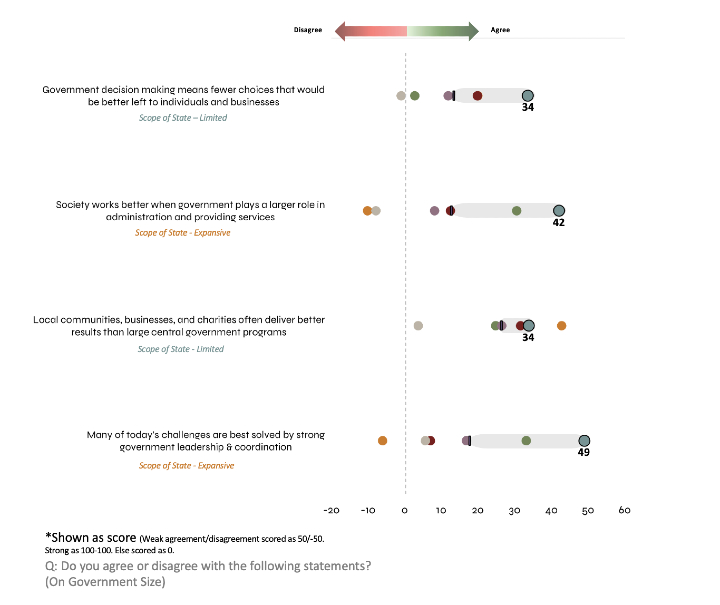
Figure 82: Head-Start views on economic structure
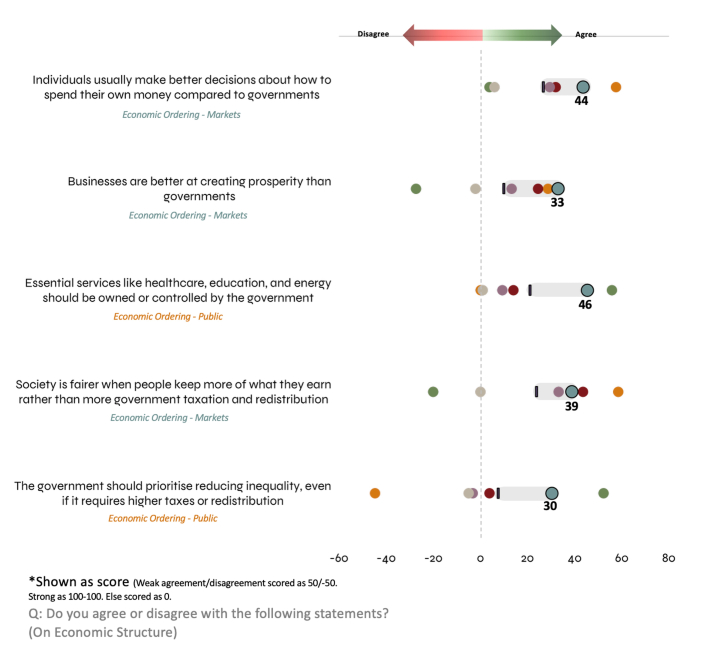
Figure 83: Head-Start views on freedom of expression
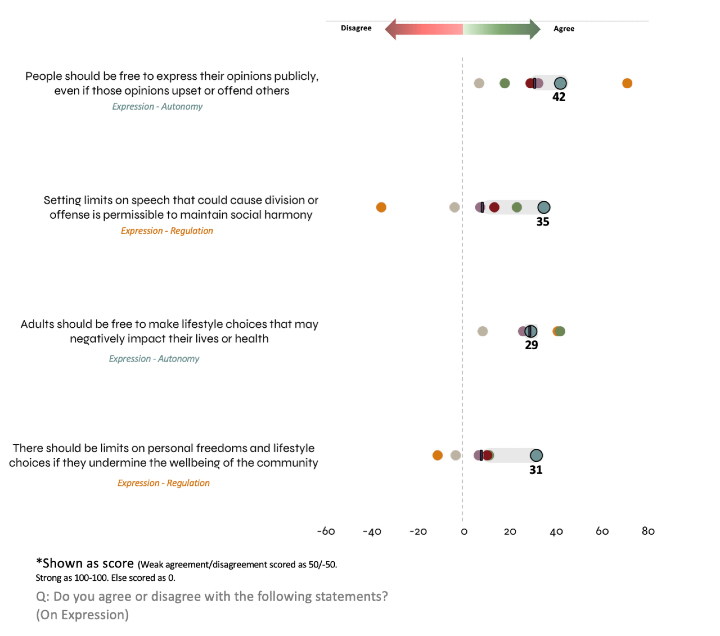
Figure 84: Head-Start views on equality
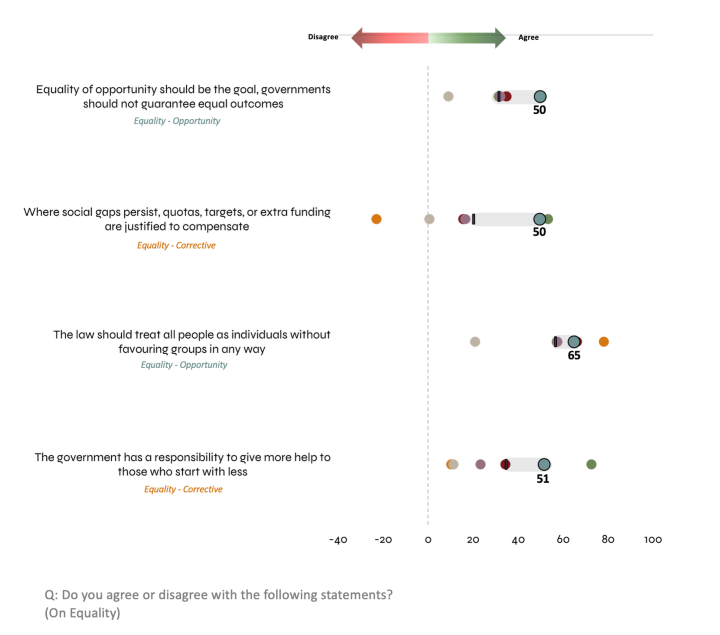
Figure 85: Head-Start views on community
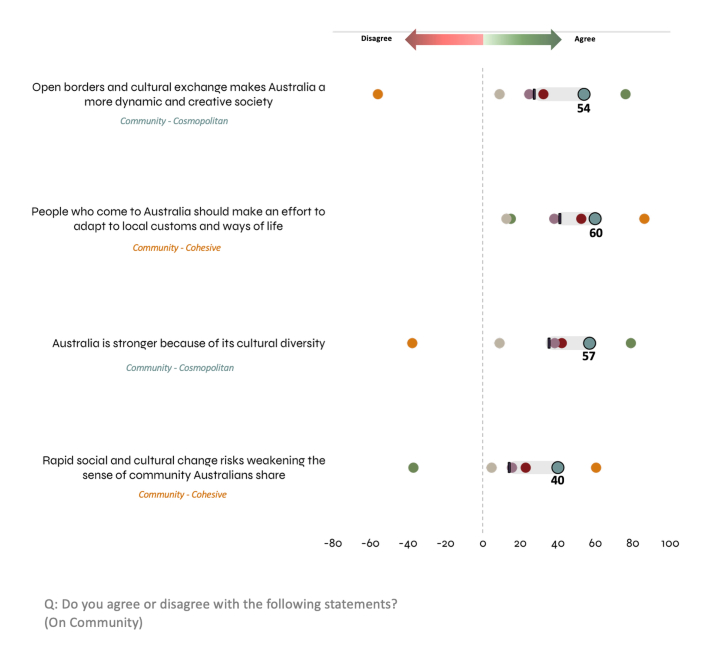
Figure 86: Overview of Head-Start values
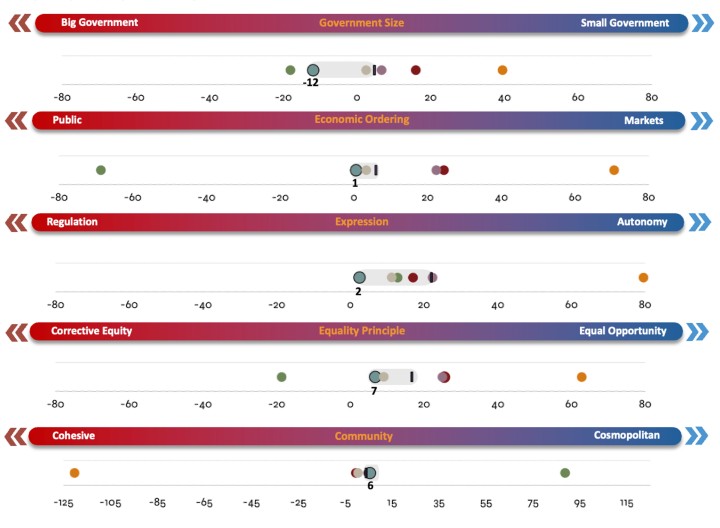
Appendices
Appendix 1: Methodology
Qualitative research conducted using conversational AI tool Juno AI first helped understand the aspirations and barriers encountered by young Australians through open questions, ensuring the subsequent quantitative research followed their lead rather than building in the biases of the researcher. The qualitative research interviewed 80 young Australians in a one-on-one format in August and October 2025.
Quantitative research was then undertaken through Spectre Strategy, asking a set of questions designed to uncover the hopes, concerns, and values of this age range. The survey sampled 2011 voters, of whom 1246 were aged 18–34, from 4–18 November 2025. The data has been weighted to be representative of Australian voters. The margin of error is +/- 3% for topline results.
Appendix 2: The symptoms of changing lives — voting patterns and democratic disenchantment
Over the last few years, numerous pollsters and researchers have noted parallel trends emerging in younger cohorts in Australia and other Western countries: an increasing inclination to vote for nominally left-leaning political parties, and at the same time a decline in support for liberal democracy. This paper treats these phenomena as symptoms of liberal democratic governments failing to understand the changing lives of citizens, rather than — as some have suggested — a failure of young citizens to understand liberal democracy.
Changing voting patterns
In 2023, an election study undertaken by the Centre for Independent Studies[17] investigated the extent to which age is a factor in determining a first preference vote for Australia’s major centre-right political parties. The study found younger voters are more likely to start off voting for left-leaning parties than previous generations and less likely to switch their vote to right-leaning parties as they get older. The study projected a structural deficit which would leave the parties of the right without a sufficient base to form government in years to come, if the trend continued.
The modelling highlighted a political problem, while raising a deeper philosophical question for classical liberals. Why are young people increasingly leaning toward parties which promise redistributive, high regulation platforms, when general prosperity has historically always been the result of the opposite? What is it about the modern world, or the policy platforms, effect, or cultural meaning of these parties, that increasingly appeals to young people? Or, conversely, what is it about parties that have to a greater or lesser degree been guided by the philosophy of classical liberalism that is increasingly repelling or failing to connect?
Democratic disenchantment
At the same time, numerous studies have found that young people are more open to authoritarian ideas than previous generations. A 2025 Lowy Institute poll found that only 67% of Australians aged 18–44 say democracy is preferable to any other kind of government — compared with 80% of those over 45.[18]
The results were even more dire in a 2024 survey by the Jeff Bleich Centre for Democracy and Disruptive Technologies at Flinders University of Australians aged 18-29, which found that only 55.7% of participants agree with the statement that “democracy is the best form of government”.[19]
Study author Dr Jean-Nicolas Bordeleau noted that “abstract disenchantment [with democracy] translates into concrete support for actions that violate core democratic norms”. Of those surveyed, 38% supported or strongly supported the “use of force to prevent policies they disagree with from being enacted”; 39% agreed that the “government should be able to bend the law when required”; 36% agreed that the “Prime Minister should be able to ignore court decisions”; and 25% supported “committing voter fraud to prevent a party they dislike from winning”.
“The most damning finding,” Dr Bordeleau writes, “relates to the principle of limited government. For the 18–39 cohort, the preference for ‘checks and balances; — a society where the prime minister must answer to Parliament and the courts — was statistically indistinguishable from zero. This can no longer be considered apathy; rather, it is the active devaluation of a cornerstone of liberal democracy. In other words, it seems that many young people have begun to see democratic processes as expendable, or even as obstacles, in the pursuit of outcomes like economic security. This creates a significant vulnerability to authoritarian appeals from any leader who promises to ‘get things done’ by sweeping away procedural constraints.”
Endnotes
[1] Oxford University, The World Happiness Report 2025. https://data.worldhappiness.report/table
[2] David Blanchflower, Alex Bryson, Xiaowei Xu, The declining mental health of the young and the global disappearance of the unhappiness hump shape in age (2025). Published by PLOS One. https://journals.plos.org/plosone/article?id=10.1371/journal.pone.0327858
[3] Elisa Birch and Alison Preston, The Falling Returns to Education in Australia UWA Business School, University of Western Australia (2025). https://onlinelibrary.wiley.com/doi/epdf/10.1111/1475-4932.12878
[4] American Psychological Association, https://dictionary.apa.org/adulthood
[5] Monash University, 2023 Australian Youth Barometer https://bridges.monash.edu/articles/report/The_2023_Australian_Youth_Barometer/24087186?file=43089670
[6] William J Chopik, Joshua A Confer, Matt Motyl, Age differences in free will and control perceptions across the lifespan and around the world (2023) https://www.sciencedirect.com/science/article/pii/S2666622723000060
[7] Australian Bureau of Statistics, Prevalence of Mental Health Disorders 2020-2022, https://www.abs.gov.au/statistics/health/mental-health/national-study-mental-health-and-wellbeing/2020-2022#data-downloads
[8] Ferdi Botha, Richard W Morris, Peter Butterworth, Nick Glozier, Generational differences in mental health trends in the twenty-first century (2023) https://www.pnas.org/doi/10.1073/pnas.2303781120
[9] David G Blanchflower, Alex Bryson, Xiaowei Xu, The declining mental health of the young and the global disappearance of the unhappiness hump shape in age (2025) https://journals.plos.org/plosone/article?id=10.1371/journal.pone.0327858
[10] Grace Lagan, The Sydney Morning Herald, Gen Zs like me can’t get into the housing market, so don’t judge us on our $15 cronuts (2025) https://www.smh.com.au/national/with-sweet-instagrammable-treats-like-these-who-needs-a-house-20251029-p5n642.html
[11] Leonie C Steckermeier, The Value of Autonomy for the Good Life. An Empirical Investigation of Autonomy and Life Satisfaction in Europe. (2020). https://link.springer.com/article/10.1007/s11205-020-02565-8#:~:text=actualization%20,One%20of%20the
[12] Shams Rahmen, David R Steeb; Unlocking the door to mental wellness: exploring the impact of homeownership on mental health issues. 2024. https://pmc.ncbi.nlm.nih.gov/articles/PMC11656966/#:~:text=This%20in%20turn%20could%20protect,lower%20stress%20levels%20%5B10%5D.
[13] Melbourne Institute, Does Homeownership Improve Personal Wellbeing? (2010) https://melbourneinstitute.unimelb.edu.au/assets/documents/hilda-bibliography/hilda-conference-papers/2011/Stillman,_Steve_5B_final_paper.pdf
[14] Levent Sümer The Global Housing Crisis (2024) https://order.springer.com/public/thankyou?orderId=88561f36-cbf7-4388-aa21-fb2de4b9516f
[15] It should be noted here that NATALs skew results in the opposite direction, in some cases balancing the Progressive Identitarians out. Without the Progressive Identitarians or the NATALs, LGBTQ+ identification in this age group would be 11% – neither the high of 40% among Progressive Identitarians or the low of 4% among NATALs.
[16] Pew Research, Young, Underemployed and Optimistic (2012). https://www.pewresearch.org/wp-content/uploads/sites/20/2012/02/young-underemployed-and-optimistic.pdf
[17] Centre for Independent Studies, Generation Left: young voters are deserting the right (2023). https://www.cis.org.au/publication/generation-left-young-voters-are-deserting-the-right
[18] Lowy Institute, 2025 Report. https://poll.lowyinstitute.org/report/2025/societal-issues/
[19] Jeff Bleich Centre for Democracy and Disruptive Technologies, Turning Away from Democracy? Democratic Antipathy and Support for Undemocratic Practices Among Young Australians (2024). Accessed 27 December 2025. https://www.flinders.edu.au/jeff-bleich-centre/democracy-report