This paper examines the human ability to expand our resource base into infinity. Given human ingenuity and the free markets, we will never have to run out of anything.
The basic premise is that more people have more ideas. More ideas lead to more inventions and more innovations. Those inventions and innovations then lead to productivity gains, which then translate into higher standards of living, which make living today superior to the kings and queens of yesteryear.
The connection between population growth, new ideas, new inventions, productivity gains, and ultimately, higher standards of living is a well-trodden territory. People have been given the Nobel Prize for these insights. This is not a homespun theory, but one grounded in established economic scholarship. Nobel Prize-winning economists, such as Paul Romer, Robert Lucas and Michael Kramer, came to that conclusion as well. Unfortunately, the beneficial relationship between population growth, ideas, inventions, innovations and, ultimately, higher standards of living are not appreciated by everyone.
Here is America’s best known show host, Bill Maher, who, according to a 2023 poll, was the most trusted source of news in the United States.
The great under-discussed factor in the climate crisis is there are just too many of us, and we use too much shit. Climate deniers like to say there’s no population problem, just look out the window of an aeroplane. Something about empty space down there. But it’s not about space. It’s about resources. Humans are already using 1.7 times the resources the planet can support. In 1900 there were less than two billion people on earth. Now it’s approaching eight billion. We can’t just keep going on like this. This world is just too crowded.
And here is Elon Musk:
There are not enough people. I can’t emphasise this enough: There are not enough people. And I think one of the biggest risks to civilisation is the low growth rate, and the rapidly declining growth rate. And yet so many people, including smart people, think there are too many people in the world and think that the population is growing out of control. But it’s completely the opposite.
Finally, here is Alexandra Ocasio Cortez, a congresswoman from the United States, and quite possibly, in near future, the Democratic nominee for the presidency:
There’s scientific consensus that the lives of children are going to be very difficult, and it does lead, I think, young people, to have a legitimate question: is it okay to still have children?
The concern about population goes back a long way. In 1798, English preacher and mathematician Thomas Malthus claimed to have shown, in his Essay on the Principle of Population that resources increase at a linear rate, 1-2-3-4-5, whereas population grows at an exponential rate, 1-2-4-16-32. And that the difference between these two rates must inevitably lead to shortages and starvation. In other words, resources become very limited. Population always outfaces resources. You end up with scarcity.
The debate over the relationship between population and resources reached a crescendo in the mid- to late-20th century, when after the Second World War, we saw a dramatic increase of population — especially in Asia — partly because of the spread of better medicine and scientific knowledge.
In 1968, Stanford University biologist Paul Ehrlich (who died in March, aged 93) picked up the baton of overpopulation from Malthus in his best-selling book, The Population Bomb. The book famously begins with the words “the battle to feed all of humanity is over. In the 1970s hundreds of millions of people will starve to death in spite of any crash programmes embarked upon now.”
Ehrlich scared and scarred generations of people around the world. Some of his ideas were turned into movies such as 1973’s Soylent Green. The premise of the movie is that the world has so little food and so many people that every time a human being dies, he or she is converted into a biscuit called Soylent Green, which is then fed to the people still living. The movie poster from 1973 shows that is what Hollywood thought the world would look like in 2022 — let alone 2026.

But we are now in 2026, and we are obviously still not eating each other. We are suffering, if anything, from an overabundance of choices. Famines, which were once present in the world, have basically disappeared. There were perhaps as many as 10 famines in France in the 18th century, which at that point was Europe’s most powerful country. Millions of people had died. Yet famines are now — outside of war zones — consigned to history. This should be a cause for rejoicing, but it is not so. Remember that the Malthusian theory argues that resources are finite. Population growth increases resource consumption, so resources will become more expensive and scarcer, and famines and collapse of living standards must follow.
The theory claims to work in case of a population increase. It’s like having a pizza. The more people you have eating the pizza, the thinner the slice must get. But the theory also claims to work if the population stabilises or even starts falling, because it’s really over-consumption that these people are concerned about. So, if the world population stabilises at around 9.7 billion by 2064 and starts falling, that doesn’t really satisfy the critics, because as we grow richer, we are going to be consuming more resources, and therefore we are supposedly still going to run out of resources in the future, no matter what we do.
However, is that true? In our book, Superabundance (co-written by Gale Pooley), we attempt to quantify abundance of commodities by looking at their prices. Essentially, when a price of a commodity increases, that tells you it’s becoming scarcer. When the price of a commodity decreases, that tells you it’s becoming more abundant. And prices are the result of expectations and desires of eight billion people in the world. The market is really a giant supercomputer that tells you in real time what you need to produce more of, and what you need to produce less of.
But which prices are we going to use? There are a lot of prices. Take the nominal price: you are all familiar with that when you go and buy butter. But you know that if you are looking at a price of a commodity of a long run, you must adjust for inflation. Below you will see a picture of a lady burning Reichsmarks during hyperinflation in Germany, because paper money was cheaper than firewood.

By adjusting nominal price by inflation, you get to real price. However, the problem with both is that they don’t take into account what is happening in your wallet. Parents or grandparents will tell you “Well, when I was a young man, a litre of petrol cost five cents.” Yes, but how much were you earning at that point in time? That’s the question.
That is why we are using ‘time prices’. Time prices do consider how much money you are earning. You get a time price by dividing nominal price by nominal hourly income at the time of the purchase. If 500g of butter costs $5 at Woolworths, and you’re earning $10 an hour, that means you are spending 30 minutes of your life earning that 500g of butter.
Whereas nominal and real prices are calculated in dollars and cents, time prices are calculated in hours and minutes. Time price tells you how long you must work to afford something.
Why do we use time prices? Because when performing a resource analysis, you want to cover as much time going backwards as you can. Our book goes back to 1850, and the problem is that many of the original currencies are gone. And we have no idea what happened to the inflation in the intervening period, whereas an hour of labour is the same — whether it’s in United States in 1850 or in 2026, whether it’s in China or Australia. An hour of labour is an hour of labour.
And more importantly, we can ignore inflation. It doesn’t matter if inflation is 1% or 100,000,000%; you’re always comparing nominal price, the price of the butter on the shelf, with nominal earning at the moment of the purchase, at the start of the analysis and at the end of the analysis. What happens in between — how much inflation has taken place — is really of no concern to us.
Below is an example of how we would calculate the time price of butter. Looking at Australian government statistics, in 1973 500g of butter cost 63 cents. By 2023 it had risen to $5.40. So, in nominal terms, butter got 757% more expensive. And very often, when you open a newspaper, you will always read that things have never been more expensive. But it’s been 50 years, let’s adjust for inflation: 63 cents in 1973 is equivalent to $7 in 2023 and we know that butter only cost $5.40 in 2023 — so that means butter actually got 23% cheaper, adjusted for inflation.
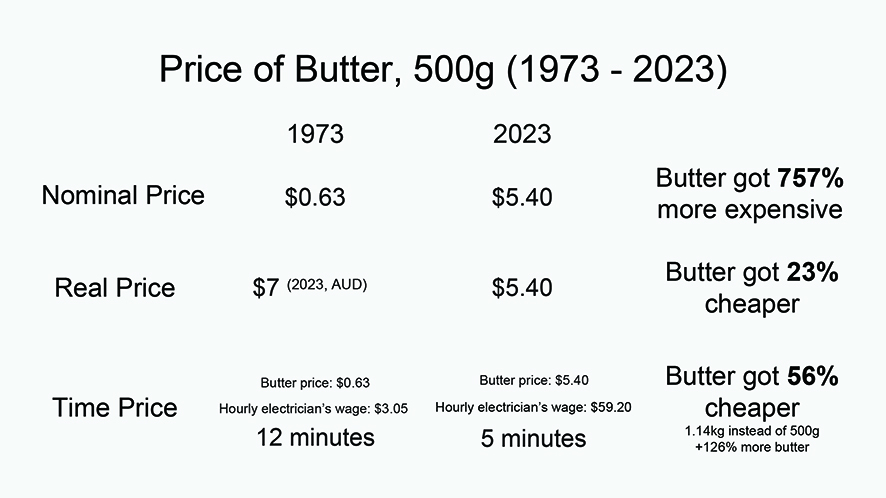
That takes us to the last step, which was necessitated again by the type of analysis we wanted to do. We know 500g of butter cost 63 cents back in 1973 and the average electrician’s wage was $3.05 per hour. Our electrician in 1973 would have to work 12 minutes to buy his butter. By 2023, the price of 500g of butter has increased to $5.40 but our electrician earned $59.20 an hour, which means he now has to work only five minutes to buy the butter. So, butter became 56% cheaper relative to wages. The same amount of time that would have bought you 500g of butter in 1973 now buys you 1.14kg in 2023 — butter got 126% more abundant relative to wages.
We undertook this kind of analysis for hundreds of different commodities. Remember that goods and services can get more expensive in nominal and even in real terms, and they can become cheaper relative to wages at the same time. What really matters is that if wages are increasing at a faster pace than inflation, then your typical worker is getting ahead.
Below is an example of growing abundance for blue-collar workers such as electricians in Australia over the past 50 years.
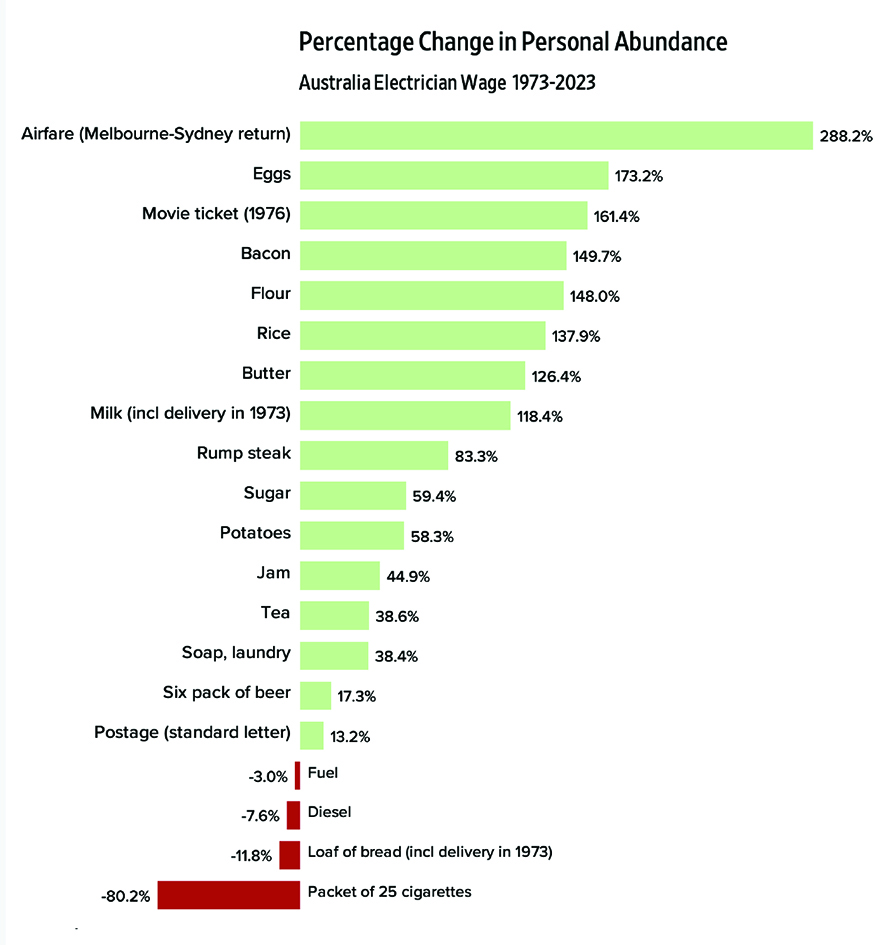
Over the past 50 years, you can see that looking at an airfare from Melbourne to Sydney, for example, our electrician can now get almost three tickets for the price of one. We can see similar things happening in terms of eggs, bacon, flour, rice, butter, milk, steak, sugar, potatoes, jam, tea… almost everything has gotten cheaper.
What didn’t get cheaper, what became scarcer over those 50 years is, for example, fuel, which is now 3% less abundant. I assume that’s because of higher taxes. And of course, cigarettes. Then, also bread, although back in the day, you got bread delivered to your door.
Below is a longer perspective of a century between 1901 and 2000 and this chart is for Australia as a whole.
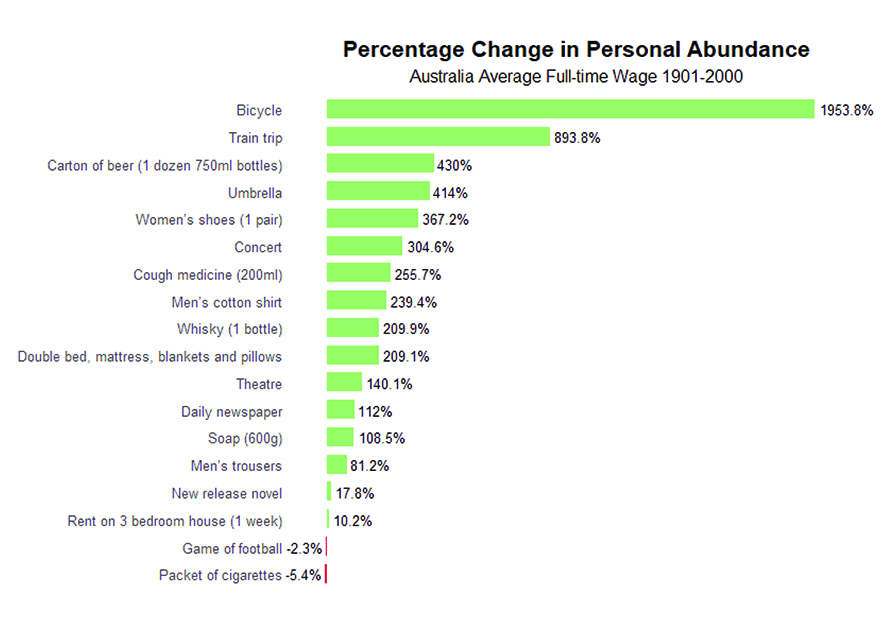
Cigarettes became more expensive, as did a game of football. But when you look at things like train trips, for example, women’s shoes, going to a concert, a bottle of whiskey, going to a theatre, a newspaper, clothing — even rent – they became cheaper.
And finally, below we have the story for Victoria.
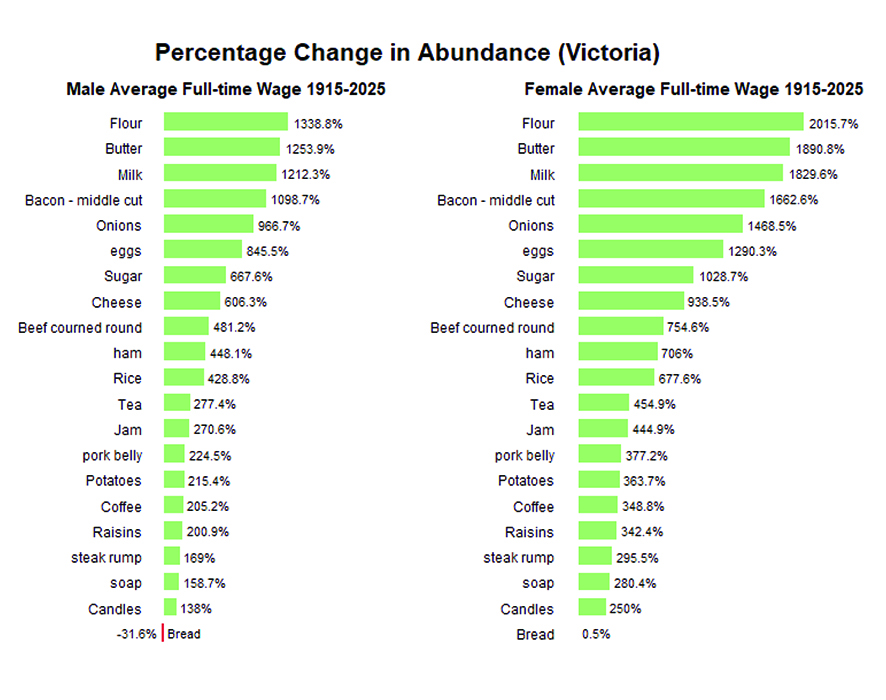
Women have experienced more abundance than men. That means that their wages have grown at a faster pace than men’s wages. That explains why flour, for example, relative to female wages is 2,000% more abundant but relative to male wages, it’s only 1,300% more abundant.
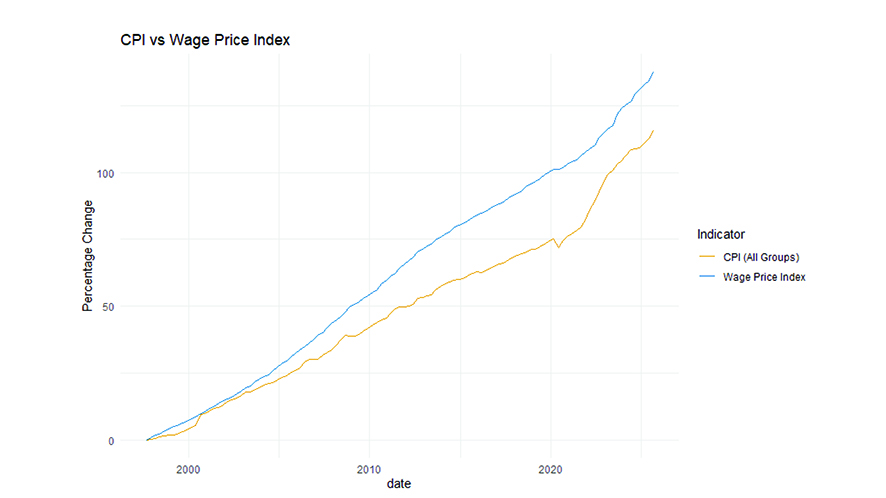
Unfortunately, not everything is getting more abundant. Below is the data for Australian inflation categories since 1997 all the way to September 2025.
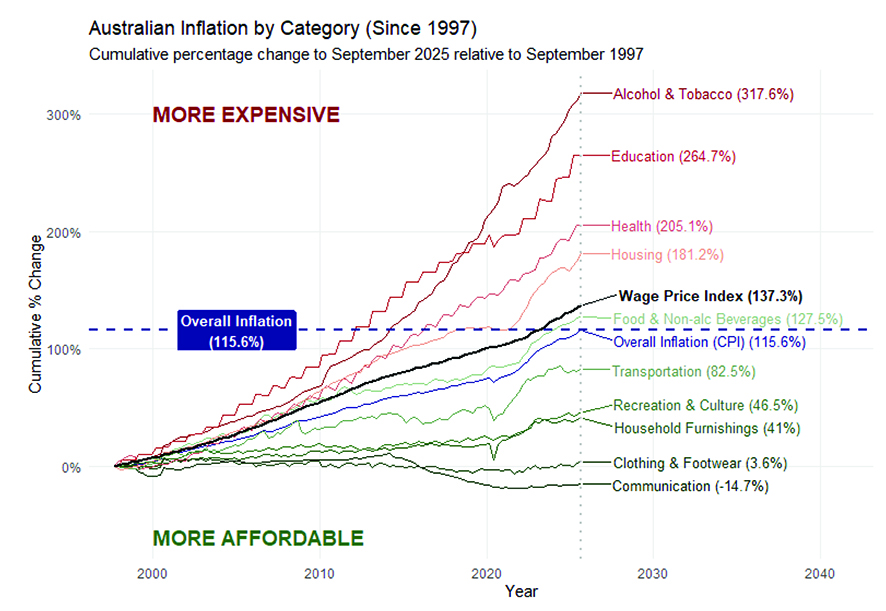
The prices of housing, health, education, alcohol and tobacco have grown at a faster click than inflation. If you adjust everything on this chart to wages (see the black line), you get an even more positive result, as shown in the chart below.
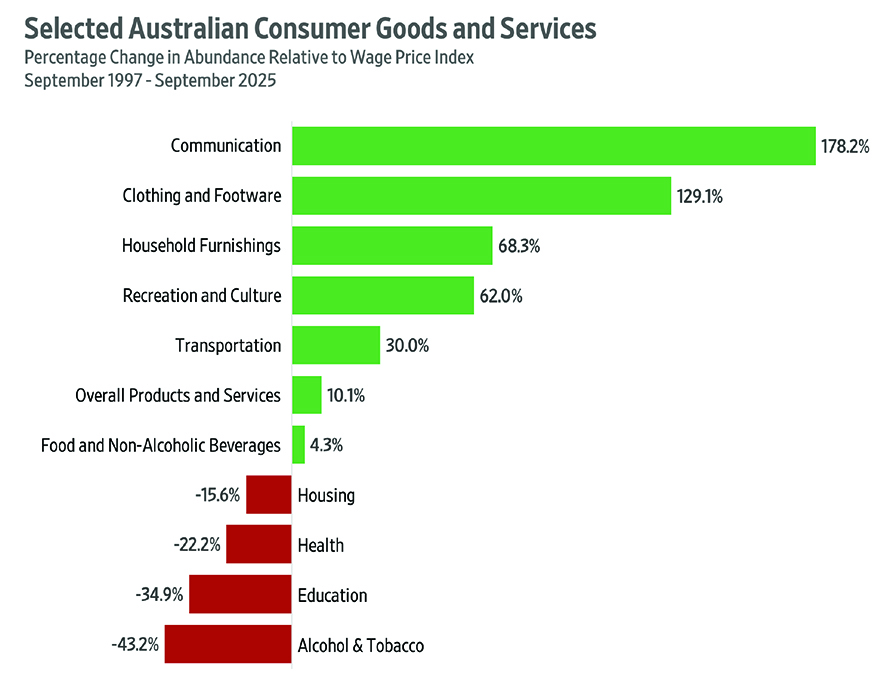
As you can see, communications have become more abundant. Clothing, footwear, furnishings, recreation, culture, transportation and even food and beverages are cheaper than what they were in 1997. But housing, health and education become more expensive.
If this chart depicted the United States, even housing would be about 10% more abundant on average. So obviously, the question for all of us is: why is it that we are not building up housing? The answer to that is NIMBYism, local restrictions, zoning laws, etc.
Health in Australia — if it looks anything like the United States — includes a lot of subsidies. Subsidisation is also pushing up the prices of education. I also suspect that the Baumol Effect [where costs rise in low-productivity sectors because wages follow those in high-productivity industries] is very much in play.
Our book was published in 2022 and the last year for which we had data was 2018. The graph below covers the period of globalisation from 1980 to 2018.
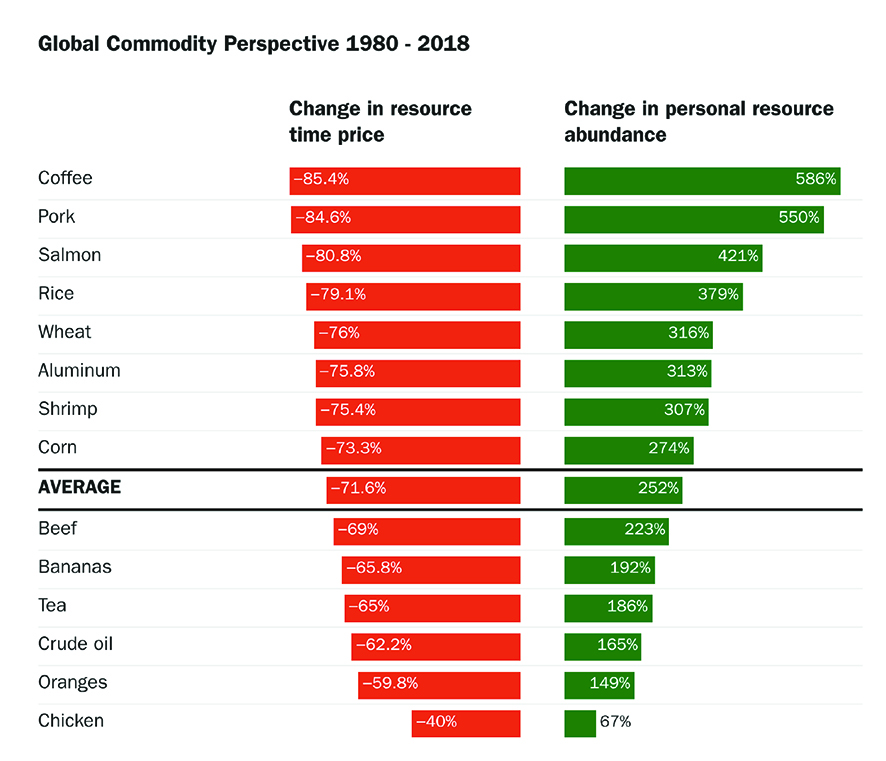
During that time, four billion people entered the global economy, including the populations of China and India. It was a period of tremendous economic growth. And it also saw a lot of consumption of resources. So, you would expect resources to increase in price. However, the opposite has happened.
In the book, we start with 50 different commodities going back to 1980 and they’ve all become more abundant. This chart shows only a few of them for the sake of legibility, but on average, those 50 most-traded commodities in the world have decreased by 72% in terms of time price, which means their abundance has increased by 252%.
Put differently, in that basket of 50 commodities, the same amount of time that would have bought you one unit in 1980, bought you two and a half in 2018 — in spite of that tremendous economic growth and consumption of resources — because resources have fallen in price; whether it’s coffee, pork, salmon, rice, wheat, aluminium, shrimp, corned beef … they’re all cheaper.
How did Australia perform? The chart below shows that Australia did not do badly, although China was the clear winner. China’s wages had grown so much that the time-price of those commodities had dropped by close to 98%.
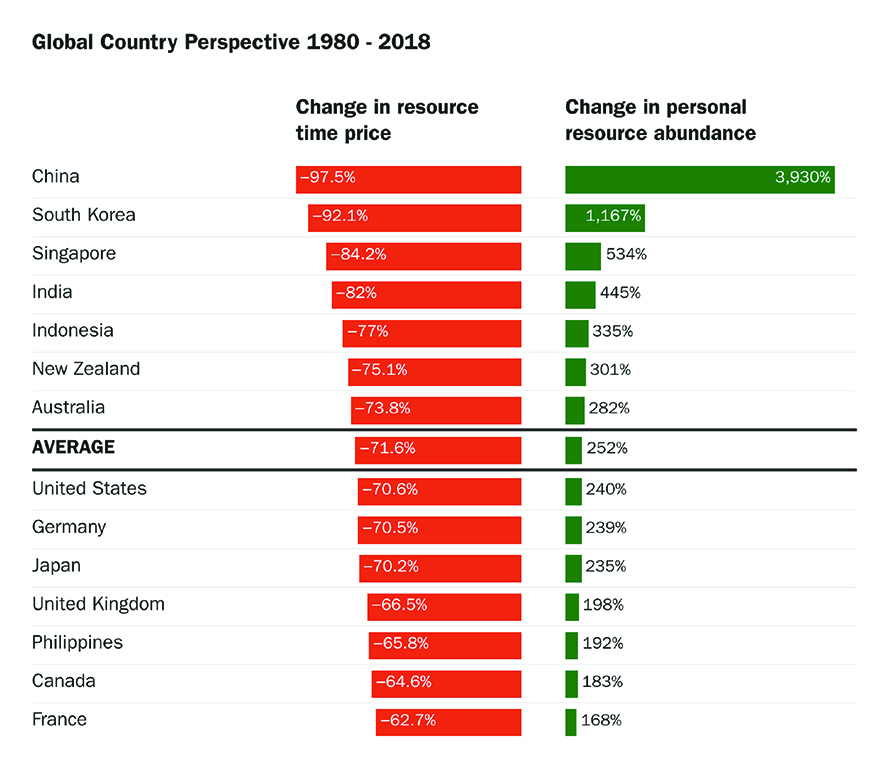
Australia is a little above average — its abundance over that period between 1980 and 2018 has increased by 282%. Time prices fell by 74% which was just about average. But Australia performed better than the United States, Germany, Japan, UK, Canada and France.
Our book looked at 18 different data sets. The chart below shows those data sets, with one axis showing an increase in population, and the other showing an increase in abundance. If Malthus were right, and if Ehrlich were right, the graph would instead show a decrease in abundance.
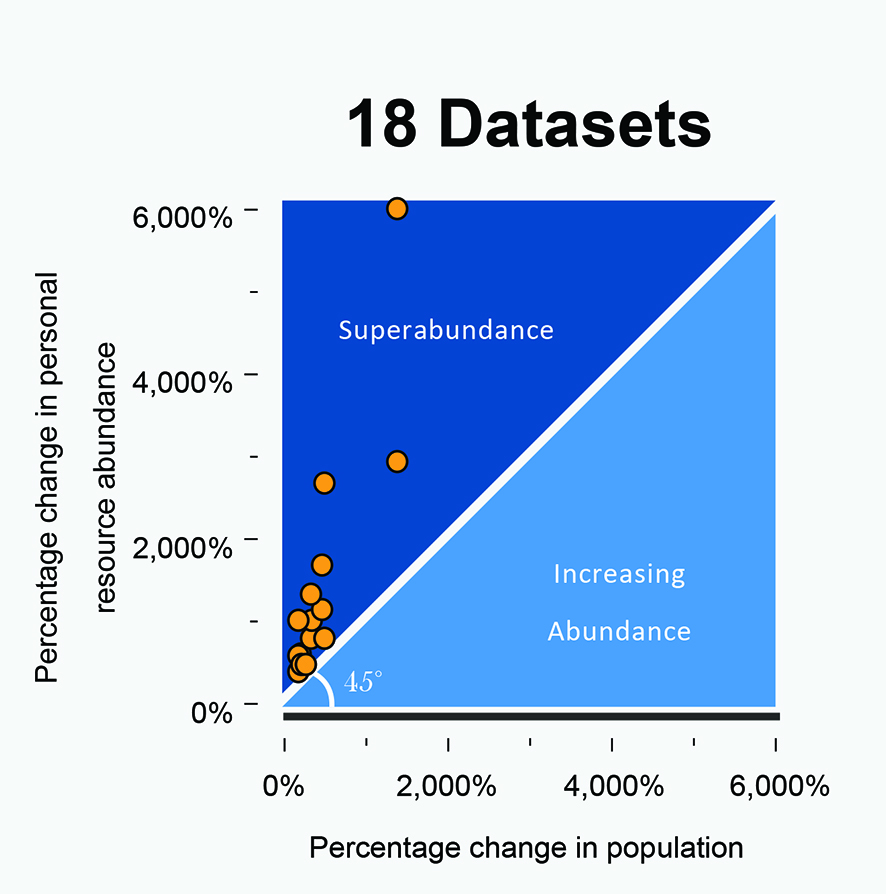
The interesting thing that emerged as we did our study, is that abundance can increase at two different rates. It can increase at a lower rate than population growth and a higher rate than population growth. The 45-degree line shows what happens when abundance and population grow at the same rate. But when abundance grows at a faster pace than population, you have what’s shown in the chart — what we call ‘superabundance’.
Returning to the views of Malthus, the reality looks different. It seems that resources are increasing at a faster pace than population, and the gap between them can be explained by the new knowledge produced in the human mind.
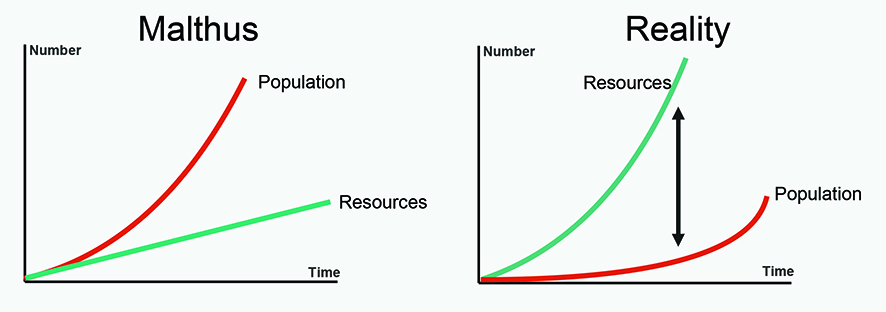
In our model, we start with the overall population size. Only a small fraction of humanity invents or innovates anything. So, the bigger the number of people living on the planet, the higher the absolute number of people who can invent or innovate something. For example, like Nobel laureate Norman Borlaug, the Father of the Green Revolution, who came up with disease resistant strains of wheat that have massively increased cereal yields — thereby contributing to the defeat of hunger that has plagued humanity since time immemorial.
But of course, population size is not all that matters. If it was all that mattered, then China would have been the world’s richest country for the last 2,500 years. China has been the most populous country, but the Chinese were poor. It was only after the economic liberalisation of the late 1970s that the Chinese people were free to invent and innovate. That’s how they became relatively prosperous. The bottom line is that population doesn’t reduce abundance. It increases abundance.
Can this situation continue? Not everybody thinks so. American environmentalist Kenneth Boulding says: “anyone who believes in indefinite growth on a physically finite planet is either mad or an economist.”
But my argument is that, from a wealth-creating perspective, the actual resource — the number of atoms — matters very little. Take a Lamborghini Huracan worth $250,000 and a crashed Lamborghini Huracan worth $5,000 … the number of atoms is the same, but they’ve been arranged differently. In the first one, the atoms are arranged intelligently and in the second one chaotically. It is human intelligence that is vital, because it allows us to grow the resource pie into infinity.
There are several ways in which we can increase our resources. One way to increase resources is through increased supply: whenever resources go up in price, that is a signal to the market to start looking for new deposits of oil, lithium, gas, or whatever else.
Another way in which you can increase supply is through technological breakthroughs. For example, in the United States in the 1970s, the oil fields were exhausted under the traditional drilling methods. And that’s when the US got very heavily involved in the wars in the Middle East, to get access to their oil. But then American entrepreneurs came up with fracking, and that allows the US to get at oil that was previously uneconomical. It suddenly became economical, and the US is once again the world’s greatest producer of oil and gas. Technological change matters.
You can also increase efficiency. A plastic bottle contains 50% as much plastic as it did 50 years ago. A can of Coke used to weigh three ounces of aluminium. Now it weighs half an ounce of aluminium. We can make these efficiencies; but they are relative efficiencies, because we are still producing a lot of plastic bottles and aluminium cans. What we want to do is to get to an absolute efficiency gain.
Rockefeller University research shows that 41% of the 100 most-used resources in the US are now post peak. Traditionally, as you have economic growth, consumption of resources grows in tandem. What started happening about 15 years ago is that the American economy continued to grow, but the absolute use of resources — the total tonnage of, for example, copper or iron — has started going down. So, you can get absolute increase in efficiency.
You can also get increased value. For example, 3,500 years ago, when we first melted sand, we would create glass beads that people used to decorate themselves. And then sometime later, we realised we can use sand to create jars and glass windows. Today, we are using glass in microchips and fibre optic cables. With every step of the way, we have increased value through human intelligence. You are moving from a situation where you are melting sand for glass beads to melting sand to create microchips. That’s human intelligence.
Lithium used to be used in ceramics to make the glaze stronger and the colours brighter. Now it is used in lithium-ion batteries to power Elon Musk’s Teslas. Graphite used to be used in pencils. But today, graphene — which is just a different form of carbon — is used to build aircraft.
We can also turn something that was useless into something that is very useful. In the early days, every oil rig would have a little flame on top of it. That was the natural gas that was being flared — being burned off. Because if you lit a cigarette on an oil rig and there was natural gas, you would blow up the entire rig and kill everybody around you. Well, we no longer flare that gas. We capture it, and then we pipe it into our cities, where it heats houses.
Substitution is a very important concept in economics. We used to kill whales to get their oil, which we then used to light our homes. Now we use electricity. We used to cut down forests for firewood. Now we use coal or gas. We used to fertilise our fields with animal manure, but later we switched to guano. Today, we use synthetic fertiliser. Some 4 billion people around the world are dependent on synthetic fertiliser — which is ammonia derived from natural gas — to survive.
Instead of animal fur, we use synthetic first. Lots of people wonder about lithium. Are we going to have enough lithium? Well, who is to say that future electric vehicles will be powered by lithium-ion batteries? They may be powered by sodium-ion batteries — China has just unveiled the first mass-market EV with a sodium-ion battery — and sodium is one of the most abundant resources on the planet.
Dematerialisation, of course, is a very important aspect of modernity. For example, 20 years ago, if you walked into a hotel in Australia, there would be a thick copper cable running from the wall that you would have to plug into your computer to get internet. Now we have Wi-Fi, which doesn’t use any atoms at all. We have dematerialised an economic function called ‘getting internet’ from using copper — which can now be used somewhere else — into air; no atoms needed.
The device in your pocket is not just a phone. It’s a TV, it’s a camera, it’s a GPS, it’s a notepad, it’s a flashlight. Imagine the mountain of atoms — the resources — that would go into producing everything that’s built into that phone. That’s dematerialisation.
Let’s turn to reuse. All the metals and minerals that Neanderthals or the Stone Age people had are still on the planet. We have shot a little bit of it into space, but ultimately, we can use and reuse anything we ever had. The same water the Neanderthals drank, we drink. The same mineral deposits they had, we have.
Transmutation is probably my favourite example of human progress. Isaac Newton was likely the smartest person who ever lived. He discovered gravity, but most of his time was spent trying to do magic — alchemy. He was trying to convert base metals like lead into gold. But we now know how to do that. About 50 years ago, we were able to use neutron bombardment to transform atoms of lead into atoms of gold. But of course, if we did it at scale, every ounce of gold would cost quadrillions of dollars in energy. So, we cannot do it yet, but given enough energy, we could do it in the future.
The good news is that almost all elements on Earth did not originate on Earth. They originated within stars. The Big Bang only created hydrogen and a little bit of helium. That hydrogen then got compressed under different pressures and different temperatures within stars, which — when they blew up — seeded the universe with gold and iron, and whatever else. And we just happen to be in that part of the universe where gravity put as much gold on the planet as we have here today.
But the point is that a star is really just a fusion reaction reactor, and the oceans are full of hydrogen. So given enough knowledge and enough cheap energy, we can replicate on our planet the process of creation of metals within stars — just using hydrogen and fusion. Those two things are necessary, and out of them, we can create anything else.
Sometimes the critics say: “maybe you’ve got the metals covered, provided you’ve got enough cheap energy and enough intelligence. But what about minerals?” Well, we already know how to create artificially the most expensive mineral. The prices of natural diamonds are collapsing. Why they’re collapsing is because we have developed methods that make synthetic diamond completely indistinguishable from a natural diamond. We take a tiny bit of diamond, we put it in a confined space, we super-heat methane until it becomes carbon vapour, and the latter deposits on top of that little diamond until it grows into the size we require. Chemically and physically, it is completely indistinguishable from the real thing.
And finally, there’s space mining. There’s a very interesting convergence going on between three different technologies. We have robotics, we have AI and we have solar. And once you put these three together, you can shoot an army of robots on a starship into the asteroid belt to mine for water, for example.
What we really need is more knowledge, and knowledge is potentially unlimited. Or as Nobel laureate economist Paul Roman says, we consistently fail to grasp how many new ideas remain to be discovered. The difficulty is the same that we have with compounding — possibilities do not add up. They multiply. What we need is more intelligence; more knowledge.
In summary, more people have more ideas, which lead to more innovations, which lead to productivity gains, which then leads to higher standards of living. Superabundance, which is what happens when abundance increases at a faster rate than population, requires two things: population and at least some degree of human freedom.
Let’s now turn to the total fertility rate (TFR) or the number of children an average woman has in a lifetime. To keep population stable, it should be around 2.1 or 2.2. Currently we are at 2.2 which is down from five in 1968 when Ehrlich wrote his famous book The Population Bomb. And by 2050 we’ll be down to 1.8 children per woman per lifetime. That’s with 95% confidence level, from a study that was produced by Lancet a couple of years ago.
So, we are at the replacement level now. We could even be lower than that and that’s only going to get worse. In 2064, world’s population begins to decline. Maybe it starts a little bit earlier. Is that a problem? In our model, yes, it is a problem. And the question is, how do you fix it?
Some people tried with subsidies. Hungary tried it — it didn’t work. Russia tried it — didn’t work. South Korea tried it — didn’t work. It’s tremendously expensive, and subsidies clearly don’t work.
We could try to reduce the cost of having a child and starting a family. One obvious way to do it is to end housing shortages. We need to take on the NIMBYs, and turn them into YIMBYs — ‘yes, in my backyard’.
The problem is human psychology and self-interest. When you are young, have no money and you want a house, you want people to build as much housing as possible. But once you are older and have bought a house, you don’t want anybody to build anything ever again, because you think the price of your house is going to go down.
We could end education subsidies, which currently keep young people at school for far too long. People spend so much time at universities that by the time they leave — especially say, for example, highly intelligent females who may go into postgraduate degrees, maybe even a doctorate — they may be in their early 30s. By that time, the amount of time left in terms of having healthy children has really shrunk to almost nothing.
But even if you can address the problem of housing shortages and education subsidies, the problem is that the opportunity cost for women to have babies is still very high. Not just in terms of money — that if a woman interrupts her career to have children, she’s going to make less money in the remainder of her life. What I’m talking about is opportunity cost in terms of time that she could be doing other things. She could be going to Bali. Or she could be going to a concert, or she could be doing X, Y and Z, rather than staying at home with children. The world has become so exciting that the opportunity cost of having babies is growing ever higher.
And that is true even in poor countries. What we are finding is that the total fertility rate is dropping even at very low level of GDP per capita. Why is that? It is because even in places you would not normally associate with prosperity, people are getting access to things that are exciting and that consume time — such as smartphones, such as internet, such as television, such as the possibility to travel and so on. Distractions are becoming cheap, and even poor people are getting access to them, and consequently they are having fewer and fewer babies. The opportunity cost is not going to go away.
The other possibility is robotics, whereby you grow a fertilised egg in an artificial womb and then you hand it over to a robot nanny.
Artificial General Intelligence (AGI) could, of course, be a replacement for humans when it comes to ideas. The problem is that Large Language Models (LLMs), while they are excellent at summarising literature and research, are not very good at coming up with their own ideas. When AIs started showing a bit of personality, such as hallucinating, we really beat it out of them. We are trying to make AIs as unsurprising as possible, because you have a lot of people who also believe AI is going to kill us.
The point is that we don’t want AI to surprise us; but if AI doesn’t surprise us, it’s not delivering on what the future needs — which is new ideas. Because ideas are, by definition, new surprises. It’s as though AI would have to know not only that there is such a thing as gravity and that there’s a mathematical formula for explaining gravity; AI would also have to know that there’s a problem that we need to solve, such as gravity.
Not all countries are suffering from collapsing Total Fertility Rate (TFR) to the same extent. Israel is a country where women, especially religious women, have many more babies than would be required for a replacement level. Can you recreate the same kind of religious commitment elsewhere? Perhaps the future will belong to certain minorities, such as the Amish in the United States, who have between five and seven babies per woman.
Or, you could have more people living in freedom. Again, superabundance is the combination of freedom and population. If more countries became free and their people were able to participate in globalisation, maybe you could have more ideas.
Unfortunately, freedom is shrinking, and innovation around the world is restricted to few countries. You’ve got the United States, you’ve got Israel, you’ve got parts of Western Europe, you’ve got South Korea — that’s where innovation happens in other parts of the world. The alternative is to bring smart, innovative people into the places where innovation happens, United States, South Korea, etc.
The problem is that immigration is unpopular and increasingly politically unacceptable. However, there is still the argument that even in places that don’t want large-scale immigration, a compromise could be struck by allowing high-skilled immigration that doesn’t involve millions of people, but does involve bringing in people who have high IQs from unfree countries into free countries. That may be the one thing that can help us maintain innovation in the short to medium term.