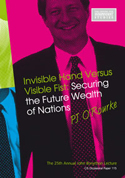

In the 25th John Bonython lecture, PJ O’Rourke presents his view of the economic and financial crisis that is shaking the world.
In a tour de force from Adam Smith to Bulgarian blue jeans, from Chicken Little to Barack Obama, O’Rourke solves the problems of our time. What is still puzzling to the world’s leaders becomes clear when seen through the eyes of America’s leading satirist. PJ O’Rourke’s answer to a decline in the value of speculative assets? To pay less for them. And what should be done about the recession? Nothing. Because the cure is worse than the disease.
Best known for his trenchant journalism and penchant for sarcasm, PJ O’Rourke is the author of some 14 books, including Parliament of Whores, Republican Party Reptile, Eat the Rich, CEO of the Sofa, and Driving Like Crazy:30 Years of Vehicular Hell Bending. The whisky-loving cigar aficionado was formerly editor of National Lampoon and foreign correspondent for Rolling Stone magazine. He is an H.L. Mencken Research Fellow at the Cato Institute and a regular correspondent for the Atlantic Monthly.
Who seeks to trade freedom for security loses both. And this is just as true of economic freedom as it is of freedom from being sent to the Gulag. You’ve got the cow of economic freedom. Are you going to take her to the market and trade her for the magic beans of a global stimulus package? When you climb that beanstalk you’re going to find a giant government at the top. Think you’re going to be as lucky as Jack in the Beanstalk was? I’m not even sure Jack was that lucky with his giant killing.
I mean, all we’ve got to go on is the story Jack told. Jack-The-Giant-Killer—that’s Jack’s version. My guess is that Jack spent years getting investigated by giant government committees and now Jack’s paying a giant 95 percent tax on Jack’s beanstalk bonus. I’m an economics fan—like some people are sports fans. I root for the free market team. Adam Smith is my star player. I’ve got all his memorabilia—The Wealth of Nations, The Theory of Moral Sentiment, the Division of Labor bobble-head doll. It’s my hobby. I wrote a book about it. So people ask me, ‘What would Adam Smith say about this financial meltdown?’ Usually these are people who are forgetting to remember that the free market is the greatest reserve of our freedoms. Economic freedom is the freedom we exercise most often and to the greatest extent.
Freedom of Speech is important—if you’ve got anything to say. I’ve checked on the Internet. Nobody does. Freedom of Belief is important—if you believe in anything. I’ve watched cable TV. I can’t believe it. Freedom of Assembly is important—if you have an assembly to go to, the way we do. But most people to go to the mall. And, at the mall, they exercise economic freedom.
But the Free Market is dead. The Free Market was killed by the Bolshevik Revolution, by fascist central planning, by Keynesianism, the Great Depression, World War II economic controls, the British Labor Party victory of 1945, Keynesianism again, the Arab oil embargo, Tony Blair’s and Bill Clinton’s ‘Third Way’ economic policies, and by the current financial crisis. That’s 10 times the Free Market as has died in the past 100 years. And every time the Free Market dies, everybody wants to know, ‘What would Adam Smith say?’ It’s a ‘Hi, God. How’s my atheism going?’ moment.
What would Adam Smith say? He’d be laughing too hard to say anything. Smith spotted the cause of our financial disaster—not just before 2008, but 232 years before 2008. Let me read a little passage from The Wealth of Nations, published in 1776. ‘A dwelling house, as such,’ wrote Smith, ‘contributes nothing to the revenue of its inhabitant.’ And Smith went on to point out that, even if the house is rented, ‘as the house itself can produce nothing, the tenant must always pay the rent out of some other revenue.’
So Smith concluded ‘the revenue of the whole body of the people can never be in the smallest degree increased …’ by a bunch of ugly condominiums and tacky housing developments. Viola, sub-prime mortgage meltdown. Adam Smith knew about speculative bubbles. The South Sea Bubble and the Mississippi Scheme, which was the French version of the same idea, had blown up just a couple of years before Smith was born. The speculative bubbles of the early eighteenth century were part of Smith’s cultural DNA. There were at least a hundred other bubbles besides the famous South Sea and Mississippi frauds. One such had as its complete prospectus a statement that a company was being formed ‘for carrying on an undertaking of great advantage, but nobody to know what it is.’
For Europeans of Adam Smith’s generation, the ‘speculative bubble’ was a defining disaster of history. This was their Gallipoli—in a financial sense. And while Smith was in Scotland writing The Wealth of Nations, the collapse of a real estate boom set off a run on Scottish banks. Only three of Edinburgh’s 30 private banks survived. The reaction of Scottish investors sounds very familiar. Smith wrote that the speculators seemed to have thought that ‘The banks were in honour bound to supply the deficiency, and to provide the speculators with all the capital which they wanted.’
Smith knew that speculative bubbles are not caused by the Free Market. Speculative bubbles are the result of a break-down in something—sometimes common sense, sometimes rule of law—but they’re not the result of a break-down in market freedoms. The free market is not a creed or a belief system that we ‘capitalists’ ask people to take on faith. The free market is a measurement. The free market tells us what people are willing to pay for a given thing at a given moment.
That’s what the free market does, and that’s all it does. It gives us one piece of information. But it’s a very important piece of information. People ignore it at their peril. Like the leaders of the old Soviet Union did. They lost the Cold War not because of tanks or troops or missile shields. They lost the Cold War because of Bulgarian blue jeans. The free market was trying to tell the Kremlin that ‘Bulgarian blue jeans suck. Nobody wants them at any price. They won’t wear Bulgarian blue jeans, not even to save their lives.’ But the Kremlin wouldn’t listen. And the Berlin Wall came down.
The free market is a bathroom scale. We may not like what we see when we step on the bathroom scale. ‘Jeeze—230 pounds!’ But we can’t pass a law making ourselves weigh 185. And socialists and fools—to the extent that there’s a difference—think we can. So how would Adam Smith fix our financial crisis? Sorry, but it’s fixed already. The answer to a decline in the value of speculative assets is to pay less for them. Job done! We could pump the banks full of our national treasure. But Smith said, ‘To attempt to increase the wealth of any country, either by introducing or by detaining in it an unnecessary quantity of gold and silver, is as absurd as it would be to attempt to increase the good cheer of private families, by obliging them to keep an unnecessary number of kitchen utensils.’
We could send in the experts to manage our bailout. But Smith said, ‘I have never known much good done by those who affect to trade for the public good.’ And we could nationalize our economies. But Smith said, ‘The state cannot be very great of which the sovereign has leisure to carry on the trade of a wine merchant or apothecary.’ Not to mention Chairman of General Motors. So, the Meltdown of 2008–09 … What’s the G-20 going to do? What sort of enormous ‘G-forces’ will we be subjected to? Ronald Reagan summed up our problem in one sentence. Reagan said, ‘The nine most frightening words in the English language are, “I’m from the government and I’m here to help.” ’
Our greatest fear should not be the recession. Our greatest fear should be that our national leaders are engaged in ‘Recession Preservation.’ That their policies will make this crisis probably worse and definitely more prolonged. I’m not saying that they mean to do this. But I’m not saying they don’t. What’s bad for us is good for politicians. The politicians are here to save us. And why would we want a politician here, if there’s nothing to save us from? HL Mencken put it well. He said, ‘The whole aim of practical politics is to keep the populace alarmed—and hence clamorous to be led to safety—by menacing it with an endless series of hobgoblins, all of them imaginary.’
Actually, it’s worse than that. When politicians are really dangerous is when the hobgoblins aren’t imaginary. Every politician is Chicken Little. ‘The sky is falling! The sky is falling!’ But then you get a situation like global warming. Maybe the sky is falling. You think Chicken Little was bad before? Think how bad Chicken Little would be if he were telling the truth. You can just hear Chicken Little’s campaign speech.
‘My feathered friends! Our coops are guarded by foxes! All our eggs are in one basket! We’re living on chicken feed! And Col. Sanders is threatening massive lay-offs at KFC! Plus the sky is falling! In these troubled times who better to lead us in squawking and fluttering and running around after our heads have been cut off than the Hon. C Little—a real chicken!’ What’s bad for us is good for politicians.
Politicians are a bit like me and my fellow journalists that way. A couple of months ago I was in a store in a little shopping center. And a TV news crew rushed in the door. I asked them what was up and they told me there was a big propane tank across the way that had sprung a leak. And I said, ‘Well, I guess this wouldn’t be the moment to step outside and have a smoke.’ And they said, ‘Oh, please do! We worship different gods than you do.’ Politicians—they worship different gods than we do.
So what are our national leaders up to? Well, I can’t speak for your national leader. But I’ve been keeping an eye on mine. The first thing President Barack Obama does is a $700-billion economic stimulus. Wasn’t that the last thing President George W Bush did? Didn’t America just spend $700 billion? And now America’s spending $700 billion again? Or am I getting old? Little problem with my hearing? Echo in the Miracle Ear? The $700-billion Bush financial bailout plus the $787-billion Obama stimulus package plus a $3.6-trillion federal budget—add all that together and it equals … More money than there is. There ain’t that much money. The Obama administration is taking more money than we, you, or anybody else has got. The $1 trillion, 487 billion that America is spending on the financial bailout plus the economic stimulus package is equal to more than a year’s worth of US individual and corporate income tax payments put together.
Which raises the question: Instead of a bailout and a stimulus, why not no taxes for a year? Zero. Zip. None. Stop taxing us! Would this be an economic stimulus? Uh, yeah. A stimulus? Comparing no taxes to what the Obama administration is doing is like comparing Viagra to Tylenol PM. Would this be a financial bailout? I guess so. A bailout? Just let that old Wall Street rowboat sink. ‘Cause we’re getting a new yacht!’ But, no taxes? This will never fly. Why not? Because no taxes—that only puts money in the pocket of people who pay taxes. Politicians can’t buy votes like that.
People don’t love a politician for giving them their own money that the politician just snatched. This is like running off with a man’s wife and expecting him to thank you when you drop her off at home the next day. Robin Hood didn’t steal from the rich and give to the … rich. Likewise, politicians who pretend that they’re Robin Hood have to give tax money to people who don’t pay taxes.
And do you know how many people pay taxes, statistically speaking? Let me give you a little math on this. The annual US federal government expenditure is close to $3 trillion. There are about 300 million Americans. Federal expenditure is something like $10,000 per year per person. (Slightly less than it is here.) So an American family of four is getting $40,000 a year spent on it by the federal government. Which means this family of four would have to be paying $40,000 a year in federal income tax just to break even.
After using all possible income tax deductions plus the customary amount of cheating on taxes, that means a family income of more than $160,000 a year. Which makes this family among America’s wealthiest families—in the top 5 percent.
Give my figures a plus or minus 5 percent margin of error and you see that, statistically speaking, nobody pays taxes. We’re all on the teat. We’re sponges. The citizens of every Western democracy are a bunch of blood-suckers. And the G-20 remedy for this recession is like the medical treatment back in the days of Adam Smith—apply more leeches! In times of crisis you get the G-20 kind of world leaders. You get Barack Obama. If you’re lucky. If you’re not lucky you get Vladimir Putin.
Obama’s got a great economic plan. If it’s working, tax it. If it isn’t working, bail it out. If it’s just scraping by, drop the Federal Reserve Bank on it ’till it screams for help. Is it too soon to talk about the failed Obama presidency? I’ve got to wonder about Obama’s whole ‘hope and change’ theme. Especially the ‘change’ part. I’ve got young kids. I just finally got the last one out of diapers. ‘Change’ is not a good word as far as I’m concerned. In fact, change is not a good word as far as most people are concerned most of the time: Change a tire. ‘You’d better change your ways.’ Change of life. ‘Spare change, Man?’ Any change is a wart or mole.
Then there’s hope. You remember your Greek mythology. The box that hope comes in is Pandora’s Box. And after Pandora opens that box, and death and disease and all the ills that plague mankind have been let loose on the world, nothing is left in the box but hope. Is it a good thing when you’ve got nothing left but hope? How about when you’ve got nothing left but hope in your bank account? The failed Obama presidency. Bringing politicians in to run Wall Street is like saying, ‘Dad burned dinner, let’s get the dog to cook.’ I love Obama’s plan to split the assets of troubled financial institutions into good banks and bad banks. Good assets go to a ‘good bank.’ Bad assets go to a ‘bad bank.’ I am opening a checking account at a bad bank. New customers at bad banks don’t get good things like toasters, we’ll get bad things like whiskey and guns. And the personalized checks in bad bank checkbooks don’t have pretty pictures on them, they have printed messages: ‘This is a stick up.’
Politics is going to take over the car industry. I can predict the result—a light-weight, compact vehicle with a small carbon footprint using sustainable alternative energy. When I was a kid we called it a bike. America has wound up with a charming leftist as a President. And this scares me. This scares me not because I hate leftists. I don’t. I have many charming leftist friends. They’re lovely people—as long as they keep their nose out of things they don’t understand. Such as making a living.
When charming leftists stick their nose into things, they don’t understand they become ratchet-jawed purveyors of monkey-doodle and baked wind. They are piddlers upon merit, beggars at the door of accomplishment, thieves of livelihood, envy-coddling tax lice applauding themselves for giving away other people’s money. They are the lap dogs of the poly sci class, returning to the vomit of collectivism. They are pig herders tending that sow-who-eats-her-young, the welfare state. They are muck-dwelling bottom-feeders growing fat on the worries and disappointments of the electorate. They are the ditch carp of democracy. And that’s what one of their friends says.
Also, a charming leftist president scares me because what if Obama really does turn out to be a ‘uniter, not a divider’? This could mean an end to partisan bickering and result in politicians of all stripes working together to solve national and international problems. Then we’re really screwed.
America needed a Republican president. Because America has a Democratic congress. Republican president, Democratic congress—this means gridlock. I love gridlock. The worst thing in politics is ‘bipartisan consensus.’ Bipartisan consensus—that’s like when my doctor and my lawyer agree with my wife that I need help. The global economic meltdown is bringing droves of these consensus-builders to office. (And I, for one, am over the age of consent.)
What does this busy-body type of politician intend to do with all the consensus that’s being built? And we have to remember that it’s not just a financial crisis that we’re facing. There’s Iraq. And the war in Afghanistan. North Korea. Darfur. Pakistan producing more history than it can consume locally. If Obama is anything to go by in the new style of crisis leadership, I am not reassured. First, he appoints a Secretary of State, Hillary Clinton, who thinks ‘foreign affairs’ means her husband is overseas.
So far, the best Barack Obama has been able to do by way of an Iraq policy is to make what I think of as the ‘high school sex promise’: I’ll pull out in time, honest, honey. Obama has committed more troops to Afghanistan. But committed them for what? For whatever the NATO allies want, I guess. Great. Obama is going to decide what to do in Afghanistan by waiting to see what France does. Although waiting to see what France does may not be such a bad idea. Because France is a treasure to mankind. French ideas, French beliefs, and French actions form a sort of loadstone for humanity. Because a moral compass needle needs a butt end. Whatever direction France is pointing—toward Nazi collaboration, Communism, Existentialism, Jerry Lewis movies, or running for cover in Afghanistan—we can go the other way with a clear conscience. We’ll need to watch what France does to stimulate its economy so we’ll know what not to do.
My guess is that France will be relying on Muslim teenagers in the suburbs of Paris, Toulouse and Marseilles. Those kids had a great plan for stimulating car sales in France. Specialitie de la maison, Citroen flambé. The European Union seems to be even more confused by this financial meltdown than the rest of us are. Not that I blame the Europeans for being confused. I mean, Joe Jerk down the road from me in America. Him with all the cars up on blocks in his front yard. He falls behind in his mortgage payments and the economy of Iceland explodes. I’m missing a few pieces of this puzzle myself.
A lot of lousy mortgages, that would probably never get repaid, were handed out to Joe Jerk and his drinking buddies and all the ex-wives and single mothers and bastard kids with whom Joe and his pals have littered the world. And Wall Street is looking at all this worthless paper and thinking, ‘How can we make a buck off this?’ Well, the answer was to wrap it in a pretty bow. If you took a wide enough variety of lousy mortgages—some from cities, some from suburbs, some from blue collar shacks, some from white collar McMansions—and you bundled them all together and you put pressure on the bond rating agencies, Moody’s and S&P, to do some fancy risk management math … You came up with a ‘Collateralized Debt Obligation’ with a triple-A rating—good as cash. Until it wasn’t.
Or, to look at it another way, Wall Street was pulling the old ‘room full of horse shit’ trick on us. The brokers were saying, ‘I’m going to sell you a room full of horse shit. And with that much horse shit, you just know there’s a pony in there somewhere.’ Anyway, it’s no use blaming Wall Street. That’s like blaming whores for getting paid. The people on Wall Street never took a vow to forsake all others and stick with us in sickness and in poverty. They’re in it for the money. We pay them to be in it for the money. We don’t want our retirement accounts to get a 2 percent return. (Although that looks pretty good at the moment.)
The one thing we know is that this financial crisis will come to an end. The left-wing crises managers may be able to slow the recovery, but they can’t stop it. The credit/investment freeze will end, because … Investment defines humanity. Animals don’t invest. If a dog has a surplus, he’ll eat it all and vomit it up rather than give some of it to another dog in return for shares in the car-chasing and the chewing of shoes. Investment defines civilization. Barbarians don’t raise money with debt and equity. They raise money by stealing. (Although, during the boom in sub-prime mortgage lending, it sometimes was hard to tell the difference between debt and stealing …) But, even so, investment is one of the most important inventions in human history. If it weren’t for investment, all the innovators, manufacturers, and business people who have brought prosperity to the modern world would have to get money the way I do, by asking their wife.
There’s one problem with my talking to you about investment, however. I was an English literature major. I don’t know anything about investment. (Of course, lately it’s looking like nobody else does either. But I really don’t know anything.) Best investment I’ve made lately? I left a $20 bill in the jacket pocket of this suit last month. And I just found it this morning. (Which puts me way ahead of my mutual fund.)
Anyway, I’m too stupid to talk to you about economics. However, in fairness to myself, I’m not just stupid. I’m a student of stupidity. I’m a political reporter. In my job stupidity is an asset. We live in democracies. Rule by the majority. Rule by the people. Fifty percent of people are below average in intelligence. This explains everything about politics. Not that we’d want to live in a country ruled only by the best and brightest. That would be too much like being married to Cherie Blair.
So we have to keep supporting democracy. Even when democracy acts up the way it’s done in Russia, Pakistan and the American presidential election. Long term there’s only one thing that gives me hope as a right-winger—the left-wing. It’s going to be hard to do a worse job running America than the Republicans did, but the Democrats can do it if anyone can.
The Left is the party of government activism—the party that says government can make you richer, smarter, slimmer, taller, and take a dozen strokes off your golf game. The Right is the party that says government doesn’t work. And then they get elected and prove it. The Right promises to ‘make the government smaller.’ And the Republicans in America succeeded—with their part of the government. The Republican majority in the House and the Senate is definitely smaller.
What the Left promises is ‘More.’ A whole lot more … of something to be named at a later date. And what the Right promises is a little less of whatever the Left is promising, plus death penalties. The Left says, ‘We don’t know what’s wrong with capitalism, but we can fix it.’ The Right says, ‘There’s nothing wrong with capitalism, and we can fix that.’ And all politicians—left, right and center—want government to solve every one of the world’s problems, from curing cancer to getting Angelina Jolie’s tattoos removed. They want government to do this.
Government can’t run a post office. I mean, government has trouble figuring out where mail goes. And mail has got our address right on the front of it. What we get is a choice between left-wingers who can’t learn from the past and right-wingers who can’t stop living in it. Between left-wingers who want to tax us to death and right-wingers who would prefer that we get shot with an assault rifle by a lunatic in the work place.
You know, my job is to make fun of politics. But after 39 years of making fun of politics, I’ve realized that I’m enjoying myself about as much as a bear getting a bikini wax. I hate politics. And I don’t just hate bad politics. I hate all politics. I even hate democracy. Imagine if our clothes were selected by the majority of shoppers, which would be teenage girls. I’d be standing here with my midriff exposed. Imagine deciding what’s for dinner by family secret ballot. I’ve got three kids and three dogs in my family. We’d be having candy and rotten meat.
Politics stinks. Think about how we use the world politics. Are ‘office politics’ ever a good thing? When somebody ‘plays politics’ to get a promotion, does he or she deserve it? When we call a coworker, ‘a real politician,’ is that a compliment? Politics stinks. And to my mind true conservatism is a room deodorizer—trying to keep the bad smell of politics out of home, school and office.
But I don’t blame politicians for not telling the truth about politics. Because just think what the truth would sound like on the campaign stump. Even a little bitty bit of truth: ‘No, I can’t fix public education. The problem isn’t funding, or teachers’ unions, or overcrowding, or absence of computer equipment in the classrooms. The problem is your damn kids!’ The business of politics is always more corrupt than the business of business.
Yes, there are some bad people in business. My stockbroker. Free market economics can be tough—as you may have noticed. But the only alternative to the purgatory of free markets is the hell of politics. Personally, right now, I would rather be starting a pig farm in South Waziristan than be trusting politics to solve my problems.
Political corruption is a law of economics. When buying and selling are controlled by voting, the first things that get bought and sold are votes. Do our politicians understand this law? They should—they’re lawyers. (And, incidentally, letting lawyers write laws is like letting pharmaceutical companies invent diseases.) Let me give you an example of how politics leads to corruption—in agriculture. I know you have this problem here.
And in America, agriculture is a business that’s been up to its bib overalls in politics since the first Thanksgiving Dinner kickback to the American Indians for subsidizing Pilgrim Forefather maize production with fish head fertilizer grants. Last year the US Congress passed the Farm, Nutrition and Bio-Energy Act of 2008. This was $285 billion worth of agricultural subsidies and price supports. $285 billion is five times the pre-war gross national product of Iraq. For what the Farm, Nutrition and Bio-Energy Act of 2008 is costing American taxpayers, we could have avoided the war with Saddam Hussein and just bought his god damned country. (And I bet we could have sold it to China for a profit. The Chinese want oil. Hand ’em the deed to Baghdad and let ’em go get it. Give the Communist Chinese a little taste of Fallujah and they’d be wishing for monk riots in Tibet.)
Anyway, as I was saying, Farm, Nutrition and Bio-Energy Act of 2008. Now, the idea of these subsidies and price supports is supposed to be to ‘save the family farm.’ The problem is there aren’t any family farms in America any more. ‘Farming’ in the US means a mass production assembly line for plucking 100,000 chickens raised in a space the size of a backyard sauna. The only family farms left in the Western Hemisphere are in places like Peru, and what they’re growing is cocaine.
As for the ‘Nutrition’ in the name of the bill. If we cared anything about nutrition, we would—to judge by the mountainous, lardy, jiggling flab of Americans—stop growing all food immediately. And ‘Bio-Energy’? That is a fraud of Bernie Maddoff proportions—taxpayer money composted to produce a fuel made of alcohol that is more expensive than oil, causes more pollution than oil, and tastes almost as bad as oil with vermouth and an olive.
Besides, up in the back hills of Kentucky, they’ve been making high-octane stuff out of corn mash for 200 years. And I can’t see it’s done their economy much good. So, the Farm, Nutrition and Bio-Energy Act of 2008 turns out to be $285 billion worth of corporate welfare for rich landowners and huge agri-businesses. And it passed to the US Congress with a big majority of votes from both political parties—bipartisan consensus at work!
Now, like most Americans my age, my actual experience with agriculture is pretty much limited to raising marijuana plants under grow lights in my off-campus-apartment 40 years ago. But I did once help artificially inseminate a cow … I had this half-baked friend, a complete city slicker, who—out of the blue—decides he’s going to raise cattle. So he buys a farm and he buys some cows. And I’m up visiting him when it’s time for the cows to get in a family way. Now this is not done like I might have thought, with a cow and a bull in a heart-shaped stall and some Céline Dion tapes. B
reeding cattle is like teenage pregnancy, but more so. Not only isn’t the bull around to help raise the calf, he’s not even there to get the cow knocked up. What happens instead is there’s this liquid nitrogen thermos bottle full of frozen bull semen. (Let’s not even think about how they get that.) And there’s this device that looks like a giant hypodermic needle. Anyway, my friend got this real farmer, Pete, to come in and actually do the honours.
So, while I’m holding the cow’s head and my friend is holding the cow’s middle, Pete takes this freezing cold syringe thing and inserts it into a very personal and private place of the cow. Then what Pete does is he sticks his arm into an even more personal and private place of the cow—all the way up to the elbow. Now, Pete does this not to get on the Internet with a pornographic website, but so that he can feel the tip of the inseminator tube through the cow’s intestine wall and guide that tip into the cow’s uterus.
It was a pretty gruesome thing to watch and, I’m glad to say, since I was up at the cow’s other end, I didn’t watch it. But I’ll tell you one thing—I will never forget the look on that cow’s face. It was the same look that I got on my face—for the same reason—when I read the Farm, Nutrition and Bio-Energy Act of 2008.
But it’s not just leftists, or pin-striped Wall Street screw-ups, or greedy factory farmers who give in to the temptation to ask the government to solve their problems. Especially economic problems. We all get confused about the role that politics should play in economics. This is because the political system and the economic system send contradictory messages. Economics sends us the message: ‘I’d better not be poor. I’d better get rich. I’d better make more money than other people.’
And politics sends us the message: ‘Some people make more money than other people. Some people are rich and other people are poor. We’d better close that “income disparity gap.” ’ It’s so unfair! Well, I’m here to speak in favour of unfairness. I’ve got an 11-year-old daughter. And she’s always saying, ‘That’s not fair!’ And I say, ‘You’re cute. That’s not fair. Your family’s pretty well-off. That’s not fair. You were born in America. That’s not fair. You’d better pray to God that things don’t start getting fair for you.’ (Although it would be fun to send a few over-compensated hedge fund managers to the guillotine … But this is the kind of political impulse that we have to force ourselves to resist unless we want to replace Barack Obama with Robespierre.)
To hell with the income disparity gap. What we need is more income, even if it means a bigger gap. Because wealth is not a pizza where if I have too many slices you have to eat the cardboard pizza box. Wealth is not a zero-sum game. In a free market with property rights and rule of law, there are no losers when somebody gets rich.
Politics promises equality—everybody the same size, weight, and income. Everybody with the same vacation. Five billion people headed for Disneyland over the Christmas holidays. Wait time for Space Mountain is now 10,000 years … This political quest for equality is really about fear. We fear the power that others have over us, and wealth is power so we fear the rich. We’re afraid Bill Gates is going to buy the weather, and we won’t be able to get sunshine on weekends unless we have a Microsoft VISTA operating system.
But how rational is this fear of the rich? We can test it scientifically. We can take a midnight stroll through a wealthy neighborhood. And we can take a midnight stroll through a slum. Sure, you can get in trouble in Monte Carlo. You can lose at roulette. But you’re much more likely to get mugged in the slum. Not that I blame the mugger. He’s just practicing a little of what I call ‘freelance politics.’ He’s just closing the income disparity gap. If that mugger would only listen to politicians, he’d put down the pistol and pick up the ballot box and steal from everyone, instead of just from you.
Using politics to create economic fairness is a sin. The Bible is very clear about this. Not that I agree with certain of my fellow right-wingers about God being involved in politics. My own attitude is: Observe politics in your country and mine. Observe politics around the world. Observe politics down through history. Does it look like God is involved? No, that would be the ‘Other Fellow’ who’s the political activist. But in one particular sense I do get my politics from the Bible … Specifically, from the Tenth Commandment. The first nine Commandments concern theological principles and social law: Thou shalt not make graven images, steal, kill, etc. Fair enough. But then there’s the Tenth Commandment: ‘Thou shalt not covet they neighbors house. Thou shalt not covet they neighbor’s wife, nor his manservant, nor his maidservant, nor his ox, nor his ass, nor anything that is thy neighbor’s.’
Here are God’s basic rules about how we should live, a brief list of sacred obligations and solemn moral precepts. And right at the end of it is, ‘Don’t envy your buddy’s cow.’ (Especially the one I helped artificially inseminate.) Now how did that make the top 10? Why would God, with just 10 things to tell Moses, choose as one of them jealousy about livestock?
And yet think about how important this commandment is to a community, to a nation, to a democracy, to a political system. If you want a mule, if you want a pot roast, if you want a cleaning lady—don’t whine about what the people across the street have, go get your own. The Tenth Commandment sends a message to the G-20, to all the world’s political leaders and to all the world’s political agitators.
It’s a message about their political promises for fairness, for bailouts, for stimulus packages, regulation, redistribution, entitlement programs, tax-borrow-and-spend-policies, and every other kind of ‘fairness.’ And the message is clear and concise: Go to hell.