
Between 1984 and 1988, the Fourth Labour Government undertook the most comprehensive and far-reaching revisions of economic policy that New Zealand had ever experienced.
Gone was the fortress mentality which for decades had encouraged import substitution. Financial markets were deregulated, the New Zealand dollar was floated, wage and price controls were scrapped.
Subsidies were abolished, the tax system upended and government departments rcstructed in a way which had been regarded as politically impossible. State-owned enterprise moved steadily towards privatisation. The process became known as “Rogernomics” after Finance Minister Roger Douglas, the driving force behind the reforms.
Deregulation was not simply a Labour Party cause: many National MPs had pushed against the dirigisme of Sir Robert Muldoon. Yet there were important aspects in which the administration did not apply free-market principles. Government spending grew subsuntially, and the labour market stood out against the tide of deregulation. At the end of 1988, the government consensus which promoted Douglas’s reforms came apart.
This book was being completed as Roger Douglas left the Government and before the impact of his dismissal became apparent. By February 1989, both New Zealand political parties were divided over the appropriate level of government involvement in the economy.
Nonetheless, as Opposition MP Simon Upton notes in his critical perspective in this book, the centre of gravity in New Zeealand’s economic debate has shifted irrevocably.
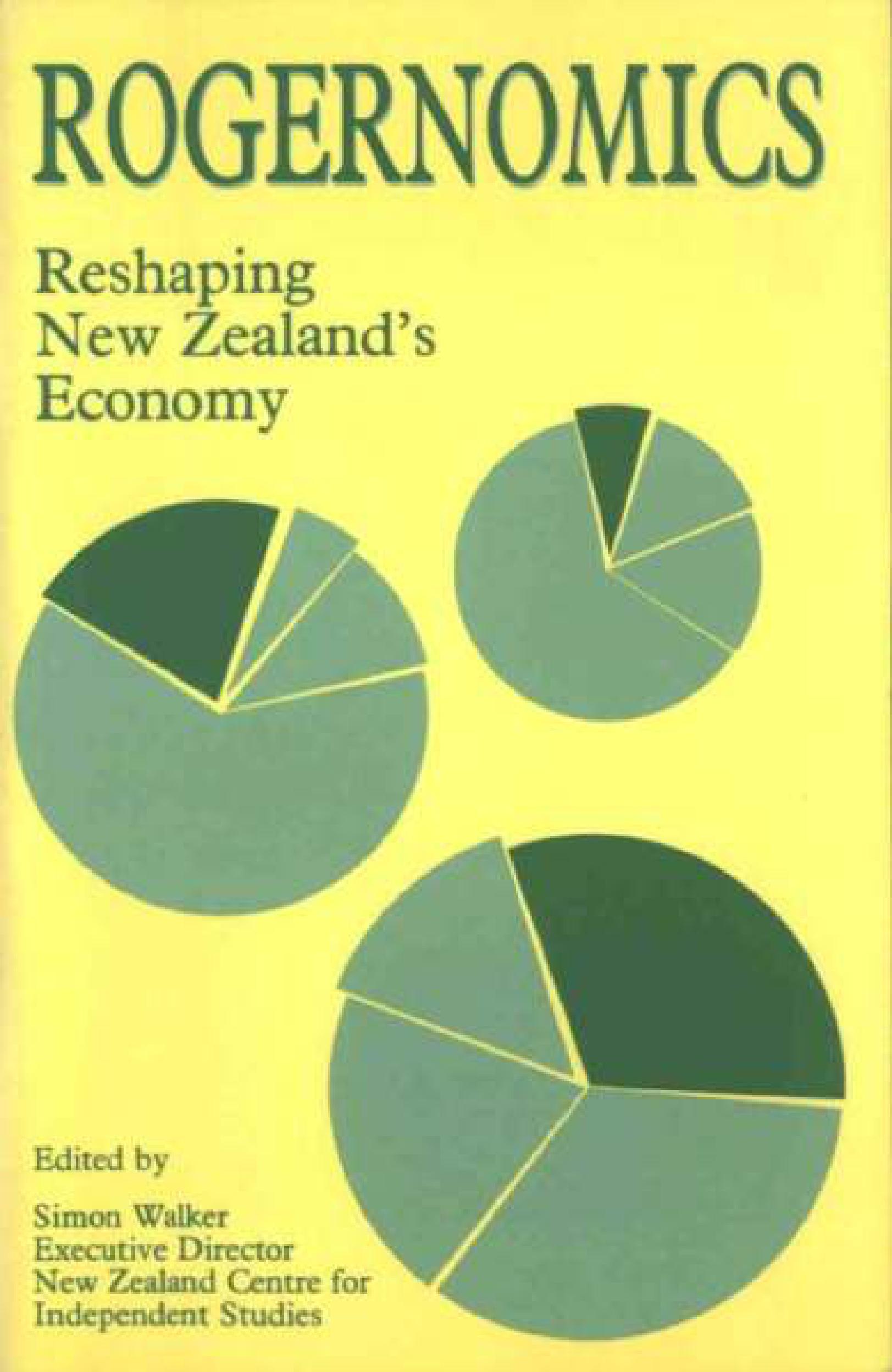
Rogemomics: Reshaping New Zealand’s Economy is an account of sectoral changes in New Zealand economic policy by individuals, many of whom have been participants in the process of change. One field of policy has been largely set aside. Although a Royal Commission on Social Policy mulled over welfare issues for much of the era of Rogernomics, the administration’s intentions seemed so uncertain that I felt little purpose would be served by speculating loosely in this book.
Several authors deal with the fiscal consequences of the Labour Government’s failure to address social policy issues. It would have been impossible to blend personal style and interpretation into a seamless analysis of events or to eliminate inevitable and sometimes substantial differences of opinion. I have not tried to do so. Rather, these essays are presented as ten individual assessments of the reform process, its achievements and inadequacies.
Like all NZCIS-generated publications, it is intended to stimulate debate rather than present a definitive verdia on what is, after all, a continuing process. I am grateful to Harme Hulme, formerly Assistant Dircaor of NZCIS, who initiated this project, and to the Centre’s chairman and trustees who have made its publication possible. My particular thanks to those who have contributed their views