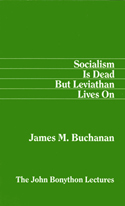

In the seventh John Bonython Lecture, James Buchanan observes that the death of socialism has not been accompanied by the rise of any widespread faith in the free enterprise system, even though that system has shown itself to be superior to socialism in producing prosperity. ‘Politics will not work, but there is no generalised willingness to leave things alone’.
Public choice theory has helped to explain the failures of politics by demonstrating how vulnerable political processes are to pressure from organised special interests. That pressure will continue to bring about the expansion of state intervention until we learn how to contain politics within its proper limits. ‘The death throes of socialism should not be allowed to distract attention from the continuing necessity to prevent the overreaching of the state-as-Leviathan, which becomes all the more dangerous because it does not depend on an ideology to give it focus.’
(Extract)
More than a century ago, Nietzsche announced the death of God. Behind the drama of its presentation, this statement was intended to suggest that the omnipresence of God no longer served as an organising principle for the lives of individuals or for the rules of their association, one with another. If we can disregard the revival of fundamentalism, notably in Islam, we can refer to this century as one “without God”. And, indeed, many of the horrors that we have witnessed find at least some part of their explanation in the absence of human fear of a deity’s wrath.
I want to suggest here that, since Nietzsche, we have now passed through an interim period of history (roughly a century) during which, in one form or another, the God pronounced dead was replaced in man’s consciousness by “socialism”, which seemed to provide, variously, the principle upon which individuals organised their lives in civil society. And I want to match Nietzsche’s announcement with the comparable one that “socialism is dead”. This statement seems much less shocking than the earlier one because it has and is being heard throughout the world in this year, 1990.
I suggest, further, that the gap left by the loss of faith in socialism may, in some respects, be equally significant in effects to that which was described by the loss of faith in the deity. In a very real sense, the loss of faith in socialism is more dramatic because it is at least traceable to the accumulation of quasi-scientific evidence. The god that was socialism took on forms that were directly observable; there were no continuing unknowns waiting to be revealed only in another life. And the promised realisation of the socialist ideal could not be infinitely postponed in time. In other words, the god that was socialism is demonstrably dead; there could have been no comparable statement made subsequent to Nietzsche’s announcement.
These are strong claims, and I intend them as such. Socialism promised quite specific results; it did not deliver. It failed in the straightforward meaning of the word. And those of us who are in positions to think about ideas and their influence can only look back in amazement at the monumental folly that caused the intellectual leaders of the world, for more than a century, to buy into the “fatal conceit” that socialism embodied — “fatal conceit” being the wonderfully descriptive appellation recently introduced as the title of F. A. Hayek’s last book (The Fatal Conceit: The Errors of Socialism, 1988).
How did we, as members of the academies and intelligentsia, come to be trapped in the romantic myth that politically organised authority could direct our lives so as to satisfy our needs more adequately than we might satisfy them ourselves through voluntary agreement, association and exchange, one with another?
I suspect that, literally, thousands of man-years will be spent in efforts fully to answer this question. I shall return to the question briefly later in this lecture. But first I want to emphasise that the “fatal conceit” was almost universal.
Let us now beware of current attempts to limit acceptance of the socialist myth to those who were the explicit promulgators and defenders of the centrally-planned authoritarian regimes of the USSR and its satellites. There were socialists among us everywhere, in all societies, at all levels of discourse, and, even in the face of the evidence that continues to accumulate, there are many who still cannot escape from the socialist mind-set.
And even for those of us who have, somehow, shifted away from the mind-set of socialism, and who acknowledge, however begrudgingly, that the socialist god is dead, there may not have emerged any faith or belief in any non-socialist alternative. We may accept socialism’s failure; we may not accept the alternative represented by the free market or enterprise system, even as tempered by elements of the welfare or transfer state.
Socialism and Individualism
I shall, first, try to define socialism, lest we allow those who enjoy the exploitation of our language to shift the meaning of terms before we realise what is happening.
Socialists everywhere, confronted with the evidence that economies organised, wholly or partially, on socialist principles cannot deliver the goods, are now making desperate efforts to redefine the term “socialism” to mean something quite different from its received meaning, either in its historical development or in modern reality.
To counter all such efforts at the outset, we can perhaps do no better than to consult the source books. The entry on “socialism” in The New Palgrave: A Dictionary of Economics (Macmillan: London), and published as recently as 1987, is by Alec Nove, a distinguished British scholar, who is himself a socialist. Nove’s definition is as follows:
Let us provisionally accept the following as a definition of socialism; a society may be seen to be a socialist one if the major part of the means of production of goods and services are not in private hands, but are in some sense socially owned and operated, by state, socialised, or cooperative enterprises. (p.389)
As Nove emphasises, the key elements in this definition are summarised in the shortened statement that “the means of production … are not in private hands”.
Socialism, as a guiding principle for organisation, is opposed directly to “individualism”, which could be summarised in the statement that “the means of production are in private hands”.
A more extended definition would include the corollary statement that the means of production, the resource capacities to produce that which is ultimately valued by persons, are owned by individuals, that is, privately, and that such ownership carries with it the liberty, and the responsibility, to make the relevant choices as to how, when, where and to what purpose these resource capacities will be put.
Only in an economy that emerges out of the complex exchange interrelationships among persons who privately own and control resource capacities can the incentives of resource suppliers be made compatible with the evaluations that persons as final demanders place on goods and services.
It is now, in 1990, almost universally acknowledged that such an economy “works better” than a socialised economy in which decisions on resource use are made non-privately, that is, by state or cooperative agencies.
And the meaning of “works better” is quite straightforward: the private-ownership, individualised economy produces a higher valued bundle of goods and services from the resource capacities available to the individuals in a politically organised community.
The only proviso here is that the value scalar, the measure through which disparate goods and services are ultimately compared, must be that which emerges from the voluntary exchange process itself. If the value scalar is, itself, determined by the centralised socialist planners, there is, of course, no reason to think that the private ownership economy will “work better” in generating more “value” along this measure.
Classical Political Economy
It is sometimes too easy to overlook the simple principles in our headlong rush to get into the complexities. Let me pause, therefore, to emphasise what I have already said here.
The private-ownership, market economy “works better” than the socialised economy; it produces more goods. But, and at the same time, it allows individuals more liberty to choose where, when and to what purpose they will put their capacities to produce values that they expect others to demand.
Should we be surprised, therefore, when our history texts tell us about the genuine excitement that the discovery of the principles of classical political economy generated?
Socialism Triumphant
We must, I think, appreciate the rhetorical genius of Marx in his ability to convert arguments advanced in support of market organisation into what could be made to appear to be support for a particular distributional class, the capitalists.
By clever substitution of emotion-laden terminology, the market system became “capitalism”, and the search of every person for his own advantage became the profit-seeking of the greedy capitalists.
This rhetorical genius, coupled with totally erroneous economic analysis embedded into pseudo-scientific jargon about the laws of history, was highly successful in elevating the distributional issue to centre stage, to the relative neglect of the allocational and growth elements that were central in the classical teachings.
And, further, the whole Marxian-socialist challenge was introduced into the political arena in the middle of the post-Hegelian epoch, during which the state was conceptualised only in a romantic vision completely divorced from the observable reality of politics.
There is no need to review in detail the history of the socialist century-and-a-half. Governments everywhere resumed their natural proclivities to interfere with the liberties of persons to make exchanges, and now supported by arguments that politicised control of economic decisions was necessary to correct market failures.
The triumph of socialism, either in idea or reality, was never complete. There were isolated residues of understanding of classical political economy, and some markets were allowed to remain free from politicised direction, particularly in Western countries.
Nonetheless, it remains accurate to describe the central and generalised thrust of politics as “socialist” up to and including the decade of the 1950s and early 1960s.
Between the early 1960s and today, the early 1990s, socialism became ill and died. What happened?
There were two sides to the coin, which may be succinctly summarised as “market success” and “political failure”. The accumulation of empirical evidence must ultimately dispel romance.
And the evidence did indeed accumulate over the three decades to demonstrate that free market economies performed much better than politically directed or planned economies.
The German Wirtschaftswunder should not be overlooked in this potted history. The economic reforms that Erhard implemented were based on an avowed acceptance of the principles of a market economy, and the principles were demonstrated to work.
Germany achieved economic recovery rapidly in the 1950s and 1960s. By contrast and comparison, the socialist experiments tried out in Britain in the late 1940s and early 1950s proved to be demonstrable failures.
But the public-choice revolution in ideas about politics, and political failures, was also sparked primarily by academic economists. When the very elementary step is taken to extend the behavioural models of economics to apply to public choosers, to those who participate variously in political roles, as voters, politicians, bureaucrats, planners, party leaders, etc., the romantic vision that was essential to the whole socialist myth vanishes. If those who make decisions for others are finally seen as ordinary persons, just like everyone else, how can the awesome delegation of authority that must characterise the centralised economy be justified?
I do not suggest here, in any way, that public choice theory set off the reaction against politicisation, socialism and other variants of the controlled economy. The reaction, which has now extended over the whole world, was surely triggered directly by the many decades of the observed record of political failures. Public choice, as a set of ideas, was, I think, influential in providing an intellectual basis which allows observers to understand better what it is they can directly observe. Political failure was everywhere observed; public choice supplied the explanation as to why the observations were valid.
The Absence of Faith
I stated earlier that there were two sides to the coin: market success and political failure. Both the observations and the ideas that have been developed over the period of socialist retreat have concentrated on the second of these, that is, on political failure. There now exists widespread scepticism about the efficacy of politics and political solutions to achieve economic results. Bureaucracies are mistrusted; politicians are not the heroes of legend. The socialist principle of organisation is not expected to work well. The faith in political and government nostrums has all but vanished, as a principle.
This loss of faith in politics, in socialism broadly defined, has not, however, been accompanied by any demonstrable renewal or reconversion to a faith in markets, the laissez faire vision that was central to the teachings of the classical political economists. There remains a residual unwillingness to leave things alone, to allow the free market to organise itself (within a legal framework) in producing and evaluating that which persons value. We are left, therefore, with what is essentially an attitude of nihilism toward economic organisation. Politics will not work, but there is no generalised willingness to leave things alone.
There seems to be no widely shared organising principle upon which persons can begin to think about the operations of a political economy.
The Natural Emergence of Leviathan
It is in this setting, which does seem to be descriptive of the era into which we are so rapidly moving, that the natural forces that generate the Leviathan state emerge and assume dominance. With no overriding principle that dictates how an economy is to be organised, the political structure is open to maximal exploitation by the pressures of well-organised interests which seek to exploit the powers of the state to secure differential profits. The special-interest, rent-seeking, churning state finds fertile ground for growth in this environment. And we observe quite arbitrary politicised interferences with markets, with the pattern of intervention being dependent strictly on the relative strengths of organised interests.
This setting, which I have referred to as Leviathan, has much in common with the mercantilist-protectionist politics that Adam Smith attacked so vehemently in his great book in 1776. Hence, in two centuries we seem to have come full circle. The selfsame barriers that Adam Smith sought to abolish are everywhere resurging, as if from the depths of history. And the selfsame arguments are heard in the land, both in support and in opposition. The arguments for Leviathan’s extensions are not versions of the socialist’s dream; they are, instead, simple efforts to claim a public interest in a single sector’s private profit.
Towards Constitutional Limits
There will be no escape from the protectionist-mercantilist regime that now threatens to be characteristic of the post-socialist politics in both Western and Eastern countries so long as we allow the ordinary or natural outcomes of majoritarian democratic processes to operate without adequate constitutional constraints.
We have learned to understand interest-group politics; we no longer have a romantic vision as to how the state operates. If we have not rediscovered, and do not rediscover, and understand the precepts of laissez faire, as organising principles, it will be necessary to address that which we do know and have learned. If we know that politics fails and that its natural proclivity is to extend its reach beyond tolerable bounds, we may be led to incorporate constraints into a constitutional structure.
Depoliticised economic order is within the realm of the politically-constitutionally possible, even if the accompanying faith in market organisation is not fully regained. We can protect ourselves against the appetites of the monster that the Leviathan state threatens to become without really understanding and appreciating the efficiency-generating properties of the market.
A threshold was crossed in the 18th century when we learned how the rule of law, stability of private property and the withdrawal of political interference with private choices, could unleash the entrepreneurial energies that are latent within each of us.