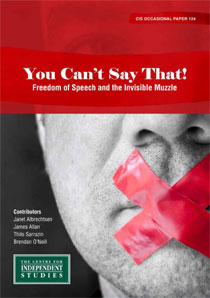

This collection of four speeches warns against the increasing restrictions on free speech in a world being taken over by political correctness. Ostensibly a tool for civility and respect, political correctness is effectively muzzling the foundation of a free society: open and robust debate in a free exchange of ideas.
(excerpt)
The Language of Political Correctness
Brendan O’Neil
Political correctness is not actually the handiwork of small groups of cultural Marxists or liberal malcontents. The rise of political correctness is simply down to the activism and agitation of unrepresented sections of the chattering classes who detest vulgar language and what they consider to be offensive ideas.
No. Political correctness represents something far more profound. The victory of political correctness is built upon the demise and decay of traditional forms of authority and morality. It is parasitical on the crisis of conservative thought. In fact, I would argue that the power of political correctness is directly proportionate to the weakness of the old, ‘taken for granted’ forms of morality. It is tempting to see political correctness as the imposition of a framework by small groups of illiberal liberals. To see it as a conscious project pushed through by these rather irritating sections of society. Two striking aspects of political correctness seem to bolster this view—the creation of a cabal of grumpy, misanthropic feminists and environmentalists.
First, political correctness came to the fore at a time when conservative governments enjoyed strong electoral support in the West. It really exploded in America and Britain in the 1980s when Reagan and Thatcher were in power. So the masses were largely supportive of conservative regimes. But political correctness was born at the same time and became more and more widespread, boosting the idea that the cultural elite sat down one day and drew up some rules for everyday life.
And second, political correctness does tend to be most vociferously promoted by the media and sections of academia, by those rather rarefied, aloof institutions with more than their fair share of worldly people. But to look at PC in that way only, to see it as a kind of conscious project of illiberal liberals, is to miss the foundation stone of political correctness. The ground upon which political correctness is built is the inability of the traditional moralists to justify themselves and to defend their way of life and their moral system. That inability creates a moral vacuum, which gets rather feverishly filled up by new forms of intolerant morality. Because when you have a profound crisis of traditional and conservative morality that had governed society for so long, previously normal and unquestioned ways of behaviour are called into question. Nothing can be taken for granted anymore. From everyday speech to interpersonal relations, even nursery rhymes and fairy tales, all that was a given in the past 200 to 300 years falls apart. And political correctness fills that hole. It’s a tentative takeover by a new kind of modern day moralist. The result is undoubtedly tyrannical and profoundly illiberal and antagonistic to individual autonomy.
To see how political correctness has its origins in the demise of traditionalism, it’s instructive to look at the example of the girl guides. For a hundred years or so, Girlguiding UK was a fairly straightforward organisation. It was designed to instil girls with imperial pride. The girl guides had a simple slogan and swore an oath of loyalty to God, Queen and Country. About 15 years ago, Girlguiding UK rewrote their constitution and brought out a new mission statement. They turned one page into about 20 pages. There was no more duty to God; instead, there was a promise to love ‘my God’ in recognition of the many gods today and that there is not one true God or one true religion. The girls were no longer required to swear loyalty to the Queen or country, only serve them. And they were encouraged to feel sympathy for the Queen because it cannot be easy for her to be photographed everywhere she goes.
The key here is that nobody invaded the girl guides’ headquarters and forced them to rewrite their constitution at gunpoint. They did it themselves because those three institutions—God, Queen and Country—are no longer real sources of authority. All three—religion, monarchy and nationalism—have suffered a profound crisis of legitimacy. And it was the girl guides’ instinctive recognition of that which led them to voluntarily rewrite their own rules and outlook.
So, political correctness is not about cultural Marxists storming the citadel and forcing us to obey them. In fact, the citadel has collapsed, and they are in the rubble trying to fashion a new kind of social morality. And that is why political correctness is so hysterical, so shrill, and so intolerant. Not because it is strong but because it is weak and isolated. It has no real roots in society, and it has no real roots in history. It has no popular legitimacy, and it has no public support. It is better seen as a knee-jerk instinctive imposition of a new morality designed to replace the old. So everything must be controlled, no one can be trusted, and no one anymore knows what is right and wrong. It is the moral hole of the heart of society that gives rise to this insatiable desire to implement all kinds of new rules and regulations.
So even nursery rhymes are being rewritten. In Britain, we’ve recently rewritten ‘What should we do with the drunken sailor?’ The drunken sailor has been replaced with a grumpy pirate because we don’t want children to know about alcohol. The old rhyme used to say, ‘stick him in a bag and beat him senseless’; the new one says ‘tickle him until he starts to giggle.’ This is PC gone mad—crazy feminists in dungarees rewriting nursery rhymes and forcing them on schools. But a more important question to ask is what kind of crazy unhinged society rewrites rhymes that children sing, rhymes that have been around for generations. Only a society that has entirely lost its moral bearing and can no longer take the most basic things for granted would do such a ridiculous, Orwellian thing.
The hysteria of political correctness really speaks to its opportunistic, parasitical nature. A more confident moral system would be able to tolerate deviance. An unconfident and accidental moral system like political correctness can tolerate no deviance at all because it continually fears for its own continued survival. And it’s important to bear that in mind because sometimes the critics of political correctness are too quick to play the victim card. But sometimes so do un-PC people. Too many right-wing thinkers claim that a conspiratorial cabal of PC lunatics are ruining our lives, which conveniently absolves these right-wing conservative thinkers of having to work out whatever happened to their morality and to their traditions. Where did they go? It is easier to claim that society has been taken over by crazy, lentil-eating, sandal-wearing feminists and annoying greens; it is far harder to account for the demise of a way of life that had existed for hundreds of years. Which is why we should get to grip with these two facts.
First, political correctness is built on the decay of traditional morality. Second, it is weak, it is fragile, and it is probably quite easy to demolish. If we bear that in mind, then we can more successfully fight against this profoundly censorious and suspicious and irrational moral system. And if you feel you are being treated like a heretic, then you should behave like a heretic. And you should pull up your socks and get your guns out.