
In a time when governments are running up enormous welfare bills and intrusively regulating everyday life, this series of essays remind us that many people do not need to rely on the government to survive.
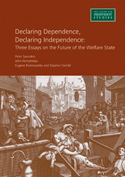
‘Some people do need the government to provide them with an income, give them housing, educate their children, and save money for them for when they grow old. But the majority of Australians do not need this support,’ says Peter Saunders, editor of the collection Declaring Dependence, Declaring Independence: Three Essays on the Future of the Welfare State.
Economist John Humphreys, in his essay ‘Declaring Independence’, says that people who can pay for their own lives should be able to ‘declare independence’ from the nanny state.
Through tax and welfare ‘churning’, many people already pay for the benefits and services they receive from the state, so they would be no worse off if they opted out and made their own provisions. Declaring independence would mean giving up the welfare safety net.
In Humphreys’ model, self-declared independent people would pay less tax because they would look after themselves rather than expecting the government to take care of them. They would still be subject to the laws of the land—but only those laws that stop them from harming others.
‘The benefit of independence would be the freedom to make personal decisions without interference from the government. This could include superannuation and saving decisions, risky activities, or any other decision that was voluntary and peaceful,’ says Humphreys.
On the other side of the coin, Eugene Dubossarsky and Stephen Samild, in their essay ‘Declaring Dependence’, suggest that those who need constant help should be able to declare themselves dependent on the government, but that they should pay a price for being supported.
Dubossarsky and Samild’s modified democratic model, where taxpayer-funded welfare is available to any citizen at any time, but is conditional on forfeiting voting rights, would eliminate the incentive for politicians to bribe taxpayers with their own money.
‘Those who generate wealth and are net contributors to the public purse fund the welfare cake, but it is in the interests of an increasing proportion of Australians to vote themselves a slice,’ say Samild and Dubossarsky.
Turning off the government
On my route to work through Sydney every morning, I drive under a huge electronic sign that straddles the northbound lanes of the Pacific Highway. It is there to flash urgent messages to drivers, warning them that there is an accident ahead, or that some road has been closed and they should take an alternative route. Most days, however, there are no accidents and all the roads are open. But rather than leave the sign blank on these mornings, the officials at the RTA always manage to invent some new warning or instruction to display to passing motorists.
Every morning, that sign is flashing at me. It is very distracting and, I suspect, really quite dangerous, for it diverts drivers’ attention from the road (I defy anyone to ignore a flashing electronic sign directly overhead). Sometimes, when the message scrolls over two screens, your attention is distracted for several seconds as you wait for the second part of the text to appear. Yet the messages are rarely important and are almost always banal.
Sometimes the sign tells me to look out for motorcyclists in the blind spot in my mirrors. Other times it tells me to buckle my seatbelt, or it reminds me of the alcohol restrictions that apply to P-plate drivers. Occasionally it assures me that speed zone restrictions are enforced. But it surpassed itself the other week when it commanded:
PAY ATTENTION TO TRAFFIC SIGNS
This giant sign is a metaphor for much of what is wrong with government in this country. It costs money to keep it running. It often sends out stupid messages. It is very intrusive. It can easily lead to counter-productive results (I sometimes wonder how many cyclists have been knocked off their bikes by motorists craning their necks to read a sign telling them to look out for cyclists). And most of the time, what it does is completely unnecessary. But as with the sign, so too with the government, nobody can bring themselves to turn it off, even when there is nothing useful for it to do.
Earlier this year, one weekend in April, a thousand people converged on Canberra for what the Prime Minister called a ‘2020 Summit.’ They were divided into ten groups, and each group was told to come up with ideas for what the government should do to make life better by the year 2020. What should the government do about health? What should the government do about social cohesion? What should the government do about the economy? And so on.
This was a strange event for a new Labor government to be hosting, for you would think that after eleven years in opposition, Kevin Rudd and his ministers would be bursting with ideas about things they wanted to do once they got back into power. We might have expected them to invite people to Canberra to advise on how to implement their ideas – how to raise indigenous levels of education, for example, or how to make the tax system simpler – but this wasn’t the point of the weekend. They insisted they really were casting around for suggestions about what they might do now they are running things. Like the RTA and its sign, the new Labor ministers found themselves with a government and didn’t know what to do with it.
To which one might respond: why not do nothing? Why do governments always have to be doing things? Just because you are in power doesn’t necessarily mean you have to go around changing things, any more than having a giant electronic road sign means you always have to flash messages at passing drivers.
I saw a television interview recently with British Prime Minister Gordon Brown. At one point he looked straight into the camera and said
‘I wake up in the morning thinking what we can do to help homeowners. I wake up in the morning thinking what we can do to help people who have got small businesses. I wake up in the morning thinking what we can do to help people looking for jobs.’[1]
Is this supposed to reassure the voters of Britain? Clearly Brown has never come across Ronald Reagan’s famous dictum: ‘The nine most terrifying words in the English language are, “I’m from the government and I’m here to help.”’
Unlike Ronald Reagan, politicians like Rudd and Brown assume government exists to do things. If it isn’t obvious that anything needs doing, they convene summits, facilitate dialogues, set up workshops or lie awake in the early hours until they have found something for it to do. With their hands on the levers of power, the questions they want answered are which levers should they move, how far and in what direction? Leaving the levers where they are is not an option.
Every day that the federal parliament sits in Canberra, another 100 pages of new laws get added to the statute book. I once heard former Labor leader Mark Latham estimate that if regulations keep growing at this rate, it will take a thousand removal trucks to house all our laws by the end of this century.
This slim volume has been written in reaction to all this. It explores the idea that government might be ‘turned off’ when there is nothing useful for it to do. Not completely turned off, let me hasten to add. There is plainly a need for government to organize foreign affairs, chase criminals, enforce contracts and provide indivisible ‘public goods’ that the rest of us need but would not organize for ourselves if we were left to our own devices.
But modern governments do a lot of other things which – for most of us – are unnecessary and often get in the way. In particular, they run massive welfare states which many of us do not need yet which cost us a fortune (about 70% of everything governments in Australia spend goes on social expenditure). And they regulate a lot of the things we try to do that don’t need regulating (there are about 600 regulatory agencies in Australia employing 35,000 people).[ii]
Now it is true that some people may need all this care and attention. Some people really do need the government to provide them with an income, give them housing, medicate them when they fall ill, educate their children and save money for them for when they grow old. For one reason or another, there always have been people who have needed other people to provide for them, and today it generally falls to the government to do it.
It is also true that some people need to be told what to do. Some people really do need the government to tell them in minute detail how to live their lives. Just as some motorists probably benefit from that giant sign on the Pacific Highway reminding them to pay attention to road signs, so some people may well need a giant paternalistic authority hovering over them, taking them by the hand, leading them away from risk and danger, and making all their important decisions for them.
But the core premise of the essays that follow is that most of the population do not need all this support and guidance. Indeed, for the majority of Australians, the government now represents more of a hindrance than a help, an irritant rather than a facilitator. Most of us could get by just fine most of the time, if only the government would get out of the way and leave us alone.
Learned helplessness
Not everybody is capable of looking after themselves. Some people do need others to run their lives for them. But as the welfare state has expanded, so the number of autonomous people has shrunk, and the number of dependent people has grown. What has been happening is that the section of the population that needs a proactive and intrusive government in their lives has been dragging the rest of the population down with them.
This happens because we only have one set of rules, and we only have one set of social policies. Every rule that gets created, and every policy that gets introduced, is applied to everyone, whether they need it or not. Because a few people can’t be trusted to run their own lives, none of us are, so we all end up being treated as if we are incompetent. It is like being back at school, when one miscreant who misbehaved caused the whole class to be kept behind for detention. It wasn’t fair when it happened then, and it isn’t fair when it happens now.
A dramatic news story is in the headlines as I am writing this. A group of 14 twenty-somethings took a small boat without permission, overloaded it with people, and were partying on Sydney Harbour at 2.30 in the morning when they were struck by another vessel. Six of them died. Reporting this tragedy, the Sydney Morning Herald carried predictable calls for tighter government regulations to be introduced which will apply to everybody who wants to take a boat out onto the harbour.[iii] Every time something bad happens, the cry goes up for more government spending and more regulation.
Every time a problem surfaces, politicians come under pressure to ‘do something.’ If house prices go up, politicians think they should intervene to solve the ‘housing affordability crisis.’ If parents find it hard raising children at the same time as they are both pursuing careers, politicians pop up with baby bonuses, child care subsidies and proposals for paid maternity leave. If somebody goes mad with a handgun, or people get fat eating junk food, or a reveler blows their hand off while lighting a firework, the knee-jerk response of politicians is to cast around for new regulations to stop people having guns, to prohibit fast food advertising, or to ban the sale of fireworks.
In a mass democracy, such reactions are probably inevitable, for no politician ever won office by promising to do less for voters, nor by telling their constituents that some things are their own fault and they need to take more responsibility for their own behaviour. But the more this indiscriminate use of governmental authority spreads, the more it breeds the very incompetence and irresponsibility which it is supposed to be countering.
Growing up in a society where government increasingly assumes responsibility for things, even the most responsible and sensible people start to assume that they need the government to provide for them and tell them how to live their lives. Families earning $100,000 or more per year start to think they need the government to give them family support payments. People who like a glass of wine with their meal start to fret over government warnings about over-consumption of alcohol. And competent drivers with unblemished records come to accept the RTA treating them as morons by telling them to look out for traffic signs.
Government agencies are increasingly regarding us all as incompetent children. The really frightening thing about this is that this assumption of mass incompetence is gradually becoming a self-fulfilling prophecy.
Declaring dependence
This volume canvasses a twofold solution to this vicious cycle of government paternalism and citizen incompetence. The first part of the solution is that those who need constant help and surveillance should be able to ‘declare themselves dependent.’ They can then get the help they need, along with all the niggling interference and busy-body nagging that inevitably comes with it.
Welfare has always been paternalistic, but it is becoming more so. In four Aboriginal communities in Cape York, anyone who receives any kind of welfare payment (including Family tax Benefit payments) is now subject to four behavioural conditions: (a) they must send their children to school; (b) avoid abusing or neglecting their children; (c) avoid any drug, alcohol, gambling or family violence offences; and (d) abide by the conditions of their public housing tenancy. If any of these conditions is breached, a local Family Responsibilities Commission can compel transgressors to attend counseling, specify how all or part of their welfare payment should be spent; or redirect their welfare payment to a more responsible adult to take care of their children.
The Cape York model was applied on a much wider canvas in the 2007 federal intervention in the Northern Territory. This imposed compulsory health checks on children, banned the sale of alcohol and possession of pornography, and imposed ‘income management’ regimes on all welfare recipients across 23 NT indigenous communities.[iv] Shortly after this intervention began, Western Australia allowed child protection agencies to ask Centrelink to impose income quarantines on welfare parents whose children are thought to be at risk of neglect or abuse,[v] and in New South Wales a six month trial is running in the mainly Aboriginal town of Walgett tying parents’ welfare payments to their children’s school attendance records.[vi] The first conditional welfare trial in a non-Aboriginal community was announced in the north of Adelaide in late 2007 where it was proposed that parents deemed to be wasting their welfare payments on drugs, alcohol or gambling should have 40% of their benefit quarantined for food and rent and be issued with smart cards which could only be spent on approved purchases in local participating shops.[vii] The Rudd government has now committed itself to a welfare card and is extending a trial of quarantining to six different communities Australia-wide, including two cities.[viii]
Quarantining of benefits has been made possible by the 2007 Social Security Act which empowers the federal government to impose ‘income management schemes’ on designated communities in NT (where it has direct powers) and on specified categories of welfare claimants elsewhere in the country where there is evidence of neglect or poor school attendance. [ix] What began as an attempt to remedy dysfunctional Aboriginal communities is now evolving into a more general tool for managing the lives of welfare recipients, and this shift towards paternalism is likely to gather strength in the future.
In some ways, this is a trend we should welcome. Long-term, habitual exposure to welfare saps confidence and creates a culture of dependency (what Noel Pearson calls ‘passive welfare’). The move towards a strongly paternalistic version of conditional welfare is a response to this, for it tries to reverse the downward spiral of passive welfare by organising people’s lives in a proactive way, pushing them into doing the things that would help them get back on their feet and stopping them from doing the things that add further to their problems. Proactive paternalism is a lot better than benign neglect.
But this trend also poses some obvious dangers, not least of which is that the new paternalism could easily spread into the wider population. We have already seen this happen on a small scale with the federal government’s NT intervention, where whole communities were subjected to income management schemes. People who were behaving responsibly were treated in exactly the same way as those who were not, losing responsibility for their own budgeting even though they were raising their children competently and were not involved in substance abuse. The danger is that, in future, this sort of approach might start happening on a much larger scale. Shadow Families and Community Affairs Minister, Tony Abbott, has already suggested that everybody on welfare should be subject to quarantining of payments to ensure money goes on rent and food.[x] If we go down this path, the next logical step is to quarantine Family Tax Benefit payments, for these are explicitly intended to help parents with the cost of raising children. With 90 per cent of the nation’s families in receipt of FTB, there is massive potential here for extending government paternalism to a point where millions of people are having the government manage their budgets for them.
To avoid smothering whole sections of the population in a new blanket of big government paternalism, it is crucial to draw a clear distinction between those who really do need their lives managed by other people, and those who can reasonably be expected to get along on their own. It is in this light that the idea of having people declare themselves dependent on the government is particularly interesting.
In their essay, Eugene Dubossarsky and Stephen Samild suggest that declaring yourself dependent should not be costless. In particular, they propose that it should entail a loss of voting rights. Their logic here is impeccable, for people who freely admit they cannot be trusted to run their own lives should presumably not be trusted to run other people’s either. Just as dependent children have a right to be looked after, but cannot then claim the full range of freedoms which adults expect, so too those who declare themselves incompetent to organize their own lives should not expect to exercise all the rights which autonomous and responsible citizens take for granted.
Dubossarsky and Samild argue that self-declared dependent people cannot be entrusted with a role in selecting the nation’s government. They base this proposition on John Stuart Mill’s discussion of the case for a universal franchise. Mill supported extension of the franchise, including votes for women – a radical idea in the mid-nineteenth century – and abolition of property qualifications for voting. However, he also pointed out that the right to vote assumes that the elector is (a) mature and responsible and (b) has a material interest in the activities of government.
If you declare that you are not responsible, you clearly fail on the first of these criteria; if you further affirm that rather than contributing to the communal exchequer, you wish only to withdraw funds from it so that you may be supported by others, you equally clearly fail on the second. Like members of a voluntary association, or shareholders in a company, if you have paid nothing in, you can hardly expect to be allowed to vote on how the money should be divvied up (especially when it comes to determining how much of it should be diverted to you).[xi]
Other implications might also follow from declaring dependence, although Dubossarsky and Samild do not pursue this. If you cannot organize your own affairs, for example, it is probably unwise to allow you anywhere near a jury room where you will be expected to weigh evidence and determine the guilt or innocence of accused parties in a court of law. Like voting, this is a serious civic responsibility that should only devolve upon those who achieve full, adult citizenship. These are not the sorts of duties to be given willy nilly to people who cannot run their own lives.
In their essay, Dubossarsky and Samild suggest the main advantage of withdrawing the vote from people who declare themselves dependent would be to strengthen democracy by weakening the ability of politicians to buy votes. About four in ten voters in Australia today rely on the government for an income (either earned or unearned). This level of dependency on government revenues establishes a putative public sector voting bloc with a permanent interest in raiding the earnings of the non-government sector to fund ever-increasing government expenditures. This is precisely what nineteenth century opponents of democracy feared would happen once people had the right to vote themselves an income, and the proposal outlined by Dubossarsky and Samild would go some way to addressing this distortion and restoring integrity to the democratic process.
Dubossarsky and Samild also claim that the prospect of losing one’s vote could provide a strong motivation to people to get off welfare and establish self-reliance. In my view, however, this is a much more debatable part of their argument, for the right to vote may have remarkably little value for some people who would be happy to trade it against a flow of welfare income. If it is stronger incentives that we are looking for, the carrot may in this instance be much more significant than the stick. In other words, the advantages to be gained by ‘declaring independence’ are likely to provide much stronger incentives prompting people into self-reliance than any perceived costs associated with ‘declaring dependence.’
Declaring independence
The second part of the solution to the increasing infantilisation of the population arising from the perpetual growth of the welfare state is discussed in John Humphreys’s chapter. He suggests that those who are capable of making their own way in the world should be allowed to ‘declare their independence.’
This proposal grows out of evidence on so-called ‘tax-welfare churning’ which indicates that many people are already paying for most or all of the benefits and services they receive from the modern welfare state. This means they would be no worse off if they opted out and made their own provisions.
One hundred years ago, it took just over three weeks for Australians to produce all the wealth needed to pay for all the state and federal government services for a whole year. Today, this takes almost four months.[xii] A major reason why governments nowadays take so much more tax than they used to is that they have committed themselves over the years to providing people with more and more services and income transfers. This is fine where people really need this help. But an awful lot of this expenditure today goes on services and cash benefits for people who could perfectly well provide for themselves.[xiii]
We think of the modern welfare state as a giant Robin Hood system, taking money from the rich and giving it to the poor. But in reality, much of it functions more like a piggy bank: the same people who put the money in take it out again. I have estimated that at least half of all the social expenditure by governments in Australia today is ‘churned’ in this way (the true figure is probably closer to two-thirds). Put another way, less than half the money governments hand out is actually redistributed from richer to poorer people.
This means the same people who are receiving benefits with one hand are often also paying for them with the other. In 2007, the Australian Bureau of Statistics announced that the average couple with dependent children paid a total of $519 per week in taxes in 2003-4, and received a total $501 per week in benefits.[xiv] Had the government simply left them alone, their financial circumstances would have been almost exactly the same! Even the richest 20% of individuals in the country received back in government benefits more than one-third of what they paid to the government in taxes.
The great ‘middle mass’ of Australian households hands over thousands of dollars of tax every year (not just income tax, but also GST, state taxes and company taxes passed on to consumers in higher prices), and then gets a great slab of this handed back in the form of family support payments, subsidized child care, government age pensions, Medicare subsidies, public hospital treatment, and so on. They are then encouraged to feel ‘grateful’ when they are given their own cash back (less overheads). At election times, politicians fall over themselves offering to take ever more of our money away so they can give it back again in all sorts of attractive packages, but they neglect to mention that if all this money hadn’t been taken away from us in the first place, we could be providing these things for ourselves and we wouldn’t need them.
One hundred years ago, when our great grandparents were much less affluent than we are today, the government did not supply many of the necessities of life, but most people still managed okay. Even in those days, when the standard of living was much lower, most people managed to save for their old age, insure themselves and their families against sickness, or join a mutual aid organization to provide them with income insurance. While the middle classes tended to pay directly for what they needed, many working families achieved self-reliance through cooperation with others. In 1913, for example, 46% of all the men, women and children in Australia were covered by membership of a friendly society which covered their health care costs, pharmaceuticals, sickness, unemployment and widows benefits.[xv] These people did not look to government to provide for their needs, and they would have been appalled at the idea that huge chunks of their earnings should be sequestered by politicians claiming to know better than they did how their money should be spent.
Yet here we are, a hundred years later, much better off financially as a result of a century of economic growth, yet apparently less able than our great grandparents were to look after ourselves. The reason is simply that today, much of our cash is taken away from us by the government. This then leaves most of us with little choice but to accept dependency on whatever the government decides to give us back.
By allowing people to declare independence, the autonomy that comes from earning and controlling your own income can be restored to the mass of the population which has seen its independence eroded over the last fifty years. This is the core idea explored by John Humphreys.
Self-declared independent people will still pay taxes, of course, but they will pay less tax because they will undertake to look after themselves, rather than expecting the government to do everything for them. This means they can retain that portion of their tax contribution which is currently recycled back to them in the form of cash benefits and government welfare services. Instead of receiving government family payments, for example, they can pay less tax and then meet the costs of raising their children out of their own retained earnings. Similarly, rather than expecting Medicare and the public hospital system to tend to them when they are sick, they can pay less tax into the government health care system so they can afford buy their own insurance using money put aside in special savings accounts. The core principle is that self-declared independent people will be left alone to make their own, autonomous arrangements using their own money.
Self-declared independent people will also still be subject to the laws of the land – but only to those laws which stop them from harming others, and stop others from harming them. These are the laws that must bind everyone if we are to live in a civilized and peaceable society. As independent adults, however, Humphreys proposes that those who declare independence should no longer be subject to the paternalistic laws which politicians put in place to stop us harming ourselves. A declaration of independence means you no longer want or need the government to pass laws to protect you from yourself. It means you are happy to take the risks and bear the consequences of your own, freely-chosen actions.
If they drive a car without wearing a seatbelt, for example, self-declared independent people will accept full responsibility for any unfortunate consequences that may follow. They will cover the full costs of their own medical treatment, and they will ensure their nearest and dearest do not become charges upon the state in the event of their disability or demise. Having made these provisions, there is no longer any justification for the government (or anybody else, for that matter) to insist they wear a seat belt, nor should they be threatened with sanctions such as the loss of their right to drive if they refuse to comply with such rules. Because the general public will have to bear none of the consequences of their risky behaviour, its elected representatives no longer have any business trying to regulate it.
The same logic applies if people choose to go cycling without helmets so the wind can blow through their hair; or if they want to grow marihuana in pots on the windowsill so they can get stoned every evening; or if they want to buy fireworks to let off in their own backyards on New Year’s Eve because they dislike the organised communalism of government-sponsored displays. Any or all of these activities may be considered unwise by others, but if anything goes wrong, it is the individuals themselves who will accept the consequences. They won’t trouble anybody else if they crack their skull in a cycling accident, or develop schizophrenia from smoking too much dope, or burn their fingers while lighting a Roman candle. They freely accept these risks, so no-one else need concern themselves with regulating their behaviour with a view to safeguarding their welfare.
By declaring independence, individuals can therefore establish a right to be left alone by their government – even a government which thinks it has lots of good ideas, and only wants to help.
One size does not fit all
The foundations for this volume were laid in an earlier collection of essays published by the Centre for Independent Studies, entitled In Praise of Elitism.[xvi] That book took issue with the unthinking version of egalitarianism that pervades so much discussion of social policy in Australia. This egalitarianism pretends that nobody is any more or less capable than anybody else when it comes to performing demanding tasks, and that almost everyone can be trusted to perform difficult duties competently and diligently. But worthwhile things done well require effort and ability, and these two assets are not evenly spread in the population. We readily understand this when it comes to sport, but we pretend not to understand it in most other areas of life which actually matter a lot more. In Praise of Elitism detailed some of the disastrous results which follow when we refuse to acknowledge this reality.
Because we insist, for example, that almost anyone is capable of following complex arguments based on evidence and logic, we entrust legal decision-making to panels of jurors who are sometimes appallingly incompetent to carry out these duties (some jurors cannot even report accurately what verdict they have just returned). Similarly, because we believe every citizen should participate actively in the political process, we force everyone to vote even though we know that election outcomes are being determined by a minority of the population that does not understand what it is doing and knows and cares nothing about the outcomes. Rather than abandon our faith in the egalitarian creed, we are willing to see vicious criminals freed (or innocent people jailed) as a result of incompetent juries, and governments elected on the votes of the most ignorant electors.
John Stuart Mill would have been appalled by all this. Above all, Mill valued human enlightenment. He thought people should be encouraged to improve themselves, and he explicitly warned against valuing the views of the ignorant as equivalent to those of the educated. But in our postmodern culture of ethical relativism, we pretend that nobody is better than anybody else, and that no group’s values or behaviour can be regarded as superior to any other’s. Rather than demanding that people improve themselves, we reduce our standards to those of the lowest performers. We insist that lazy people are no worse than hard-working ones; that educated people are no wiser than those with little learning; and that people who look ahead and take precautions are no more deserving than those who are reckless. Nowadays we feel queasy about discriminating between people, so we choose to pretend they are equal, even when we know they are not.
The result when it comes to public policy is a one-size-fits-all approach which treats the incompetent as if they are competent while the responsible are treated as if they need constant guidance and correction. Not only is this very costly, but it also generates all sorts of unintended and perverse outcomes.
For example, the Prime Minister has set a target of raising Year 12 retention rates from 75% to 90%. But research carried out by the Australian Council for Educational Research clearly shows that low ability pupils do better if they leave school after Year 10 and find a job. Their earnings are higher and their employment rates are better than for those who stay on for another year or two and then try to find work. Giving more education to people who cannot benefit from it therefore does harm, but nobody wants to hear this. It is much more comfortable to carry on pretending that low ability students are just as capable of benefiting from more education as high ability ones are, so we are going to blow billions of taxpayer dollars on feel-good educational ‘investments’, even though we know they will not work.[xvii]
Similarly, the Prime Minister has committed himself to a ruinously expensive program of multi-purpose parent-and-child centres to be established across the country. Research tells us that children from deprived homes can benefit from early intervention schemes like these, for they ameliorate the wretched parenting they receive at home, but most young children do better being raised by their parents than being consigned to communal child care for long hours each day. Again, however, nobody wants to draw this distinction lest we ‘stigmatise’ hopeless parents. Instead, we are committing to a nationwide program which at best will squander huge resources in areas where they are not needed, and at worst will encourage good parents to disadvantage their children by putting them into long hours care.
Sometimes this sort of absurdity works the other way around as well. In addition to devising paternalistic interventions for incompetent people and imposing them across the board, we sometimes adopt a laissez-faire approach suitable for competent people and then apply it with disastrous consequences to those who are incapable of exercising responsibility.
A clear example is in family policy where we refuse to make judgements about the merits of having two parents raise a child rather than one. The evidence is actually overwhelming that on average, children raised by single parents do much worse – they perform worse at school, they are more likely to get into trouble with the police, they are at much higher risk of physical or sexual abuse, and so on.[xviii] But it is very difficult to get well-educated, middle class people to accept this evidence, for in their experience, it doesn’t ring true. Most of the single parents they know are doing just fine, their kids are OK, and everyone involved is sensibly working things out. They are blissfully unaware that, at the other end of the social scale, in a world they never visit, the spread of single parenting is creating misery and chaos. But it is the middle classes who draw up the policies and write the commentaries in the newspapers, so their view of the problem (which is basically that there is no problem) prevails and nothing gets done to stem the avalanche of social pathologies in the hidden suburbs.
Another example of the same problem is thinking about so-called ‘soft drugs.’ Try suggesting that cannabis can create major problems and most educated, middle class people will smile knowingly and tell you that you don’t know what you are talking about. Again, this is because in their experience, cannabis is largely benign in its effects. They know how to use it and they do not allow it to dominate their lives. They have never experienced people like the group of unemployed youngsters I encountered in Melbourne a few years ago whose whole existence revolved around using dope and getting almost permanently stoned. These youngsters had rendered themselves unemployable, and their lives had become meaningless. Policy pressure towards greater toleration of ‘soft drugs’ is therefore fine for the majority, but it could prove a disaster for people like these.
Horses for courses
The basic problem we face is that our egalitarian inclinations lead us to believe that what is true for one is true for all. If I am capable of making my own judgements about how to live my life, then you are presumed to be capable of making sensible judgements of how to live yours. By the same token, if the government thinks you need help in organising your life, then it must follow than I must endure governmental intrusion into mine, for nobody is any better or any worse, any more competent or any more stupid, any more responsible or any more needy, than anybody else. The same policies and the same regulations must therefore be appropriate for everyone.
For as long as we keep telling ourselves this, we will continue to mix up competent people with incompetent ones, to the detriment of both. That is why this collection of essays suggests it is time to draw some demarcation lines. We must discriminate.
The proposal is that we allow people to decide for themselves if they need help, support and direction in their lives, or if they want to run their own affairs. Eugene Dubossarsky and Stephen Samild spell out the case for allowing those that want help to ‘declare dependency’, and John Humphreys develops the argument for those who wish to lead autonomous lives to ‘declare independence’.
Publishing these two essays side-by-side draws attention to a symmetry that exists between two approaches to social policy which are more often regarded as incompatible:
- On the one hand, there is the libertarian approach associated with writers like Charles Murray who wants to cut people loose from the apron strings of government.[xix] Murray sees welfare dependency as essentially an economic problem arising from perverse incentives. He argues individuals are rational economic calculators, and that if you offer people money for being needy, you will inevitably end up with more needy people. His answer is to reverse this vicious cycle by cutting back government provision and demanding that people take more responsibility for themselves.
- On the other hand, there is the paternalistic approach associated with writers like Lawrence Mead (or, in Australia, Noel Pearson). This approach sees welfare dependency as primarily a cultural problem and argues that people become habituated to passivity. Mead, for example, insists that people on welfare generally know they should take more responsibility for themselves, but they don’t think they are capable of doing it. The answer in cases like this is to attach paternalistic conditions to their receipt of aid so that recipients are ‘hassled’ into doing the right thing as a condition of receiving help.
What we are suggesting in these essays is that Murray’s libertarianism is valid for the majority of people, but that Mead’s paternalism is necessary for a minority. Most of us could and should be coping without extensive aid and support from government, and in these cases the state needs to be rolled back and contained to give us the scope to make our own judgements about how to live our own lives. Murray in this instance is right. But some of us probably cannot cope unaided, and in these cases it is right and appropriate that the government should play a directive, paternalistic role, supporting people materially where necessary while at the same time monitoring, regulating, cajoling and enforcing behaviour so they are pushed in the right direction. In these cases, Mead is right.
Could it ever work?
Is it practical to suggest a divergent strategy for social policy – Murray for the majority (who get the chance to reduce their reliance on the state and assert their autonomy and freedom), and Mead for the minority (who are more intensively supervised and coordinated as a condition of receiving financial and other support)? Is it even plausible to think that any political party might pick up an idea like this and run with it?
Probably not. Given the egalitarian bias in our democratic system of politics, it would be extremely difficult for any politician to put a program like this into practice. Even among the majority, many would be scared by the greater freedom they were being offered. Vociferous organizations claiming to speak for the minority would fiercely resist the increased conditions being attached to receipt of welfare. And politicians looking for votes would surely be disinclined to explain publicly that some voters are less competent and more irresponsible than others. All the political pressures therefore point to more of the same, rather than a radical change in direction.
But let us be clear where ‘more of the same’ is leading us: towards even bigger and less sustainable welfare bills, ever-more intrusive government regulation of everyday life, and an increasingly infantilised population. This is why it is so important to air these issues, even though we know that politicians and commentators will be swift to dismiss them. Sometimes it is important to spell out the logical solutions to a problem even if they appear impractical or implausible. That way, we can at least clarify the direction we should be moving in, even if we suspect we’ll never get all the way there. Seen in this way, Declaring dependence; declaring independence establishes the benchmarks against which future real-life, messy political developments should be evaluated.
The key message from these essays is that we must stop turning responsible adults into irresponsible wards of the state, and we should stop giving irresponsible people responsibilities that they cannot hope to discharge adequately. To achieve this twofold objective, we must overcome our fear of discriminating. Some people need more paternalism in their lives while others need more freedom. Social policy is going to have to become a whole lot smarter than it has been up until now if it is adequately to reflect what both groups need.
2: Declaring Independence
John Humphreys
Half a century ago, most Australians were independent and self-reliant. Today, despite being significantly richer, almost everybody relies on the government to help pay their bills. The welfare state was introduced to help the unfortunate, but it has grown to dominate all parts of our lives, whether we need it or not.
Much money is still distributed to the unemployed and low-income earners. But much more money is taken from average working Australians and given back to those same people in welfare – including direct payments, as well as subsidised services. There is no reason to keep these people playing the pointless and wasteful game of paying tax and receiving welfare.
This chapter makes two suggestions. The first is that we can and should establish a mechanism whereby capable families can once again become self-sufficient, while still maintaining support for the less fortunate. This can be achieved through a four-step process that will take us towards a ‘semi-welfare state’.
The second suggestion is that people who can fund their own lives, and thereby exercise choice, should be able to ‘declare independence’ from the nanny state and have greater control over their own lives without requiring the approval of politicians and bureaucrats.
The current state of welfare
Welfare involves a lot more than the Newstart Allowance (the ‘dole’). It also involves the disability support pension, the aged pension, student allowances and many other payments. In addition, for parents there is the baby bonus, child payments and education subsidies. Finally, and importantly, there is significant government help in paying for health care. The welfare system in Australia is universal. There is nobody in Australia who does not receive welfare in some form.
While families, health and education are important for all Australians, it does not follow that the government must necessarily deliver these services to all Australians. The government has neither the correct skill-set nor incentives to provide high quality and efficient services.
The rationale for government help in these areas is not that the government is a more efficient supplier of goods and services. Indeed, the government often provides a lower quality at a higher price. The reason we have government help in health, education and childcare is to ensure that all families can enjoy a set minimum standard in these important areas.
For families who can already care for their children, pay for private education and enroll in private health funds – the argument for government help disappears. These families are forced to pay a significant amount of their income to the government, just so that they can receive the same money back in inefficient services.
This pointless churning of tax money motivated Peter Saunders to publish three papers on self-reliance[xx] that form the inspiration for some of the ideas in this paper. Saunders notes that the Australian government churns up to $90 billion each year and he explains the costs associated with a system of churning, government control and dependence. These problems have motivated Saunders to suggest an alternative approach to welfare[xxi] which I will call the ‘semi-welfare state’.
The idea of the semi-welfare state is to continue providing the welfare to those families who need help, while providing a clearly defined path for people to move towards self-sufficiency as they become more financially independent. This should satisfy social democrats who insist on the importance of direct government welfare, while also pleasing liberal democrats who would like to see a smaller welfare state and greater individual responsibility.
As sensible as this option sounds, it is actually a significant departure from the current policy of universal welfare for all people from cradle to grave. Unfortunately, after a decade of important microeconomic reform at the end of the 20th century, Australia has become increasingly reform shy. But reform is needed.
Saunders’ proposal for a semi-welfare state was based on the idea of “opt-outs” for welfare, where people can decide between a high tax/welfare system or lower tax and greater self-sufficiency. While endorsing the general idea of a semi-welfare state, the proposal in this paper suggests a more moderate alternative path towards self-sufficiency that may be more politically acceptable: means-testing.
Four-step plan for self-sufficiency
At the core of this proposal the current infrastructure of the welfare state remains stable, and always available to anybody in need. To shift the system from “universal welfare” to “semi-welfare” it would be necessary to introduce four fairly moderate reforms.
The four reforms are:
- Means-testing of all government services
- proper costing of government services
- a compulsory tax-free savings account
- matching tax-cuts
Means-testing
It is impossible to create a path to self-sufficiency without removing welfare payments and services. This can be achieved through means-testing welfare payments so that people on higher incomes are forced to become self-sufficient. Free-market advocates should endorse means-testing as a way to decrease the welfare state, while social-democrats should endorse means-testing as a way to prevent high-income earners accessing services designed for the disadvantaged.
There are three problems with means-testing welfare, but all can be easily overcome.
First, a significant amount of Australian welfare is distributed as a service, not a transfer. This includes Medicare, the PBS, hospitals and public schools. To means-test these welfare services it is necessary to firstly introduce a proper system of pricing to public services. This is discussed below as “proper costing of government services”.
The second issue with means-testing is that without government support, a family may fail to invest in necessary spending and when a crisis comes they will again be dependent on the government. This issue was addressed with retirement income by introducing compulsory superannuation savings, which has proved a popular policy. The same solution is available with regards to other welfare payments and will be discussed below as “compulsory savings accounts”.
Third, the withdrawal of welfare payments increases the “effective marginal tax rate” (EMTR) that people face when they earn more income. The solution to this problem is to ensure that lost welfare is matched with tax cuts. As explained below under “tax cuts”, it is possible to do this in a way that leaves the EMTR unchanged, while maintaining government transfers to the disadvantaged.
Proper costing of government services
The proper costing of government services is not an exciting reform, but it is important. Even without the context of this paper, it is a good idea for the government to clearly identify the value of the subsidies being provided to all citizens so that we can have a more informed public debate.
The government should provide information as to what Medicare insurance costs for each person covered. Likewise, it is possible to estimate the per-person cost of PBS, hospitals, schools and other government services. For the sake of transparency, it would be appropriate for the government to provide this information to all recipients of government services in an annual receipt.
For example, instead of receiving annual Medicare insurance without knowing the details, each citizen should be informed of the cost of the service and the subsidy received. For those dependent on the government, that would simply mean an annual notification that Medicare insurance costs them (say) $2500 and they are receiving a $2500 subsidy, so there is nothing left to pay.
In addition to the benefits of increased transparency and information, the proper costing of government services also allows the government to introduce means-testing to government services. For example, as a family income increases, their Medicare subsidy may decrease from $2500 to $1700, leaving them with a necessary payment of $800 to receive Medicare insurance. As their income increases, their subsidy decreases, until finally they are required to fund the entire cost of their Medicare insurance.
Of course, this family is free to not take out Medicare insurance, but then they must pay for private health insurance or other forms of healthcare.
The increased transparency of the subsidy also opens up the possibility of allowing people to use their subsidy for healthcare other than Medicare insurance, thereby increasing choice and competition. For example, with the example of the above family, they may decide to use their remaining $1700 subsidy to purchase private health insurance and/or other health services. This “voucher-style” approach has been previously suggested by Vern Hughes[xxii], Peter Saunders[xxiii] and Noel Pearson[xxiv]. The author is sympathetic to this approach, but it is worth noting that this in an added extra and not central to the current policy proposal.
Compulsory savings account
With transparent information on subsidies, means-testing becomes possible. However, there is still a concern that people without access to free government services may fail to make their own plans and might consequently end up in serious trouble. For example, a family may fail to save for health insurance, and then suffer a significant medical cost that they cannot afford.
Fear of such mistakes leads many Australians to support the “nanny state” of politicians and bureaucrats controlling our behaviour. Since individuals can’t be trusted to look after their own interests, the government makes it compulsory to go to school, to have healthcare, use helmets and seat-belts, and to save for retirement. While this may be offensive to some classical liberal sensitivities, it is a very common concern in Australia and one that must be addressed.
The solution to this problem already exists in the system we use for retirement – compulsory savings. This idea can be extended into a general “compulsory savings account” (CSA) that can be used for several approved expenditures, such as healthcare (i.e. compulsory insurance, hospitals, PBS), childcare and education.
A similar idea was first proposed by Saunders in 2005 as a “personal future fund”. Saunders suggested that the Future Fund should be allocated to all Australian citizens as a personal fund, which would equate to about $3000 per person. Saunders suggests mandatory contributions of 1% of income (offset against income tax cuts). This paper suggests a more significant role for the CSAs which would need a higher rate of contribution.
Saunders suggests that the CSA could be used to pay for 6 months of income replacement in the case of sickness or unemployment. If somebody used up all their money, then they could revert to the general welfare system and become entirely dependent on the government. While the author is sympathetic to this approach, it is not fundamental to the current proposal.
The central role of the CSA would be to hold compulsory savings that would then be used to pay for key services such as healthcare (compulsory insurance, hospitals, PBS), childcare and education. As it would be compulsory to contribute to the savings account and it would be compulsory to spend that money on approved activities, there is no longer any fear that people will mismanage their money and miss out on these vital services.
It is important at this point to note two points about the CSAs and the means-testing of welfare services. First, contributions to CSAs and withdrawal of government subsidies should only apply to people who are not still receiving direct welfare payments. People still dependent on the government for basic income need to be treated separately and are covered in the chapter by Dubossarsky and Samild.
Second, government subsidies should only be withdrawn at the same rate as the required contributions to the CSA, to ensure that people are always able to afford the minimum level of service. Of course, people would always be free to contribute more than the minimum towards their health, education and childcare.
By imitating and building on the already popular example of compulsory superannuation, CSAs should be relatively easy to introduce. The funds could initially be linked directly to each person’s superannuation account. The benefits of CSAs are very similar to the benefits of compulsory superannuation – incentives for increased self-sufficiency and higher savings.
Tax cuts
A final, but significant, problem with means-testing is the impact on effective marginal tax rates (EMTRs). For example, if a person earns an extra $100 and they pay $30 tax then they have a marginal tax rate of 30%. But if they also lose $40 in welfare benefits, then they actually have an EMTR of 70%, which is a strong disincentive against working and can lead to a “poverty trap”. To ensure that means-testing does not create unacceptably high EMTRs, tax cuts are absolutely necessary to make this reform work.
Further, if people are required to contribute a large portion of their income to the CSAs then this will leave them with significantly less disposable income, unless there are offsetting tax cuts.
To ensure that nobody is worse off and that EMTRs do not change, the tax cuts should be matched exactly to the amount of lost welfare and also to the minimum required contribution to the CSA. This trade-off between tax-cuts and lost-welfare (with associated CSA contributions) should continue until a person no longer receives any government subsidy. In this way, no recipient of government subsidies would be paying tax and no tax-payer would be receiving government subsidies. Churning would have been abolished, self-reliance restored and taxes cut, all while maintaining the exact same welfare services for the unfortunate.
As these tax cuts are being funded by removing middle-class welfare going to the exact same person, they should receive broad political support.
Evaluating the semi-welfare state
The interplay of the above four reforms is perhaps best illustrated with an example. Consider a situation where a person earns $30,000/year. Currently they might pay $3000/year tax which is then mostly churned back to them as $2500/year in various health subsidies.
Under the proposed reforms, the health subsidies would be means-tested so the worker would receive a lower subsidy, and be compensated by lower tax. In this simplified example, the worker would now pay $500/year tax and receive no subsidy. The final part of the story is that they are required to put $2500/year in their “compulsory savings account”, and they are required to use that money to buy approved health services (including compulsory insurance). They can of course choose to spend more on health care if they desire. Alternatively, they could also decide to purchase the exact same government health insurance for $2500.
In one sense, this is only a minor reform. Very little has changed. The only real consequence is that instead of “tax and spend” we have returned to people some more control over their own lives. Instead of contributing 15% or 30% of their income to the government, the same money would instead be directed towards the CSAs, and used to exactly offset lost welfare subsidies. Disposable income would actually not change.
However, the potential benefits are significant. In addition to giving people the dignity of self-sufficiency, this reform decreases the size of the welfare state, increases individual choice and removes $90 billion of wasteful churning from the economy every year.
Perhaps the most important benefit of the reform is the long term consequences. Under the current “universal welfare” approach, welfare spending will continue to increase in Australia faster than GDP as the aging population leads to greater demand for health services (see Inter-generational report[xxv]). This will ultimately lead either to higher taxes or cuts to government programs.
In contrast, under the “semi-welfare” approach, welfare spending will trend down over time as continued economic growth helps push more people into self-sufficiency. This will mean that future generations will be able to cut taxes and/or add to government programs. It is this long term difference that provides the most compelling argument for welfare reform.
Once a person is self-sufficient they should not be required to contribute any additional money to their compulsory savings account. Instead, they are required to contribute tax to general revenue to pay for welfare and public goods. However, self-sufficient people should be allowed to make additional voluntary (tax-free) contributions to the compulsory savings account, on the understanding that such savings can only be used for a limited number of approved purposes. This paper has already discussed healthcare, childcare and education as appropriate purposes. Saunders has suggested using the accounts as income insurance. Other potential approved expenditure might be long-term investments (including, but not limited to, property), charitable donations or building a savings-fund for children. However, these options are behind the scope of this paper.
Declaring independence
Under the semi-welfare-state described above, anybody in need of government help will always have the welfare state to fall back on. However, it will also be possible for some families to work their way towards self-sufficiency and effectively escape the welfare state. In contrast to the current system, these people would now be paying for their own health, education and childcare and paying lower tax.
However, while such people would have escaped the welfare state, they are still subject to the nanny state. The welfare state is here to protect us from hard times. In contrast, the nanny state is here to protect us from ourselves. Once people have escaped welfare they will be self-sufficient, but as their lifestyles are still closely controlled by the government, they are not yet independent. The next step is to offer the opportunity for people to “declare independence”.
The government does more than charge tax and protect the poor. There are hundreds of thousands of bureaucrats working every day to manage most elements of your life. They determine how much money you should save for retirement. They determine what is appropriate education, and for how long. They mandate health cover and control your health choices. They enforce seatbelt laws, helmet laws and other victimless crimes. The government carefully controls access to drugs, and prohibits many recreational drugs. Bureaucrats run expensive and wide-ranging campaigns against smoking, drinking and eating the wrong foods. (Further, under the suggested ‘semi-welfare state’ described above, there would be compulsory savings).
The idea of the nanny state is so ingrained in modern politics that it is almost inevitable. Nearly everybody in Australia approves of some sort of rules or regulations designed to protect people from making a mistake. While this is the opposite of freedom in any meaningful sense of the word[xxvi], it is the political reality in which we live.
The nanny state is defended primarily on two grounds: welfare and paternalism.
Under the current welfare system, any decision that a person makes regarding their own health has a public consequence, because the government is involved in funding everybody’s health care. Consequently, defenders of the nanny state insist that decisions about smoking, drinking, eating, drug-use, seatbelts, helmets and any other action that is potentially dangerous should be regulated by the government. Likewise, because the government has committed to providing an old-age pension, defenders of the nanny state insist that it is appropriate to mandate compulsory superannuation.
While it isn’t popular to admit it, the second reason for the nanny state is simply paternalism. The idea is that the government (i.e. politicians and bureaucrats) are probably more competent at making important decisions than most other people. Without government guidance, people may fail to make the appropriate educational and health decisions. They may take stupid risks. They may make decisions that the government thinks are wrong. Consequently, they need to have their decisions managed by somebody better informed than them.
Even if we accept these arguments, it does not follow that they apply to all people. This chapter accepts that the nanny state remains popular in Australia and that it will continue to apply for many people. However, if the reasons for the nanny state don’t apply to some people, then it is reasonable to allow those people to ‘declare independence’ and escape the many rules of the nanny state, if they choose.
The first concern of public welfare is largely solved through achieving self-sufficiency. If somebody can show that they have been self-sufficient for a set period of time (say, three years), have been a net contributor to society, have no debts with the government, that they have sufficient assets and/or income to maintain their self-sufficiency, and that they have no desire or intention of returning to the nanny/welfare state, then the argument for micro-managing their life is significantly undermined. They have earned the right to own their own life.
One concern is that people may choose to swap in and out of independence as it is suits them. Consequently, declaring independence must be seen as a one-way decision. People should only be allowed to re-enter the welfare/nanny state if they declare bankruptcy, or accept sanctions similar to those associated with bankruptcy.
The paternalistic argument is also undermined by the above criteria of long term self-sufficiency. We already recognise varying degrees of paternalism for different people, depending on their capacity for making decisions. Children are denied the right to vote, drive, drink or smoke. Adults are given more rights than children because they are considered more responsible. If responsibility is a guide to being allowed to make your own decisions, then it follows that more responsible people should be free to make more of their own decisions.
If a person can show that they have been a law-abiding, self-sufficient and contributing member of society for a number of years, then this is a strong indicator of responsibility. If such a person wants greater independence, they should be able to apply. As they have shown that they are able to act like a fully independent adult, then they deserve to be treated like a fully independent adult and allowed to control their own life decisions.
Indeed, if we cannot trust such people with control of their own lives, then why do we trust them (as politicians and bureaucrats) with the control of everybody else’s life?[xxvii] It seems absurd to suggest that the only people in Australia responsible enough to manage important decisions all work for the government.
Given the possibility, some people would choose independence. Other law-abiding self-sufficient people may choose not to declare independence. The benefits of independence would be freedom to make personal decisions without interference of the government. This could include superannuation and saving decisions (which are no longer compulsory), pursuing unapproved and risky activities or any other decision that was voluntary and peaceful. Independence may also be a point of personal pride. Independent citizens would still be required to pay tax and to follow laws designed for the safety of others (e.g. speed limits, theft), but otherwise they would be free.
However, in declaring independence a person would be giving up the comfortable safety of the welfare system. For those without full independence, if their income was to drop below the level of self-sufficiency, they would again receive government assistance. But for an independent person, if their income was to drop then they would still be required to look after themselves, or take the drastic step of declaring bankruptcy. Basically, they would have opted-out of the welfare/nanny state.
Conclusion
Australia needs welfare reform. This chapter suggests a path for moderate welfare reform which leaves nobody worse off, but can move us closer to a world of self-sufficient and independent citizens in control of their own life.
Through means-testing, transparent welfare, compulsory savings accounts and tax cuts it is possible to create a path to self-sufficiency. Further, by allowing law-abiding and self-sufficient people to ‘declare independence’ it is possible for the path to go further all the way to greater freedom. At the same time, welfare can be maintained for all those who need it.
As economic growth continues, more people will be able to become self-sufficient and independent. Eventually, it might even be possible to envisage an Australia dominated by independent people with a truly free choice, where the government exists only in a much diminished role of supplying public goods and helping the few left behind. I believe that is a vision worth pursuing.
Appendix: the various levels of independence
Following this proposal it would be possible to note the various levels of dependence and independence from the welfare/nanny state.
- dependent – dependent on government for basic income
- semi-dependent – dependent on government for non-cash welfare (or short-term welfare)
- self-sufficient – not dependent & a net tax payer
- independent – self-sufficient, given up welfare rights & free of the nanny state
At the moment, only dependent and semi-dependent exist. This chapter suggests the introduction of a path towards self-sufficiency and independence. The companion chapter by Dubossarsky and Samild discusses the appropriate limits to place on dependents.
3: Declaring Dependence
Eugene Dubossarsky and Stephen Samild
Economist Bryan Caplan has demonstrated that voters evidence persistent and systematic biases about economics.[xxviii] Moreover, these biases are not random, but are systematic in the sense that individual errors aren’t cancelled out in the aggregation process (as standard public choice theory has long assumed). This means the wisdom of the crowd in the democratic arena consistently works against success.
Caplan identifies four mistaken beliefs that voters persist in holding because of their irrational appeal. Voters distrust markets; they downplay the benefits of international trade; they’re confused about the source of economic growth, attributing it to labour inputs rather than productivity; and they are wildly pessimistic in their expectations of future economic conditions. They also tend to conflate intentions with outcomes, enabling politicians to claim credit for results simply on the basis of having passed legislation, with little fear of downstream accountability for negative consequences.
The outcome of systematic voter irrationality is the implementation of consistently bad but popular policies. Democracies incline themselves towards self harm because voters mistrust and constrain the very mechanisms that provide for their future prosperity.
We are concerned with this problem in this chapter, and we add an additional and compounding problem—a condition in which even a rational assessment by individual voters leads to aggregate outcomes which imperil the health of the body politic.
The self-enlarging welfare state
According to the latest official figures, 17.5% of working-age Australians – more than one in six of them – are reliant on welfare payments despite the sustained economic boom of the last fifteen years and record low unemployment. Only 3.5% are formally recorded as unemployed, but more than 5% are recorded as ‘disabled’ (a doubling in just 25 years) and almost 5% are ‘carers’ (most of them are single parents caring for dependent children, although their numbers have started to fall since government policies started encouraging single parents back into the workforce). The overall dependency level of 17.5%, while huge, is significantly below the peak of 24%, recorded between 1995 and 1997. It is, however, still substantially above the 14% figure of 1980, and it represents a massive increase compared with the estimate of just 3% for the early 1960s.[xxix]
Not all of these welfare recipients rely entirely on benefits – some combine benefits with an element of paid work – but nearly all are net tax beneficiaries who do not make a contribution, in real terms, to the public purse. Come election time, however, they are compelled, as adults, to vote. Their participation in the democratic process, through which welfare policies are guided, creates a serious conflict of interest. As John Stuart Mill argued, in the context of his support for the expansion of suffrage:
[T]he assembly which votes the taxes, either general or local, should be elected exclusively by those who pay something towards the taxes imposed. Those who pay no taxes, disposing by their votes of other people’s money, have every motive to be lavish and none to economise. As far as money matters are concerned, any power of voting possessed by them is a violation of the fundamental principle of free government; a severance of the power of control from the interest in its beneficial exercise. It amounts to allowing them to put their hands into other people’s pockets for any purpose which they think fit to call a public one.[xxx]
Australia’s self-enlarging welfare state is an example of what economists call a ‘tragedy of the commons’ – a situation where everyone takes as much as they can from a common resource because their personal gain outweighs their share of the collective cost. This has dire implications for our prosperity and sustainability.
In addressing this problem, we recognise that the welfare state is nonetheless the outcome of democratically expressed preferences, and we hold that any proposed reparative measures remain true to the core liberal democratic values of freedom, choice, opportunity and representation.
We are not arguing to abolish the welfare state. Clearly there is overwhelming support for a taxpayer-funded safety net to ensure that the vulnerable, the disadvantaged, and those managing otherwise unfeasible life transitions are looked after during their times of need.[xxxi] Our concern is that a dysfunctional economy guided by a misaligned body politic eventually, among other things, precludes an effective welfare state. The current taxation-welfare configuration works to undermine itself, systematically stimulating welfare demand which must be met with greater taxation and an expanding bureaucracy, and at the same time reducing incentives to growth.
The welfare cake is funded by those who generate wealth and are net contributors to the public purse but it is in the interests of an increasing proportion of Australians to vote themselves a slice. The phenomenon of tax churning, whereby taxes are ‘skimmed’ and returned to (mostly middle class) taxpayers in the form of specific goods and services or cash equivalents having been cycled through the administrative mechanisms of the state, is a measure of both the extent of this problem and its tendency to escalate.
Churn exacts additional social costs in that it represents the outsourcing of personal responsibility to government. To the extent that taxpayers eventually get their own contributions back in the form of specific purpose vouchers or rebates, or actual goods and services, they have surrendered decision making autonomy. And while the welfare state exists nominally for the protection of the few, the nanny state’s encroachments affect everyone. Australian adults today can no longer lawfully celebrate Guy Fawkes’ with their own fireworks, ride without helmets or drive without seatbelts. Systematic application of the precautionary principle by governments, encouraged by lobbyists and rent seekers, has prohibited each of these and stigmatised many other choices (smacking children, for example). More broadly, it has undermined citizens’ incentives and abilities to take responsibility for family and community, and to self-manage risk, resource allocation, security provision, and the transmission of culture and values.
This corrosive process can be seen at work currently in the area of diet, where eating is the new smoking and obesity the new lung cancer. Obesity—however defined—is not a public health problem in any conventional sense. It is neither a disease nor contagious, and is by and large a matter of personal choices. Yet a growing proportion of public money is being allocated to various interventions aimed at micro-managing what Australians eat. These will increase in scope, reach and cost in years to come. Their justification will be that they save public money in the long term, however this can only hold if it is assumed that individuals’ health is government’s responsibility in the long term and not their own.
One of the markers of adulthood is responsible decision making. Adults can’t guarantee they won’t make mistakes, but they can and do take responsibility for the exercise of their own judgement and its consequences. That is why a common and natural reaction to these measures is to sense that one is being ‘treated like a child’. Indeed, one is—a theme to which we will return shortly.
The growth of the self-destructive welfare state by means of ongoing democratic endorsement is evidence of a sick body politic—a malaise more advanced in parts of Europe. Germany and France have belatedly recognised the dangers but are deadlocked in addressing them due to the entrenched interests of an ageing population, students, unions, and others who continue to vote themselves unsustainable entitlements. These voting blocs not only treat wealth generation as ‘someone else’s problem’, they exacerbate it by further institutionalising disincentives to business through the democratic process. The conflict of interest is thus playing itself out to the detriment of all.
Challenges to resolution
One way to resolve this conflict is with a modified democracy. The body politic would benefit from more responsible, capable and appropriately motivated voting, but the nature of the democratic stalemate is such that voting patterns will not favourably self-correct. To consider restricting electoral participation only to those somehow determined ‘fit’, however, is to raise serious concerns.
Practically, the prospect of assessing eligibility and monitoring compliance introduces a number of challenges: criteria, (on what basis is eligibility determined?), authority (who decides?), objectivity (how is fair and consistent assessment ensured?), testing (how is measurement conducted?) and monitoring (how are changes over time detected?). Cost and design questions are also implied: for example, is it more efficient to establish ineligibility or to prove eligibility? More fundamentally, universal suffrage is regarded by many as a pinnacle liberal democratic achievement and a core value. But here it is worth noting that Mill, the champion of expanded suffrage, by no means considered universal suffrage an unqualified right:
I regard it as required by first principles, that the receipt of parish relief should be a peremptory disqualification for the franchise. He who cannot by his labour suffice for his own support has no claim to the privilege of helping himself to the money of others. By becoming dependent on the remaining members of the community for actual subsistence, he abdicates his claim to equal rights with them in other respects. Those to whom he is indebted for the continuance of his very existence may justly claim the exclusive management of those common concerns, to which he now brings nothing, or less than he takes away.[xxxii]
The appeal to principle appears still less intractable when it is noted that a similar conflict of interest presents itself and is resolved daily in society. The family is a natural model in which those who are dependent depend and those who are providers decide, to the benefit of all. This model underpins almost all institutions involving adults and children, from the compulsory (schools) to the voluntary (scout groups, church groups, and sporting clubs). One side gives, the other side receives, but the side receiving does not set the rules. Children are ‘stakeholders’ in most family decisions in the sense that outcomes affect them, but they are not afforded shareholders’ rights. In functioning families, children’s preferences and interests are appropriately weighted by their competence and contribution. Parents’ exercise of their duty of care is further supported by the state’s legal framework as children mature towards adulthood—mandatory school attendance, restrictions on engaging in paid employment and entering into legal contracts, and prohibition from such ‘adult’ pleasures as alcohol and tobacco. Under-18s are excluded from voting for the same reason that their transition from learners to fully licensed drivers is carefully managed. Without minimum standards of competence in these areas society would be a more dysfunctional and dangerous place.
Arguably the same model can be seen in adapted form in other institutions such as corporations and the military. Here, adults consent voluntarily and formally, through contract, to be bound by the authority of the decision makers elected by those on whom their ongoing employment and welfare depends.
Resolution through the choice mechanism
Our contention is that this model can be used to both define and resolve the state’s currently problematic relationship to its dependents. In our modified democratic model, taxpayer-funded welfare is available to any citizen at any time but is conditional on forfeiting voting rights. This realigns democratic enfranchisement with public contribution while retaining the safety net. All citizens benefit from an appropriately motivated democratic process.
The model is effective because it short circuits the destructive feedback loop that escalates dependency. It recalibrates the interplay of work, taxation and welfare so that wealth creation is rewarded, self-reliance not penalised, and dependence on others discouraged.
Simultaneously it ensures that state assistance is available to anyone in serious need and without recourse to alternatives, and that its costs are shared according to means: taxpayers consent to the transfer of their wealth and dependents ‘pay’ with votes—the implicit value of which they alone determine through choosing when to declare dependency. The social capital of enfranchisement is built through this exchange. The state’s role is reoriented towards the provision of true public goods while the citizenry’s expands to reclaim personal responsibility and community stewardship.
First and foremost, the model significantly reduces the ability of politicians to use welfare spending to buy votes. If a government knows that no one to whom it provides targeted payments can vote for it, it is highly unlikely to pursue such policies. In contrast to the profligate short-termism characterised by pre-election spending sprees and knee-jerk reactions to bad publicity, governments would instead be incentivised to more responsibly develop more fair-minded policies. Reckless transfers such as the First Home Owners Grant—which was quickly capitalised into house prices—would be given more balanced consideration.
Some will argue that those in need have ‘no choice’, but this is beside the point. The existence of need is inevitable, in that at any given time some members of society will invariably, through a combination of circumstances, find themselves in positions of vulnerability. In this context, we contend that it is the definition of need that becomes important—that is, the point at which the safety net is required. Because need is subjective this point is optimally determined through individual choice, just as the price system enables each consumer to maximise utility in a market setting. Every citizen is able to prioritise voting rights against access to welfare as he sees fit. This mechanism also elegantly resolves the perceived challenges of measurement and monitoring identified above. Answers to these practical questions appear fraught with complexity and arbitrariness if voter eligibility is conceived as a ‘top-down’, ‘one-size-fits-all’ determination, however they emerge spontaneously when individuals are free to choose.
The choice mechanism also acts as a dynamic means test of appropriate minimum voter competence—the ability to look after one’s self being a functional definition of adulthood. ‘Rational’ voters by Caplan’s definition are those that think more like economists. The most significant predictor of this quality turns out to be education level. Given that voting is voluntary in the US, and that a higher proportion of the less educated self-exclude, he reasons that “[i]f “get out the vote” campaigns led to 100% participation, politicians would have to compete for the affection of noticeably more biased voters than they do today.”[xxxiii]
Seen in this light, the status quo Australian model embeds maximum anti-economic bias (short of extending the vote to children). Given the correlation between welfare dependency and low levels of education, it follows that the adjusted median voter under our proposed model would be less susceptible to the self harm tendencies that characterise the present. a better informed electorate leads to better policies that benefit all citizens—especially dependents, whose livelihood is in relative terms more contingent on policy outcomes.
In inviting consideration and criticism of our model we withhold other prescriptions relating to Australia’s welfare state and assume its existing configuration as the application platform for the welfare choice apparatus. More to the point, we are proposing a mechanism for allowing the democratic process to better determine its composition in a manner that we expect would result in something other than an oversized welfare bureaucracy in a co-dependent relationship with its growing client base.
In this context, the model modifies incentives for three groups: independent citizens, dependent citizens, and government. Independent citizens of voting age experience an increase in political enfranchisement at the margin as their individual responsibility and competence is rewarded. Currently dependent citizens of voting age face a choice: continue to claim welfare and forfeit voting rights, or discontinue welfare and retain them. Most likely, some would immediately drop from the welfare rolls,[xxxiv] and a steady reduction in dependency would continue over time, eventually reaching a natural baseline not unlike—and not unconnected to—unemployment. The phenomenon of welfare churn means that many Australians who receive welfare currently would financially gain or experience no change without it, provided taxation levels adjusted downwards in response to reduced claims and associated administrative overheads (we assume this transition). Some would be financially worse off but would nonetheless resist welfare claims in order to retain their voting rights. Such individuals signal both their willingness and ability to take care of themselves to their own levels of satisfaction.
Citizens of voting age who elect to remain or become dependent experience a decrease in political enfranchisement as a consequence of their dependence. Those who value participation in the democratic process may come to view non-dependent citizenship in aspirational terms—as a worthy goal with voting its reward. Some may consider disenfranchisement to be of little consequence, but others will no doubt feel that for circumstances beyond their control they have been unfairly punished or condescended to.
Here we stress that the model makes minimal changes. We do not consider non-voting dependents to have ‘lost their voice’ or been ‘silenced’. Freedom of speech and decision making are not equivalent, and we are proposing no changes to the former. Nor do we equate voting eligibility with citizenship. We distinguish between different expressions of citizenship. The proposition is that the body politic as a whole would benefit from the welfare choice model, with the understanding that some unintended consequences and collateral damage are policy reality.
The emergence of a ‘dependents’ rights’ movement would not come as a surprise, however—somewhat similar to and closely aligned with the existing welfare industry. Here it is worth noting that sections of the Left in the United States are presently challenging all existing discriminatory boundaries to enfranchisement: campaigning to further lower the voting age and remove existing prohibitions on prisoners, non-citizens, and the mentally ill.[xxxv]
The biggest impact on government behaviour is the dramatic reduction in its incentive to directly bribe taxpayers with their own money. This does not put an end to all rent seeking, however. Government is arguably encouraged to shift its focus to corporate welfare to better align its spending to its redefined constituency. Nor is there any reason to expect a reduction in other counterproductive appeals to voters such as protectionism and over-regulation. Nonetheless, the median voter would be marginally more sceptical and less susceptible to such forms of collective self-harm.
While any adult citizen should be free to declare dependency at any time as a matter of personal choice informed by need, we hold that shifting out of dependency must of necessity be a more demanding and lengthy process than declaring it. Were it not so, sudden and temporary independence could be declared as elections approached and revoked soon after. Conversely, those eligible who do not wish to vote should not be perversely incentivised to claim welfare in order to avoid penalties. Voluntary voting therefore follows. To ensure that the social capital associated with voting citizenship is not eroded we insist on a probationary period for those moving out of dependency during which neither welfare nor voting rights are exercised. Mill proposed that:
As a condition of the franchise, a term should be fixed, say five years previous to the registry, during which the applicant’s name has not been on the parish books as a recipient of relief. To be an uncertified bankrupt, or to have taken the benefit of the Insolvent Act, should disqualify for the franchise until the person has paid his debts, or at least proved that he is not now, and has not for some long period been, dependent on eleemosynary support. Non-payment of taxes, when so long persisted in that it cannot have arisen from inadvertence, should disqualify while it lasts. These exclusions are not in their nature permanent. They exact such conditions only as all are able, or ought to be able, to fulfil if they choose.[xxxvi]
We suggest that the ‘upward mobility’ time frame exceed the maximum election term, but both its specific length and the possibility that certain objective markers of irresponsibility also negate voting rights, as Mill suggests, we consider subjects for further discussion. We also omit a specific discussion of transfers to the elderly in the form of aged care benefits, and to all citizens in the form of universal health care. These transfers are significant in population and dollar terms, and they do constitute welfare. However, for purposes of considering the model’s core proposition, they can be considered as implementation details (possibly exceptions). For the same reason we acknowledge but do not further discuss the basic model’s lack of distinction between deserving and undeserving welfare recipients (e.g. between paraplegics and the lazy unemployed).
Another benefit of the model is that it shows us for whom the nanny state can be relaxed. While alcoholism, bad diet and chronic gambling represent problem behaviours for some, enjoying a few drinks and a high fat meal at the casino is a matter of harmless pleasure for others. Those who have passed the means test of self-reliance ought not be bothered by inappropriate interventions that assume a lack of responsibility, motivation and competence. At the same time, those who may benefit from targeted assistance have self-identified their need.
We observe as a secondary matter that further distinctions may be discerned within the two classification levels created by the welfare choice mechanism. Different levels of dependency (say, from mild to acute) may be identified in order to consider differentiated means of compliance, support and terms of transition: ‘hard’ dependency might involve the ex ante micro-management of behaviour, for example coerced restrictions on alcohol and drug intake, whereas ‘soft’ dependency might be limited to passive and reactive measures such as non-coerced access to subsidised services or the imposition of ex post penalties for destructive behaviour. We make no firm prescriptions here. One-size-fits-all solutions are observably wasteful and counterproductive, and it is a matter of common sense that a different mix of options would best assist different individuals depending on their needs and self-management capabilities. ‘Best fit’ is an empirical question, and as such the state, taxpayers, and dependents would all profit from experimentation.
We note in closing that universal suffrage is a relatively recent democratic experiment. Voting is an important act of responsible citizenship that affects others, and we consider arbitrary and non-meritocratic restrictions on its exercise—such as those of sex, race, land ownership and social class which characterised our democracy’s historical antecedents—to be inequitable. We also hold that the existing conflict of interest, in which enfranchised free riders escalate unsustainable dependence on the productive, needs to be restrained for the good of the body politic, and we propose choice as the just means of conflict resolution.
END NOTES
[1] Interview with Sky News, 15 April 2008
[ii] Craig Emerson, ‘Complacency and over-regulation are holding us back’ The Australian 4 April 2007. See also Chris Berg, The Growth of Australia’s Regulatory State Melbourne, Institute of Public Affairs, 2008
[iii] Jordan Baker and others, ‘Young lives destroyed in reckless moment’ Sydney Morning Herald 2 May 2008
[iv] Joel Gibson ‘Swings and roundabouts of Indigenous fortune’ Sydney Morning Herald 30 November 2007; Editorial ‘Important steps to better quality of life’ The Weekend Australian 1-2 March 2008; Stephanie Peatling ‘Intervention policy does not wash’ Sydney Morning Herald 3 March 2008
[v] Alexander Symonds ‘Quarantining of welfare extended’ Australian Financial Review 28 February 2008
[vi] Joel Gibson ‘Town ties welfare pay to truancy’ Sydney Morning Herald 7 March 2008
[vii] Andrew Faulkner ‘White welfare gets some tough love’ Weekend Australian 15-16 September 2007. Although Labor gave the idea cautious backing at the time, the new federal government has now suspended funding of the smart cards pending further review.
[viii] Patricia Karvelas ‘Parents to lose pay if kids miss school’ The Australian 14 May 2008
[ix] ‘A person may become subject to the income management regime because: (a) the person lives in a declared Northern Territory area; or (b) a Child Protection Officer of a State or Territory requires the person to be subject to the income management regime; or (c) the person, or the person’s partner, has a child who does not meet school enrollment requirements; or (d) the person, or the person’s partner, has a child who has unsatisfactory school attendance’ Social Security and Other legislation Amendment (Welfare Payment Reform) Act 2007, No.130, Part 3B, 123TA
[x] Phillip Coorey ‘Extend welfare quarantine to all: Abbott’ Sydney Morning Herald 2 May 2008
[xi] Although Dubossarsky and Samild do not go into this, we might want to distinguish those who have no choice but to rely on the help of others (e.g. people with severe disabilities preventing them from working), who might still be deemed competent, from those who could be autonomous but fail to achieve it. This is essentially the distinction between ‘deserving’ and ‘undeserving’ which underpinned English social policy for 400 years or more after the establishment of the Elizabethan Poor Law.
[xii] Tax Freedom Day in 2008 fell on 22 April.
[xiii] I have discussed the evidence at length in Peter Saunders, The Government Giveth and the Government Taketh Away Centre for Independent Studies, 2007
[xiv] Australian Bureau of Statistics, Government benefits, taxes and household income (Cat No: 6537.0: June 2007),
[xv] David Green and Lawrence Cromwell, Mutual Aid or Welfare State: Australia’s Friendly Societies, George Allen & Unwin, Sydney, 1984.
[xvi] Peter Saunders (ed) In Praise of Elitism Centre for Independent Studies 2007. The volume includes essays by Charles Murray, Denis Dutton and Claire Fox.
[xvii] Peter Saunders, ‘What are low ability workers to do when unskilled jobs disappear? Part 1’ Centre for Independent Studies Issue Analysis 91, December 2007
[xviii] Barry Maley, Family and Marriage in Australia (CIS); Patricia Morgan Family Matters: Family Breakdown and its Consequences New Zealand Business Roundtable, Wellington, 2004
[xix] For example: Murray, What it means to be a Libertarian (Broadway Books, 1997)
[xx] “The $85 Billion Tax/Welfare Churn”, (2005) Centre for Independent Studies Issue Analysis 57, “Six Arguments in Favour of Self-Funding” (2005), CIS IA 61 and “Twenty Million Future Funds” (2005), CIS IA 66. The papers were later reworked in The Government Giveth and the Government Taketh Away
[xxi] Peter Saunders, “A Welfare State for Those Who Want One, Opt-outs for Those Who Don’t” (2007), Centre for Independent Studies, Issue Analysis 79
[xxii] Vern Hughes, “A cure for health care”, Policy 20:1 (Autumn 2004), pp22-27
[xxiii] Peter Saunders, “A Welfare State for Those Who Want One, Opt-outs for Those Who Don’t”
[xxiv] Noel Pearson, “Welfare Reform and Economic Development for Indigenous Communities”, CIS Lecture, Sydney, 25 October 2005.
[xxv] Intergenerational Report 2007, Commonwealth Department of the Treasury, http://www.treasury.gov.au/igr/
[xxvi] For the idea of “freedom” to have any meaning, it must include the freedom to make mistakes. Even under the most authoritarian dictators, people have always been free to do exactly as they were told. But freedom only makes sense if it is the freedom to make decisions that other people disapprove (so long as it’s voluntary and peaceful). See also John Humphreys “Freedom from choice: The governments futile quest to take the risk out of life”, Policy, Centre for Independent Studies, Sydney.
[xxvii] This is a paraphrase of Thomas Jefferson, who wrote: “Sometimes it is said that man cannot be trusted with the government of himself. Can he, then, be trusted with the government of others?”
[xxviii] Bryan Caplan, The Myth of the Rational Voter – Why Democracies Chose Bad Policies, 2007, Princeton University Press
[xxix] Dale Daniels, ‘Trends in the receipt of income support by workforce age people 1978 to 2007’ Background Note Parliamentary Library 22 April 2008, Table 1. For data going back to 1965, see also Peter Whiteford and Gregory Angenant, ‘The Australian system of social protection – an overview’ Dept of Family & Community Services, Occasional paper No.6 2nd edition, Commonwealth of Australia 2001, Table 8
[xxx] John Stuart Mill, Considerations on Representative Government, 1861, p.69-70.
[xxxi] Indeed, many who call themselves libertarians are today willing to support the welfare state in various configurations. Charles Murray’s In Our Hands – A Plan to Replace the Welfare State, 2006, American Enterprise Institute, argues the case for universal and lifelong welfare capped at $10,000 pa.
[xxxii] Mill, as above.
[xxxiii] Caplan, p.198.
[xxxiv] Just such a reduction followed the passage of the Personal Responsibility and Work Opportunity Reconciliation Act of 1996 in the United States, which made welfare contingent on employment.
[xxxv] Roger Clegg, “Voting Rights on a Slippery Slope”, 30/11/07, Pajamas Media,
http://pajamasmedia.com/2007/11/get_out_the_vote_who_shouldnt.php
[xxxvi] Mill, as above.