Introduction
Several states have recently overhauled their planning legislation. However, the flaws in their heritage legislation put clearer and more important obstacles in the way of housing supply and hence housing affordability. In particular, heritage decisions fail to consider the costs of heritage protections. As a result, too many unremarkable buildings are preserved, restricting housing density and exacerbating the housing crisis.
This paper discusses flaws in heritage legislation and how they might be rectified. Many of my examples are drawn from New South Wales, the state with the worst problems and where there is a substantial review of heritage strategy underway. Processes and issues differ slightly in other states though most problems are common. For brevity, I use NSW terminology.
1. Decisions do not compare the costs of listing with the benefits
Heritage listing is costly. It prevents alternative uses of a site that may be very valuable. For example, as discussed in Section 8, heritage-listed houses in the Sydney suburb of Gordon have a market value of about $4 million. However, if they were not heritage items, the sites would be sold for apartments, with a site value of about $10 million. The heritage listing costs the owner $6m. But this forgone benefit is not considered. Consideration of costs is not required in the legislation nor observed in practice (Productivity Commission, 2006, Finding 6.2). It should be: if the value of preservation exceeds $6 million, listing is worthwhile and should go ahead; otherwise it shouldn’t.
The largest cost of listing is indirect and rarely mentioned. Our large cities are facing a crisis of housing affordability, because the supply of housing is not keeping up with the demand. The inability to increase density on heritage sites exacerbates this shortage, increasing housing costs. Again, legislation provides no mechanism for comparing benefits of preservation with the effect on affordability.[1]
The problem is large. The Grattan Institute (2025 p23) estimates that 21% of residential land within 10km of Sydney’s CBD is a heritage conservation area. In Melbourne, 29% of residential land within 10km of the CBD is covered by a heritage overlay. Character Residential zones account for 12% of Brisbane’s residential zoned land area (Gallagher, Sigler and Liu, 2024). Restrictions tend to be most severe in inner suburbs where the demand for housing is greatest (Chart 1), seriously aggravating the housing affordability crisis.
For a simple, back-of-the-envelope sense of scale, assume more than 100,000 sites in each of Sydney and Melbourne are protected, foregoing a million dollars of development per site,[2] then the total cost of preserving old buildings would run into the hundreds of billions of dollars in each city.
Chart 1: Heritage areas in Sydney and Melbourne
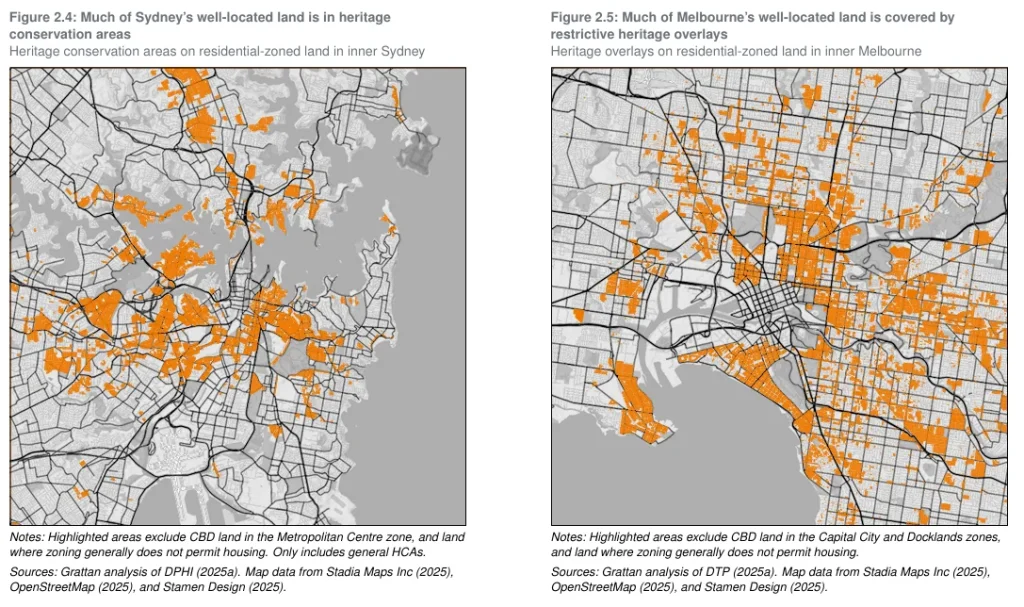
Source: Reproduced from Grattan (2025). For a similar map of Sydney, see NSW Productivity Commission (2023, Figure 17). Gallagher, Sigler and Liu (2024, Figure 1) provide maps of Brisbane.
Estimates of comparable benefits are much smaller. SGS Economics and Planning (2018) report that large majorities of Victorians say it is very important to preserve old houses (Tables 4.1, 4.2, E.7). However, this seems to hinge on somebody else paying. When asked what they might forgo to preserve a nearby locally significant house the average willingness to pay is only $68 (SGS, p 17).[3] Research in progress by Fifer (forthcoming) in NSW suggests a willingness to pay for pre-WW2 houses of local significance of $46 per household per year. Respondents report much greater willingness to pay for buildings of state significance, however there are only 400 of these in NSW — a miniscule share of the total housing stock.
To find a value for the community as a whole, these estimates need to be summed over those affected. SGS (p17, Appendix F.4) recommends that “For valuing an individual asset, the appropriate catchment is the area in which there are no other substitutable/similar heritage assets”. That is, if a building is distinctive, the community places a significant value on preservation. If it is common, preservation is not valued. On this basis, the value of a locally significant building would be summed over a few hundred nearby households. The total benefit of preservation of a locally significant house would be in five figures – which is tiny compared to the $6m cost to homeowners discussed above.
SGS sum willingness to pay over all heritage items in Victoria and estimate the total value of the heritage stock was only $1.1 billion. Again, that is tiny compared to a cost in the hundreds of billions. Of course, these calculations could be more precise, but that would not affect the conclusion.
Valuations of the heritage stock in most other states are not available. In itself, that is a problem, indicating a neglect of trade-offs. However, the research in progress by Fifer, noted above, also suggests low valuations. The costs of heritage protection seem to greatly exceed the benefits.
Because benefits are not compared with costs, too many low-benefit items are listed. Appendix A gives some examples of items that do not seem to merit heritage protection. Many of them are eyesores that reduce neighbourhood amenity. While these examples are not typical, they demonstrate clear flaws in the process.
While extreme cases support simple remedies, the more important problem is the preservation of very many unremarkable suburban buildings. They account for most of the heritage areas shown in Chart 1. If a building is not mentioned in any book, pamphlet or other document, if it doesn’t have a plaque explaining its significance, if it never has curious visitors and if it is not dramatically different to others, then it is difficult to describe it as significant and deserving special protection. A flight of nostalgia is not enough. Yet few heritage-protected buildings meet those standards. Preserving unremarkable buildings is harmless when housing is abundant, but exacerbates our leading social crisis when housing is scarce.
Buildings with little heritage value are often listed by the opponents of development when they have no other legal tools. As Councillor Luise Elsing told Woollahra Council “We are in this municipality suffering from overdevelopment and our last line of defence is heritage protection” (Koziol, 2023; Barwell, 2024). James Conlan of Merri-bek Council makes the same argument. This fraudulent weaponisation is perhaps the clearest evidence that the process fails to honestly weigh benefits and costs. The benefits can simply be fabricated.
As always, there is room for debate. Randwick Council opposed development of 3 Berwick Street, Coogee as the site of Coogee’s first dentist (Patrick, 2024)! Perhaps they were genuine, though it is easy to be sceptical. While the legislation should be clearer about excluding trivial and fraudulent listings, the more important, encompassing safeguard is a comparison with the cost of preservation — reported to be $1m in this example.
Most State laws require consideration of limited costs. For example, Queensland’s State Interest Review process requires the criteria in the State Planning Policy be satisfied. While requirements like this overlap with elements of a cost–benefit analysis, the Queensland Productivity Commission (2026 p199) points out “there is no requirement for any explicit or robust quantification of the impacts on community welfare”.
The NSW Heritage Act requires that consideration be given to “whether the listing would cause undue financial hardship to the owner, mortgagee or lessee of the item or the land on which the item is situated”. This wording prioritises direct and visible costs, while neglecting costs that are hidden because they are imposed on someone else, especially third parties. Both should matter.
There are two specific reasons why the wording is too narrow. First, it does not require consideration of higher value uses. Costs are not just hardship but also include forgone benefits. Preventing hardship is too weak an objective; we should not forsake prosperity or urban improvement.
Second, and more important, the list of affected parties is too short. When development is prevented, it is not just the landowners of listed sites who are affected, but the hundreds of potential residents who would move into the new apartments. They would all be better off if the heritage item were not preserved, but this is not taken into account. More importantly, extra supply would put downward pressure on the prices and rents of other properties, through the normal market forces of supply and demand. Heritage listing exacerbates housing unaffordability and this needs to be taken into account.
This argument is opposed by many heritage consultants who consider the effects of supply and demand to be abstract and speculative. However, a large body of strong research finds market forces to be important, including in the Sydney apartment market. For a summary, see Tulip (2024). The tendency of the heritage community to deny that extra supply will improve affordability reflects unfamiliarity with the evidence.
Willoughby Council argues that the cost of heritage listing is small and outweighed by benefits. It points to academic studies that find “heritage listing has a neutral or moderately positive impact on property values when comparing properties of the same type”. This is true but beside the point. The most important effect of heritage listing is to prevent a change of use. That is, to prevent sites being used for higher-value purposes. It is true that listing has little effect compared to other old properties with big gardens. But compared to upzoned properties it has enormous effects.
An alternative test is suggested by the Productivity Commission (2006, Section 9.5) which recommends that “unreasonable” costs be grounds for rejecting a listing. This is a term that many regard as vague, involving subjective judgement, though the Commission has an extended discussion of what would be included and excluded. A clearer and more relevant test, with similar intent, is to allow listing if benefits are judged to exceed costs.
A qualification about process. It is sometimes argued that heritage listing by itself does not legally prevent alternative uses, which could be allowed when Development Approvals (DAs) or Local Environment Plans (LEPs) are determined. In principle, costs could technically be considered at these later stages. In practice, it is generally understood that heritage restrictions put new housing “off-limits”, as the NSW Productivity Commission (2023, p42) says. Councils require listed properties to be preserved. They have guidelines like “heritage items and buildings in conservation areas cannot be demolished” (North Sydney Council) or “demolition is generally prohibited for listed items” (Willoughby Council; Port Stephens Council). Listed items were left ‘stranded’ by NSW’s Transport Oriented Development policy. As discussed in Section 8, owners of listed properties (on the basis of multiple discussions with builders and developers) argue delisting is necessary for their properties to be developed.
The argument that “heritage does not prevent development” often means that new buildings can be built around or above the heritage item. That may permit a modest extension or renovation, but it typically makes higher density commercially infeasible; in part, because it restricts the footprint and makes foundations more costly. Moreover, the clash of architectural styles reduces the aesthetic and heritage value of the old structure, a point discussed below.
2. Criteria for listing do not reflect community values
There is disproportionate emphasis placed on protecting historical architecture compared to the rest of our history.
As noted above, the cost to society of preserving old buildings may run into hundreds of billions of dollars. In contrast, NSW spends only $586m a year on operating costs for artistic and cultural institutions, like the Art Gallery of NSW and the Australian Museum.
Whereas NSW’s State Heritage Register lists about 400 residences (with 40,000 being locally listed), only 58 items are listed primarily for their importance to Aboriginal people.
The heritage industry seems oblivious to many items of real historical significance. For example, the Honeysuckle Creek Tracking Station, the facility through which Neil Armstrong’s one small step for man was broadcast, was demolished in 1992. In 2016, the ACT Heritage Council got around to registering the concrete slab that remains.
Disparities like these suggest that the advocates of heritage listing may not actually be interested in genuine heritage as such. Or, to be precise, they are not interested in preserving heritage for which the costs are visible or borne by them. As noted above, some users of the heritage system consider it is just a convenient tool for obstructing housing development.
Within the narrow area of architecture, criteria for listing are skewed towards the unrepresentative values of a small clique of heritage insiders. In particular, buildings of “architectural distinctiveness” are heavily protected at great cost, though it is mainly architects who care about this. The general public cares about whether buildings are attractive or old, not whether it is an unusual example of some style only architects have heard of. Preservation of eyesores (Appendix A) reduces neighbourhood amenity, lowering overall welfare, for the benefit of a small elite.
The unrepresentative values of the heritage industry are evident in opinion polls. The housing shortage and its consequent effects on affordability are at the top of voter concerns (Yougov, 2024; Olbrycht-Palmer, 2024; SEC Newgate, 2025). Heritage protection, in contrast, is rarely mentioned. When the Susan McKinnon foundation asked 3,000 Australians about their concerns with increased housing density, only 10% of respondents mentioned heritage in their top 5. “Losing built heritage” ranked 17th out of 19 concerns. (Chart 2).
Chart 2: Opinion polls show a low value of preserving built heritage
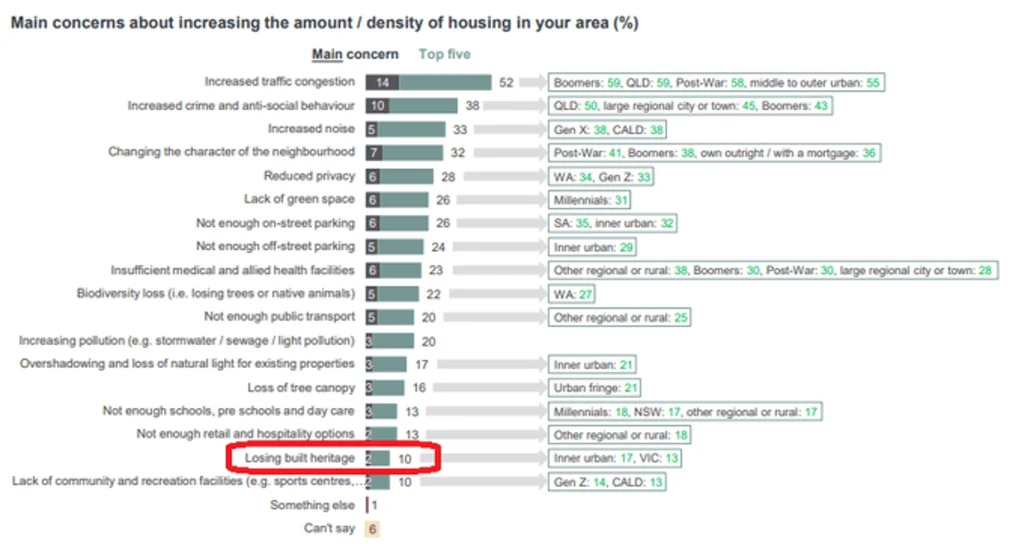
Source: McKinnon, 2023
Heritage protections do not just cover distinctive buildings. The criteria for listing in Victoria include “Criterion D: Importance in demonstrating the principal characteristics of a class of cultural or natural places or environments – representativeness”. For example, the Earl of Carnarvon Conservation Area in Roseville, NSW, is registered as having “high significance” because it comprises typical bungalows from the 1920s and 1930s. Criteria that include both distinctiveness and representativeness rule little out. Moreover, representativeness seems inconsistent with the SGS study discussed above which found the public places little value on preservation of ordinary buildings.
3. “Context is not a criterion”
Ku-ring-gai Council argues that if a building is listed because it is unusually old or attractive or distinctive, the characteristics of the neighbourhood are not legally-relevant considerations:
Heritage listing is based on heritage significance, using the NSW Heritage Council criteria set by the state government. …The heritage item context or setting beyond the listed boundary, based on development of the neighbouring property, is not one of the Heritage Council criteria for listing. Listing decisions are limited to the listed land boundary – the property boundary in most cases.
— Heritage and density (Ku-ring-gai Council, 2025).
This legal interpretation is contested. More to the point, it seems wrong as a matter of policy. Legislation should be amended to clarify that context should be considered as relevant. Buildings are attractive when they are compatible with their neighbours and not if they aren’t. Preserving an isolated detached house in a sea of tall apartment buildings looks like a smile with a missing tooth. The opening guideline of NSW’s Apartment Design Guide leads with “Principle 1: Context and Neighbourhood Character. Good design responds and contributes to its context”.
This is a reversal of positions from other debates on housing. Opponents of development often complain that high density clashes with existing low density and creates a jarring anomaly. Supporters of new housing disagree. Tastes differ and many people like variety; as seen in Tokyo streetscapes, for example. However, Broockman, Elmendorf and Kalla (2025) and Pietrzak and Mendelberg (2025) find most people prefer a uniform look. Though whether they would be willing to forego any significant sum to impose those values on their neighbourhood remains to be shown. In so far as aesthetics should determine planning restrictions (which is controversial) they justify treating adjoining properties similarly.
The rationale of a ‘Heritage Conservation Area’ (HCA), heritage overlay or character zone is that preservation of a neighbourhood is worth more than the sum of the individual parts. Either that logic should be extended, by making context an explicit criterion, or HCAs, overlays and character zones should be revoked, with properties preserved on their individual merits.
4. Delisting is too costly
The process of delisting a property is about as costly and difficult as the original listing, often more so. NSW’s Environmental Planning and Assessment Act requires an amendment to the Local Environmental Plan (LEP). That requires a planning proposal and heritage assessment, both of which need to be prepared by professional consultants. The process involves many steps that are financially costly and typically take at least a year to complete (Ku-ring-gai Council, 2025).
This is inappropriate, given most relevant information and decisions should already be available from the original listing. It will often be that only one important assumption from the original listing has changed. For example, an assumed adaptive re-use turns out to be not financially viable, or maintenance costs increase, or the neighbourhood is rezoned. A comprehensive re-examination is not necessary to consider the implications of that one change. Councils should be free to modify the listing based on a simple majority vote of councillors, requiring whatever extra information they judge to be necessary.
A special, but important, example is when there is a widespread change affecting many properties; as is currently happening with new planning policies in several states. The information from one suggested delisting would be similarly applicable to other affected properties. So councils should be free to consider them jointly. New South Wales requires that each delisting be considered individually, each requiring its own planning proposal and heritage assessment from professional consultants. This duplication is excessively costly and inefficient.
5. The onus of proof for delisting is on the owner of the property
Minimal evidence has often been provided for heritage listing. For example, Ku-ring-gai Council’s 1987 Heritage study led to 650 ‘drive-by listings’ with minimal explanation.[4] In Victoria, batch council listings of ‘contributory’ buildings do not even have a sentence, just an address. The City of Yarra is an example. Brisbane is possibly the worst offender, with many houses preserved for the sole reason they were built before 1947.
With heritage preservation the default, the onus of proof for delisting is on the owner of the property. That seems unfair. If outside parties wish to reduce the value of the property, surely the onus of proof should be on them. Market economies prosper when property owners can manage their own property unless good reasons are given to the contrary.
It is especially unfair to require the owner to undertake expensive consultant reports to maintain their rights when those taking away these rights have not done so. As a minimum, the evidence required for delisting should be no greater than evidence supplied for listing.
6. Incentives are biased
Decisions on listing place considerable weight on the recommendations of heritage consultants. But listing increases the demand for input from those consultants. Future proposed modifications, even of a trivial nature, require hiring of more consultants. The heritage industry has been given the power to create demand for its own services — with predictable results.
This conflict of interest is especially problematic when heritage listings are vague and subjective. It is hard to see how this would not lead to biased decisions.
7. Case Study: The Stranded Assets of Ku-ring-gai[5]
As mentioned above, NSW’s Transport Oriented Development policy has ‘stranded’ about 70 locally-listed properties in Ku-ring-gai Council, on Sydney’s affluent north shore. These properties had a typical value of around $4m in 2024, according to conversations with the owners. Adjoining (unlisted) sites have since been upzoned and are selling for about $10m each.[6] However, developers do not want to develop or buy the heritage-listed properties, which will be built around on all sides (like in the movie Up, or the real-life story on which it was based).
Many owners consider that development on adjoining sites would destroy the amenity and heritage value of their property and the attractiveness of the streetscape, like ‘a smile with a missing tooth’. They want their properties delisted, so they can sell at similar prices to their neighbours. However, Ku-ring-gai council has advised that attempts to delist would be difficult and costly. Given that neither context nor the value of alternative uses are criteria for listing, applications for delisting would not be expected to be successful.
These stranded heritage-listed properties simultaneously illustrate several flaws in the heritage legislation, including the failure to consider alternative uses, the neglect of context and the excessive costs of delisting. As ABC interviewer Craig Reucassel commented, “It does seem like a kind of ridiculous outcome”. Ku-ring-gai councillors agree and have sought assistance from the NSW government. However, the NSW government has said that remedies would require changes in the Heritage Act.[7]
8. Another remedy: pay compensation
It would be possible and desirable to amend the heritage legislation on a clause by clause basis, rectifying each of the individual flaws noted above. In particular, a simple amendment to require that heritage listing decisions provide a quantitative comparison of costs and benefits (and a discussion of who should bear those costs) would considerably improve decision making.
However, the various flaws reflect a deeper underlying problem. The beneficiaries of heritage listing do not pay the large cost of listing, but impose it on others. As a result, there is no discipline or prioritisation of what is listed. Instead, the local community should pay fair compensation to owners of listed properties, as recommended by the Productivity Commission (2006, Section 9.3). Then listing would occur if, and only if, benefits exceed costs. As higher value alternatives arise, compensation would increase and low-value heritage items would be delisted. Given that owners of heritage items are providing a service to the community, it is fair that they be paid for that service.
If heritage stewardship were put on a contractual basis, owners might be expected to provide limited access to the public and/or provide information on their property — something they currently do not do. Admittedly, there is rarely any demand for that, which raises deeper issues. The public receives little tangible benefit from extremely costly listings.
Appendix A: Examples of heritage industry excess
This appendix provides some illustrative examples of heritage restrictions. Some of these are eyesores; others are just ordinary suburban streets.
In principle, judgements on aesthetics are subjective. In practice, there is a substantial agreement by the public over what is attractive (Stamps, 1999). For example, people like traditional architecture and trees; they dislike brutalism. Public values differ substantially from those of architects (Stamps, 2010), which may be relevant to how standards are set and enforced.
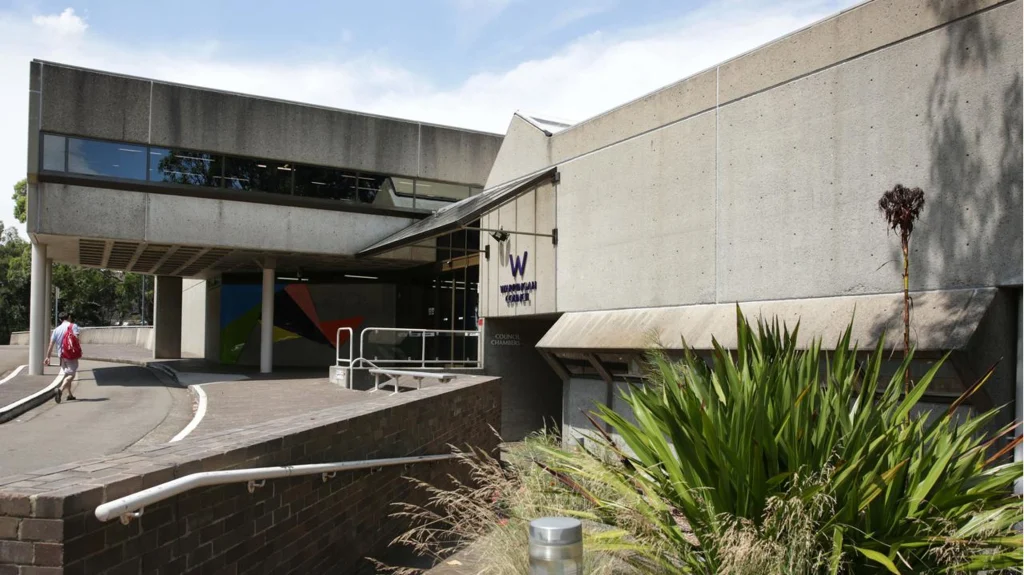
The brutalist Dee Why civic centre is being formally considered for inclusion on the NSW State Heritage Register. As Northern Beaches mayor Sue Heins notes, the building is “loathed” by many residents.
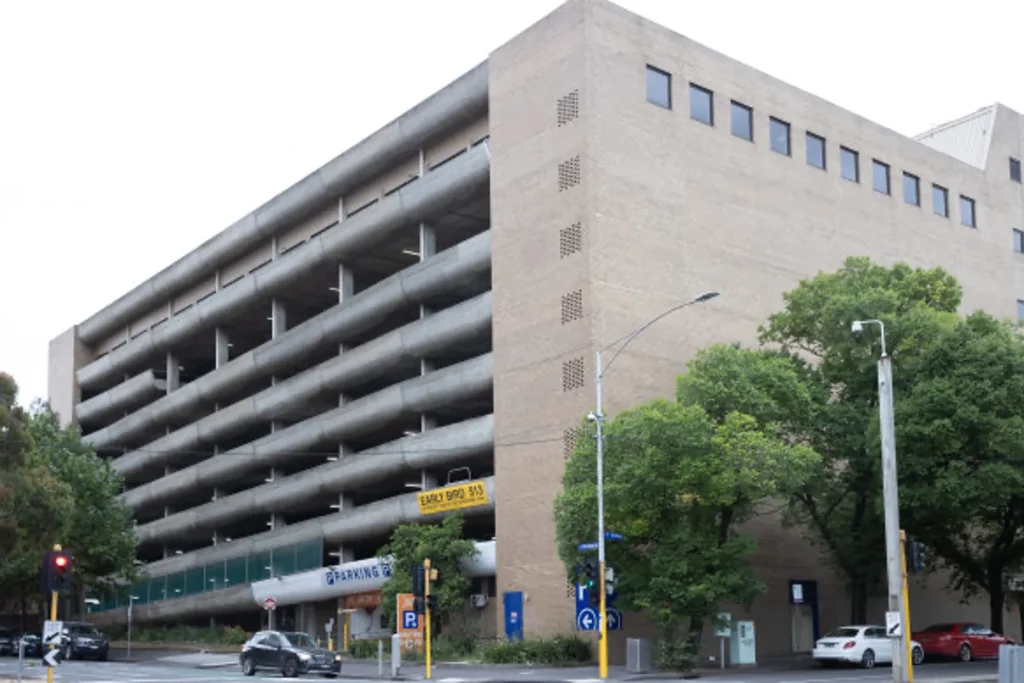
A brutalist carpark in Carlton, Vic, listed by the City of Melbourne
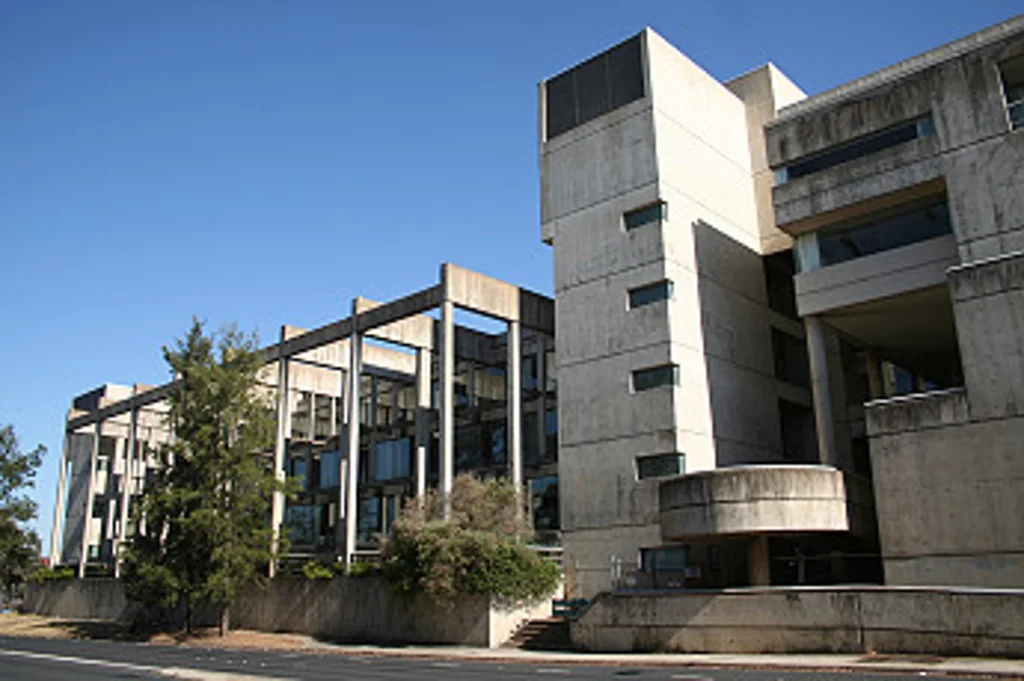
The Cameron Offices in Belconnen, ACT, “a significant example of late 20th-century structuralism and brutalism” are on the Commonwealth Heritage List. Whether they are ugly and reduce neighbourhood amenity is not legally relevant.
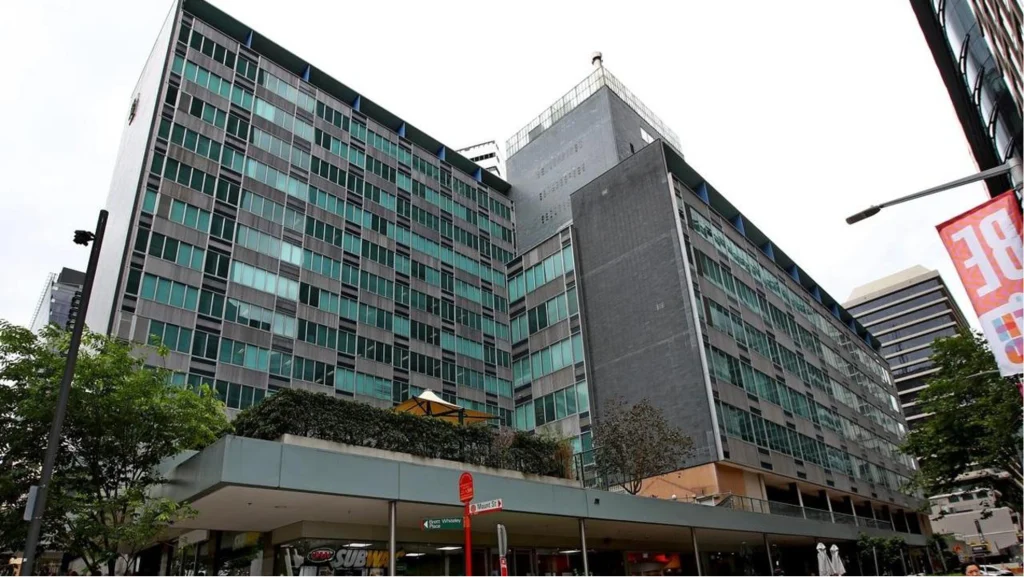
The MLC building in North Sydney is listed on the New South Wales State Heritage Register.
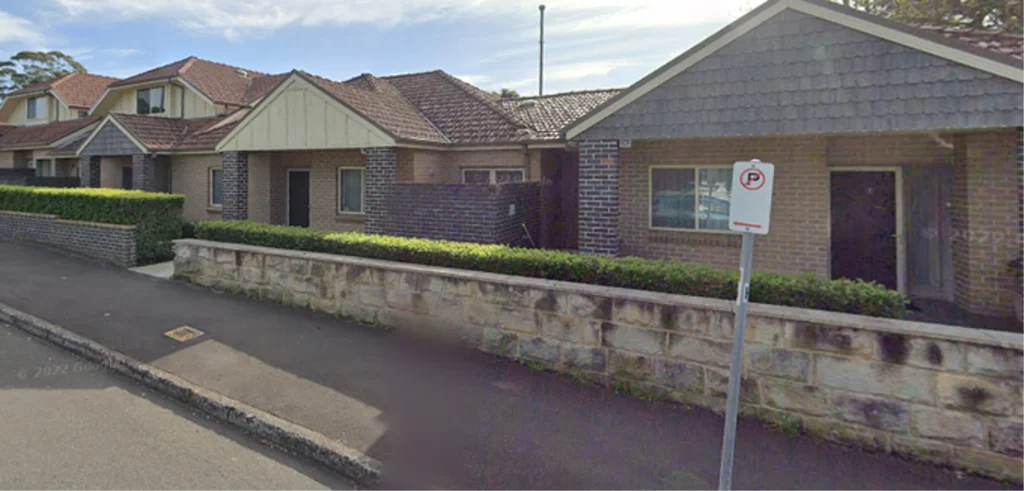
Ordinary housing on Hill St, Roseville, NSW; 300m from Roseville Station. Part of the Grove Conservation Area.
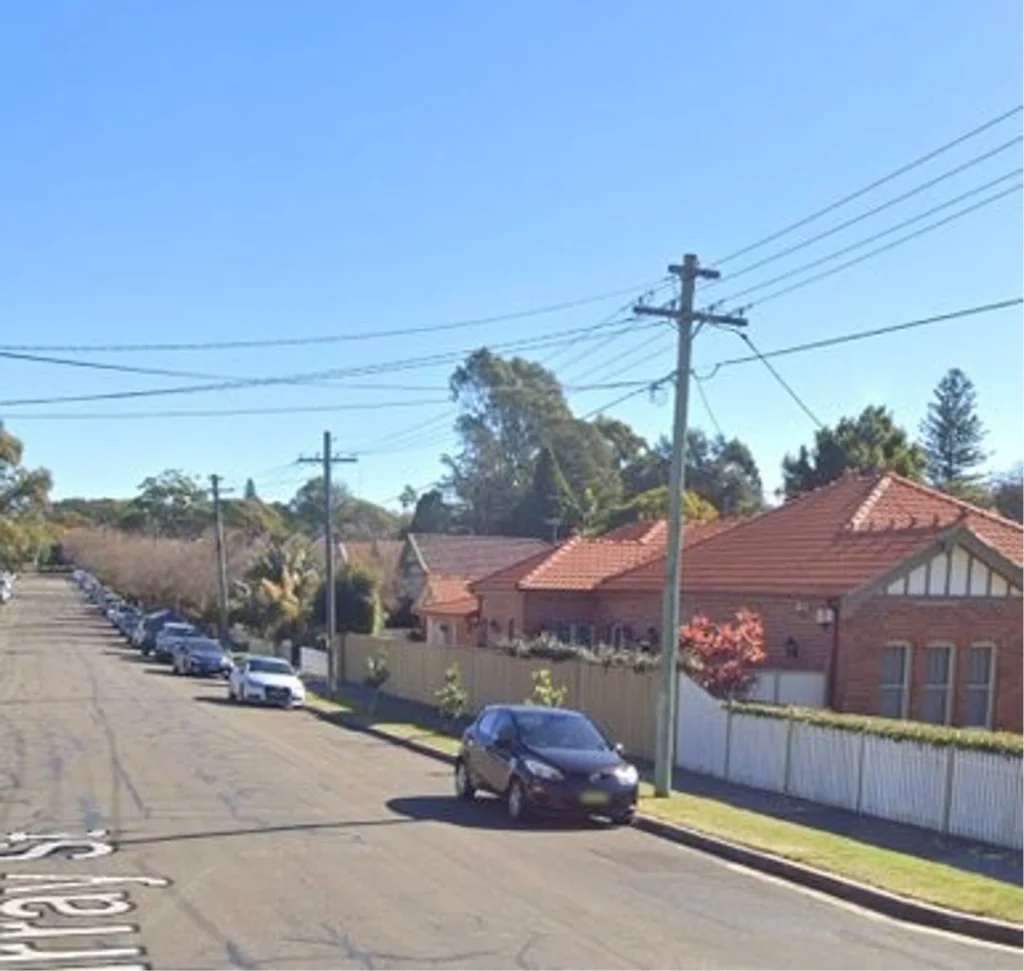
Another unimpressive suburban street, Murray St Croydon, NSW; part of the Malvern Hill Conservation Area; near Croydon station.
If we actually wish to improve neighbourhood amenity, burying the overhead wires and planting street trees would make much more difference to the attractiveness of the streetscape, at lower cost, than preserving old buildings. Unfortunately, that is not an objective of heritage legislation.
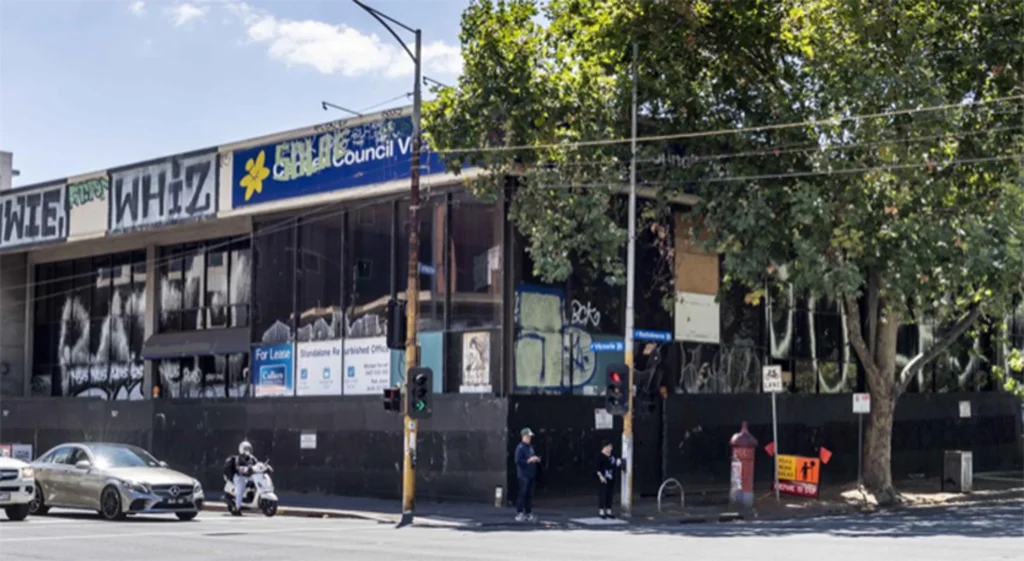
The former Cancer Council building in Carlton, Vic, is not listed but is in a heritage overlay. Applications to develop the site have been rejected in part because it was near the heritage-listed Royal Exhibition Building and Carlton Gardens.
Proposals for 2,500 homes in North Parramatta are opposed because they would be visible from heritage-listed sites.
Randwick Council opposes a tower because it is “visible from the Kensington Heritage Conservation Area, across Southern Cross Drive”.
An ACT resident, Graham Mannall, was denied permission by the ACT Heritage Council to install solar panels on his house, which was built in 2000, as they would be partially visible from the street in a Heritage Area.
In contrast, The Mint and Hyde Park Barracks in Sydney are a few metres away from tall office blocks, as are the Colosseum in Rome or Westminster Abbey in London. No-one suggests this significantly impairs their value.
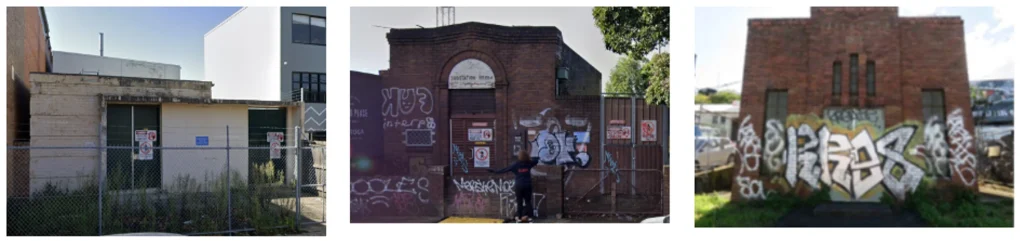
Merri-bek council lists 14 electricity substations as “historically significant for their association with the establishment and development of the Brunswick electricity supply network”, stopping a development for 333 apartments until the Minister intervened. Inner West Council proposed heritage-listing 15 electricity substations.
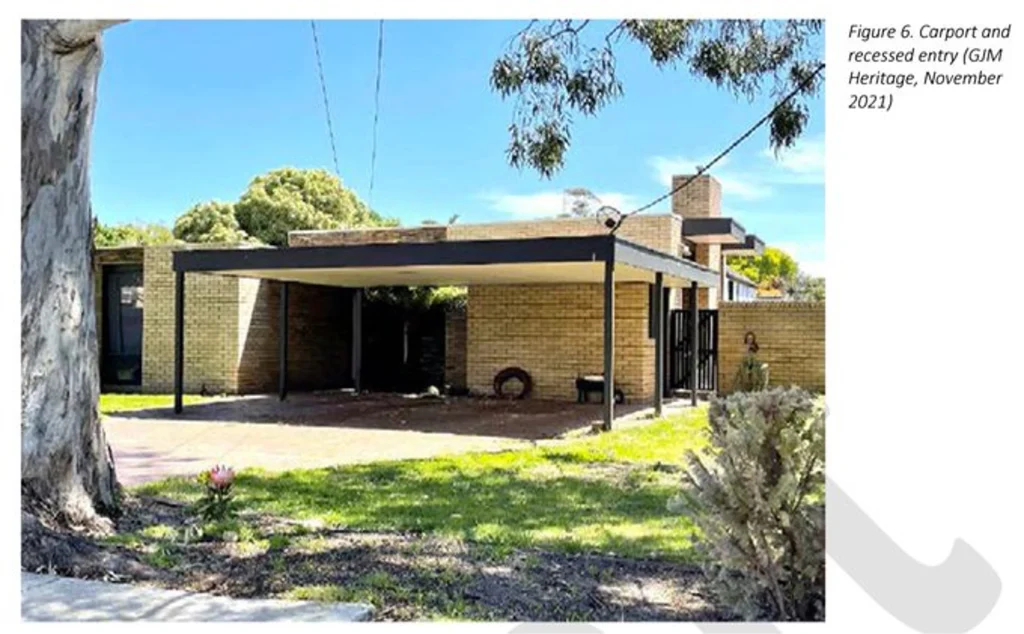
Heritage consultants in Bayside, Vic recommend listing carports as “locally significant”.[8]
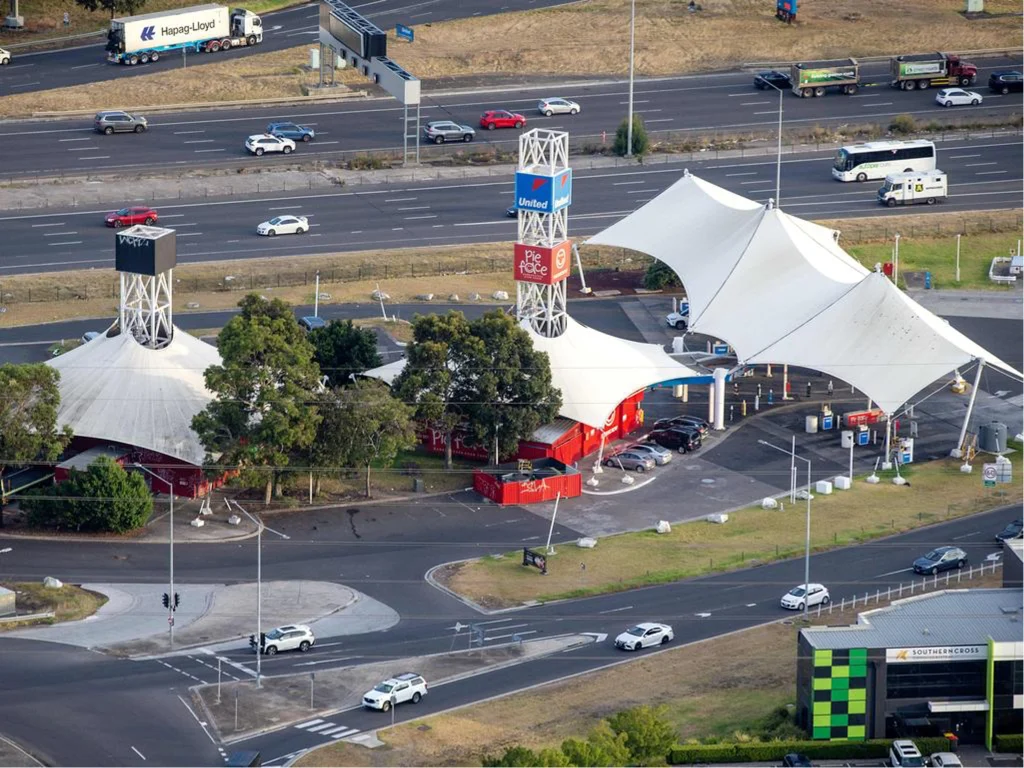
A City of Melbourne council report recommended listing a service station due to its “rarity, aesthetic and technical significance to the city”.
The site of a 1928 dairy farm, Goldenholm, in Fyshwick, ACT, is 6km from Parliament House. The listing, “an enduring example of Canberra’s agricultural history”, restricts usage to agriculture. Little is done to promote the site’s history and nearby residents are unaware of its alleged importance. While some of the land is a (reducible) 1% flood risk, a large part would be valuable as residential or commercial space. Instead, it is used to grow turf.

Acknowledgements
Thanks to Simon Cowan, David Marchant, Jonathan O’Brien, Katie Roberts-Hull and David Tindale for helpful discussions and comments. This paper draws heavily on submissions to the review of New South Wales draft Heritage Strategy.
Endnotes
[1] Although the economic costs of listing are ignored, perceived economic benefits like tourism are routinely claimed. Here is an example.
[2] The National Trust (2022) estimates that 186,000 buildings are protected by heritage overlays in Victoria. “At least a hundred thousand” is a conservative interpretation of Chart 1.
With respect to forgone benefits, Knight Frank (2023, 2021) estimate that the average developable site in Sydney in 2022 was valued at about $250,000 per apartment and $130,000 in Melbourne in 2020. This is broadly consistent with estimates of the apartment “zoning tax” from the urban economics literature (Jenner and Tulip, 2020). The average detached house uses 31 times as much land as the average apartment in Sydney and 57 times as much in Melbourne (Jenner and Tulip, 2020, Table 4). That suggests a typical site for development might be valued at over $7 million in either city, substantially greater than the value of detached houses in heritage-afflicted suburbs.
[3] SGS describe this is a one-time payment on p 9/22 of Appendix D and Tables F.2 and F.3 of Appendix E. Other reports, including those discussed in detail by SGS, present estimates in terms of an annual levy.
[4] The justification for the listing of 31 Beaconsfield Parade, Lindfield was that the property is of ‘historic, cultural, architectural and municipal significance’ and that it has ‘fine trees’. See also (Productivity Commission, 2006, pp167-169).
[5] Information in this section comes from a Ku-ring-gai council public forum, in particular, speeches by David Tindale (20 minutes into the video), David Lane (26 mins), Ian Clarke (31 mins) and Sarah Watson (40 mins), (Gorrey, 2025), an ABC interview with David Tindale, and discussions with property owners.
[6] The size of this uplift surprises those who think zoning is benign but it is similar to revaluations reported in Lindfield, Rose Bay, Mosman, Rhodes and Woollahra. Uplifts of 1.5 to three times initial value are reported to be typical.
[7] See, for example, Ku-ring-gai’s Mayoral Minute of 19 August, 2025.
[8] This example, like many others, comes from the @Heritage: Why? twitter account.