
Reform of Heritage Legislation
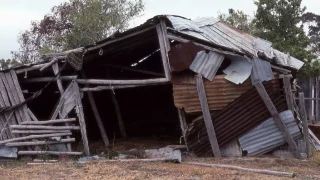
Introduction Several states have recently overhauled their planning legislation. However, the flaws in their heritage legislation put clearer and more …

Executive Summary Public debate about the ‘cost-of-living crisis’ often confuses nominal price increases with declining affordability. This paper argues that …
Executive Summary At the centre of Australia’s mental health system lies a paradox. Government spending has soared, doubling and redoubling …
Trouble has been brewing in Australia’s smelting paradise over the last two decades, as rising energy prices, carbon charges and foreign competition have taken their toll
Introduction Australia’s natural gas sector has transformed dramatically between 1975 and 2025. What began as a series of isolated gas …
Executive Summary Australia’s tobacco control policy has reached a breaking point. For decades, bans on advertising and steady excise increases …
Executive summary Several well-known bodies, from the Productivity Commission to the Australian Competition and Consumer Commission, the Minderoo Foundation and …
Executive Summary Fiscal rules are numerical limits to one or more of government spending, revenue, deficits and debt. Their use …
Executive Summary Australia faces persistent economic challenges. Productivity growth has slowed, business investment is uneven, and real wages have lagged …
This is an edited version of Michael Stutchbury’s keynote address to the 2025 Freedom to Choose Conference Australia is a …
The government has been rightly blamed for fuelling the inflation flames with too rapid growth of its own spending. This has come not just from the federal government but from several state governments as well.
The decisions that made higher rates unavoidable were taken in Canberra. If inflation is the fire, interest rates are the fire brigade. Labor lit the match.
Jim Chalmers doesn’t have a central bank governor to blame for his forward misguidance or for his complaint that monetary policy may be “smashing the economy”.
We’re not in danger of becoming a banana republic, like Paul Keating warned in 1986. But we are losing our exceptional prosperity and sliding back into the pack of other less prosperous developed economies.
Jacking up the price of a product usually ensures that less of it is sold. That can be a good …
Sometimes it takes outsiders to say the obvious but unwelcome things: high spending, low growth and red tape are hurting us. Why does Labor fail to see it?
Australian conservatives — however much they might be impressed by the way MAGA has fought back against woke ideas — would do well to understand that a successful movement cannot be defined forever by what it opposes.
A half-century on from stagflation, outdated workplace rules and union monopolies remain the biggest barrier to reversing the Australian economy’s slipping productivity and wealth.
The Labor government’s early surpluses now look like a flash in the pan and the budget is back to a deficit – which is set to deepen.
There is a long history of fiscal rules, but the overall record is patchy, with governments lacking the fortitude to stick to rules when the going got tough.
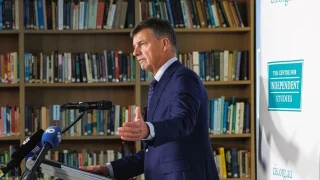
Speaking at his first address outside Canberra since being elected Leader of the Opposition by the Liberal Party room, Angus …
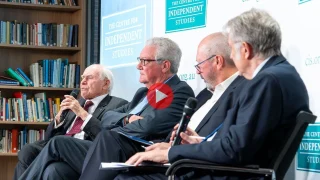
Alexander Downer and former Prime Minister John Howard join author Tony Parkinson and CIS Executive Director Michael Stutchbury for a …
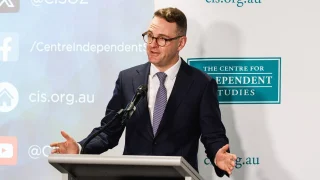
Senator Andrew Bragg and economist Peter Tulip join Michael Stutchbury for a wide-ranging conversation on Australia’s housing crisis, the politics …
Ever wondered how governments keep massive spending hidden from the public eye? In this eye-opening video, we dive into the …
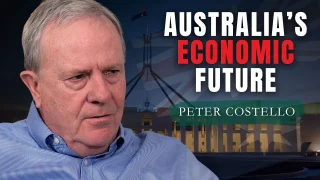
From economic reform and rising government spending to cultural shifts and the decline of liberalism, Costello reflects on the ideas …
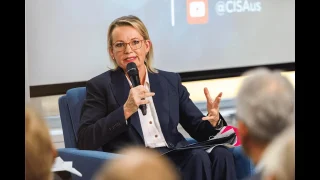
At this Centre for Independent Studies lunch forum on 20 October 2025, Opposition Leader Sussan Ley delivered a major address …
Where is the line between risk and regulation? In this episode of The Stutchbury Sessions, Fred Roeder from the Consumer …
Australia’s economy is slowing. Productivity has flatlined, debt is soaring, and growth has frozen. What caused one of the world’s …
At this Centre for Independent Studies forum, NSW Premier Chris Minns and New Zealand Housing Minister Chris Bishop hosted CIS …
Australia’s new superannuation tax will target balances over $3 million. Yet, what seems like a modest reform does not just …
The federal government should pause increases in tobacco excise to weaken the profit of the black market. Australia’s aggressive policy of continuously hiking tobacco excise has created a multi-billion-dollar illicit market, inadvertently turning a public health initiative into a significant funding stream for criminal organisations.
Despite good intentions, Australia’s Early Childhood Education and Care system has expanded well beyond its original purpose as a work …
The Productivity Commission’s statement that careful emissions reduction policy design will enable gains in productivity and living standards is unfounded. …
This submission argues that NSW’s heritage legislation has serious flaws. In particular, costs of listing are not compared with benefits. …
Victoria Planning Provisions Amendments VC257, VC267 and VC274: Submission to Victorian Legislative Council Select Committee Inquiry 1. Introduction Housing in Victoria, …
Regulation of the financial system is needed to protect depositors and avoid financial crises. However, current financial regulations go beyond these legitimate objectives to prevent mutually advantageous loans.
Submission to the Senate Economics Legislation Committee in relation to its inquiry into the Better Targeted Superannuation Concessions and Other Measures Bill.
Housing policy in NSW has been failing. It has relied on setting targets for local governments and hoping councils would adhere to them. Those targets are too low, out of date and have not been enforced. As a result, the housing affordability crisis is getting worse.
Allowing first home buyers to borrow from their superannuation would transform superannuation from an obstacle to home ownership into a vehicle towards it.
Rents are too high. This leads to homelessness, rental stress, long commutes, overcrowding, and a host of other social problems. …